
司美格鲁肽通过改善心脏自噬来减轻心脏压力超负荷诱导的心肌肥厚,从而抑制 NLRP3 炎性体的激活。
Semaglutide ameliorates pressure overload-induced cardiac hypertrophy by improving cardiac mitophagy to suppress the activation of NLRP3 inflammasome.
机构信息
Department of Cardiology, First Affiliated Hospital, Guangxi Medical University, 6 Shuangyong Road, Qingxiu District, Nanning, 530021, China.
出版信息
Sci Rep. 2024 May 23;14(1):11824. doi: 10.1038/s41598-024-62465-6.
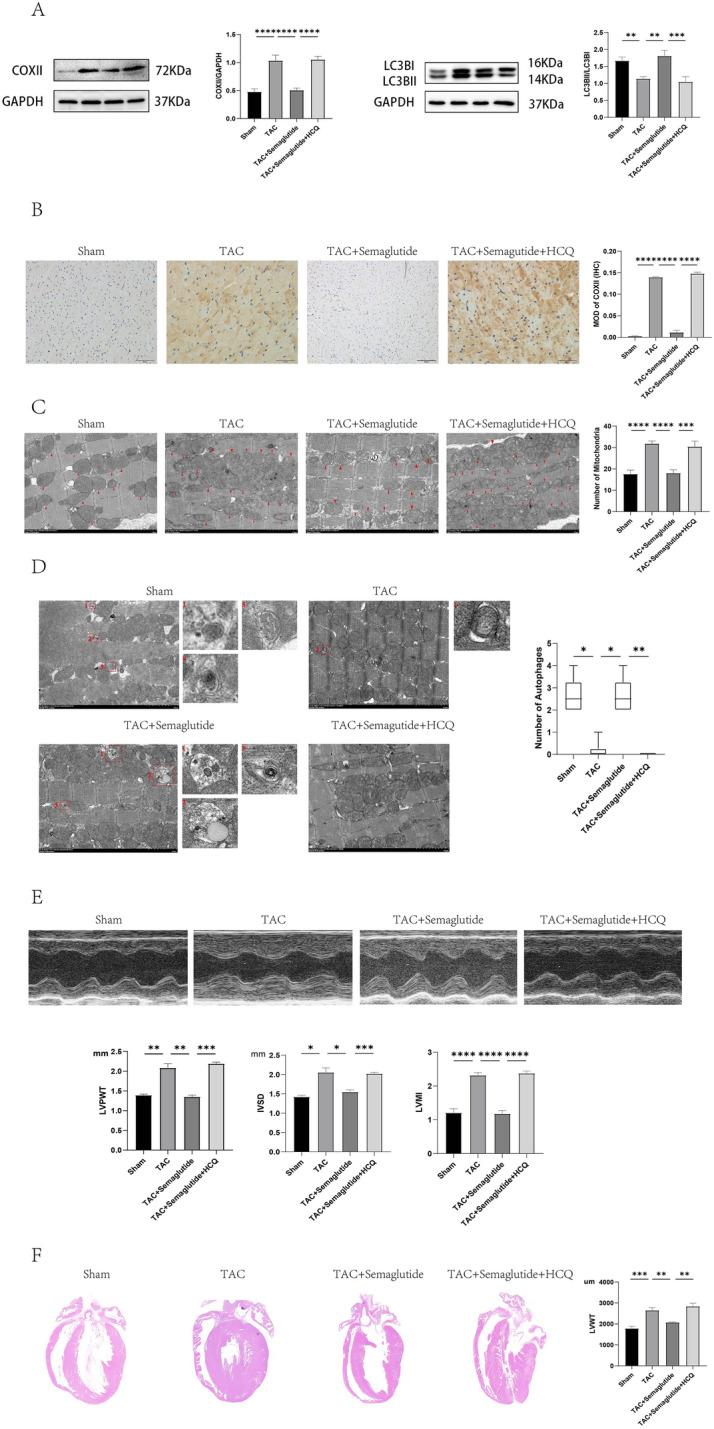
Pathological cardiac hypertrophy is an important cause of heart failure(HF). Recent studies reveal that glucagon-like peptide-1 receptor (GLP1R) agonists can improve mortality and left ventricular ejection fraction in the patients with type 2 diabetes and HF. The present study aims to investigate whether semaglutide, a long-acting GLP1R agonist, can ameliorate cardiac hypertrophy induced by pressure overload, and explore the potential mechanism. The rats were performed transverse aortic constriction (TAC) to mimic pressure overload model. The rats were divided into four groups including Sham, TAC, TAC + semaglutide, and TAC + semaglutide + HCQ (hydroxychloroquine, an inhibitor of mitophagy). The rats in each experimental group received their respective interventions for 4 weeks. The parameters of left ventricular hypertrophy(LVH) were measured by echocardiography, Hematoxylin-eosin (HE) staining, western-blot and immunohistochemistry (IHC), respectively. The changes of mitophagy were reflected by detecting cytochrome c oxidase subunit II (COXII), LC3II/LC3I, mitochondria, and autophagosomes. Meanwhile, NLRP3, Caspase-1, and interleukin-18 were detected to evaluate the activation of NLRP3 inflammasome in each group. The results suggest that LVH, impaired mitophagy, and activation of NLRP3 inflammasome were present in TAC rats. Semaglutide significantly reduced LVH, improve mitophagy, and down-regulated NLRP3 inflammatory signal pathway in TAC rats. However, the reversed effect of semaglutide on cardiac hypertrophy was abolished by HCQ, which restored the activation of NLRP3 inflammasome suppressed by improved mitophagy. In conclusion, semaglutide ameliorates the cardiac hypertrophy by improving cardiac mitophagy to suppress the activation of NLRP3 inflammasome. Semaglutide may be a novel potential option for intervention of cardiac hypertrophy induced by pressure overload.
病理性心肌肥厚是心力衰竭(HF)的重要原因。最近的研究表明,胰高血糖素样肽-1 受体(GLP1R)激动剂可改善 2 型糖尿病和 HF 患者的死亡率和左心室射血分数。本研究旨在探讨长效 GLP1R 激动剂司美格鲁肽是否能改善压力超负荷引起的心肌肥厚,并探讨其潜在机制。通过横主动脉缩窄(TAC)构建压力超负荷模型,将大鼠分为假手术组(Sham)、TAC 组、TAC+司美格鲁肽组(TAC+semaglutide)和 TAC+司美格鲁肽+羟氯喹组(TAC+semaglutide+HCQ),每组大鼠接受相应的干预 4 周。通过超声心动图、苏木精-伊红(HE)染色、western blot 和免疫组化(IHC)分别检测左心室肥厚(LVH)的各项参数。通过检测细胞色素 c 氧化酶亚基 II(COXII)、LC3II/LC3I、线粒体和自噬体来反映自噬的变化。同时,检测 NLRP3、Caspase-1 和白细胞介素-18 以评估各组 NLRP3 炎性小体的激活情况。结果表明,TAC 大鼠存在 LVH、自噬受损和 NLRP3 炎性小体激活。司美格鲁肽可显著减轻 TAC 大鼠的 LVH,改善自噬,并下调 TAC 大鼠的 NLRP3 炎症信号通路。然而,HCQ 逆转了司美格鲁肽对心肌肥厚的作用,恢复了改善的自噬抑制的 NLRP3 炎性小体的激活。综上所述,司美格鲁肽通过改善心肌自噬抑制 NLRP3 炎性小体的激活来改善心肌肥厚。司美格鲁肽可能是一种治疗压力超负荷引起的心肌肥厚的新的潜在选择。



 Zotero 插件