
利用硫醇官能化苯并硅氧硼杂环戊烷实现多种取代模式——有前景的抗菌剂的合成、表征及生物学评价
Exploiting thiol-functionalized benzosiloxaboroles for achieving diverse substitution patterns - synthesis, characterization and biological evaluation of promising antibacterial agents.
作者信息
Nowicki Krzysztof, Krajewska Joanna, Stępniewski Tomasz M, Wielechowska Monika, Wińska Patrycja, Kaczmarczyk Anna, Korpowska Julia, Selent Jana, Marek-Urban Paulina H, Durka Krzysztof, Woźniak Krzysztof, Laudy Agnieszka E, Luliński Sergiusz
机构信息
Faculty of Chemistry, Warsaw University of Technology Noakowskiego 3 00-664 Warsaw Poland
Department of Pharmaceutical Microbiology and Bioanalysis, Medical University of Warsaw Banacha 1b 02-097 Warsaw Poland
出版信息
RSC Med Chem. 2024 Mar 20;15(5):1751-1772. doi: 10.1039/d4md00061g. eCollection 2024 May 22.
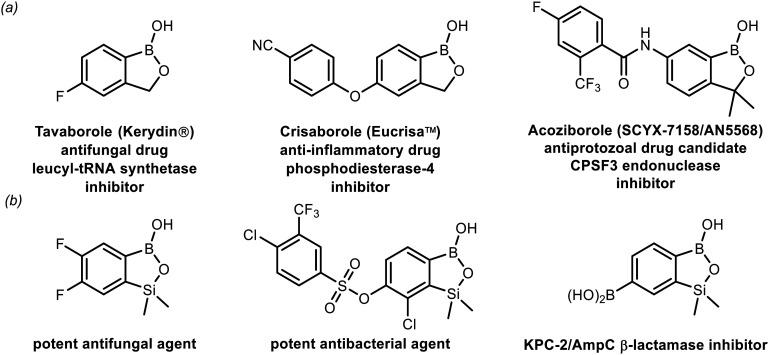
Benzosiloxaboroles are an emerging class of medicinal agents possessing promising antimicrobial activity. Herein, the expedient synthesis of two novel thiol-functionalized benzosiloxaboroles 1e and 2e is reported. The presence of the SH group allowed for diverse structural modifications involving the thiol-Michael addition, oxidation, as well as nucleophilic substitution giving rise to a series of 27 new benzosiloxaboroles containing various polar functional groups, , carbonyl, ester, amide, imide, nitrile, sulfonyl and sulfonamide, and pendant heterocyclic rings. The activity of the obtained compounds against selected bacterial and yeast strains, including multidrug-resistant clinical strains, was investigated. Compounds 6, 12, 20 and 22-24 show high activity against , including both methicillin-sensitive (MSSA) and methicillin-resistant (MRSA) strains, with MIC values in the range of 1.56-12.5 μg mL, while their cytotoxicity is relatively low. The assay performed with 2-(phenylsulfonyl)ethylthio derivative 20 revealed that, in contrast to the majority of known antibacterial oxaboroles, the plausible mechanism of antibacterial action, involving inhibition of the leucyl-tRNA synthetase enzyme, is not responsible for the antibacterial activity. Structural bioinformatic analysis involving molecular dynamics simulations provided a possible explanation for this finding.
苯并硅氧硼烷是一类新兴的具有潜在抗菌活性的药物。本文报道了两种新型硫醇官能化苯并硅氧硼烷1e和2e的简便合成方法。SH基团的存在使得可以进行多种结构修饰,包括硫醇-迈克尔加成、氧化以及亲核取代,从而产生了一系列包含各种极性官能团(羰基、酯基、酰胺基、酰亚胺基、腈基、磺酰基和磺酰胺基)以及侧链杂环的27种新的苯并硅氧硼烷。研究了所得化合物对选定的细菌和酵母菌株(包括多重耐药临床菌株)的活性。化合物6、12、20和22 - 24对金黄色葡萄球菌(包括甲氧西林敏感菌株(MSSA)和甲氧西林耐药菌株(MRSA))表现出高活性,MIC值在1.56 - 12.5μg/mL范围内,而它们的细胞毒性相对较低。对2 -(苯磺酰基)乙硫基衍生物20进行的实验表明,与大多数已知的抗菌氧硼烷不同,涉及抑制亮氨酰 - tRNA合成酶的合理抗菌作用机制并非该抗菌活性的原因。涉及分子动力学模拟的结构生物信息学分析为这一发现提供了可能的解释。



 Zotero 插件