
东欧平原中部森林草原生态系统中植物量和碳储量的评估:利用无人机进行陆地环境监测和遥感的综合方法。
Assessment of Phytomass and Carbon Stock in the Ecosystems of the Central Forest Steppe of the East European Plain: Integrated Approach of Terrestrial Environmental Monitoring and Remote Sensing with Unmanned Aerial Vehicles.
作者信息
Slavskiy Vasiliy, Matveev Sergey, Sheshnitsan Sergey, Litovchenko Daria, Larionov Maxim Viktorovich, Shokurov Anton, Litovchenko Pavel, Durmanov Nikolay
机构信息
Faculty of Forestry, Voronezh State University of Forestry and Technologies named after G.F. Morozov, 8 Timiryazev Street, 394087 Voronezh, Russia.
Department of Bioecology and Biological Safety, Institute of Veterinary Medicine, Veterinary and Sanitary Expertise and Agricultural Safety, Federal State Budgetary Educational Institution of Higher Education Russian Biotechnological University (ROSBIOTEC'H University), 1 Volokolamsk Highway, 125080 Moscow, Russia.
出版信息
Life (Basel). 2024 May 15;14(5):632. doi: 10.3390/life14050632.
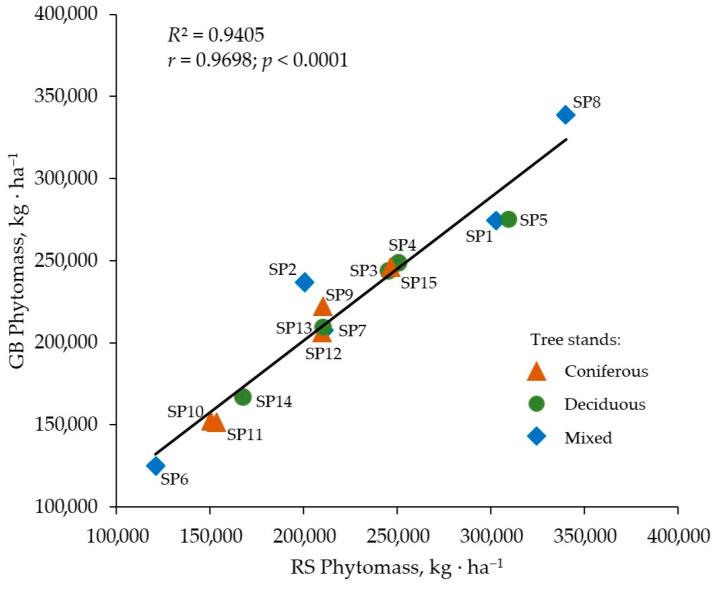
The rapid and accurate estimation of aboveground forest phytomass remains a challenging research task. In general, methods for estimating phytomass fall mainly into the category of field measurements performed by ground-based methods, but approaches based on remote sensing and ecological modelling have been increasingly applied. The aim is to develop the scientific and methodological framework for the remote sensing estimation of qualitative and quantitative characteristics of forest stands, using the combination of surveys and machine learning models to determine phytomass of forest stands and calculate the carbon balance. Even-aged stands of different tree species growing in the forest steppe zone of the East European Plain were chosen as test objects. We have applied the modernized methodological approaches to compare and integrate forest and tree stand characteristics obtained by ground-based and UAV-based comprehensive surveys; additionally, we developed computer vision models and methods for determining the same characteristics by remote sensing methods. The key advantage of the proposed methodology for remote monitoring and carbon balance control over existing analogues is the minimization of the amount of groundwork and, consequently, the reduction inlabor costs without loss of information quality. Reliable data on phytomass volumes will allow for operational control of the forest carbon storage, which is essential for decision-making processes. This is important for the environmental monitoring of forests and green spaces of various economic categories. The proposed methodology is necessary for the monitoring and control of ecological-climatic and anthropogenic-technogenic transformations in various landscapes. The development is useful for organizing the management of ecosystems, environmental protection, and managing the recreational and economic resources of landscapes with natural forests and forest plantations.
快速准确地估算地上森林植物量仍然是一项具有挑战性的研究任务。一般来说,估算植物量的方法主要属于通过地面方法进行的实地测量范畴,但基于遥感和生态建模的方法也得到了越来越广泛的应用。目的是建立科学的方法框架,用于通过结合调查和机器学习模型来确定林分植物量并计算碳平衡,从而对森林林分的定性和定量特征进行遥感估算。选择生长在东欧平原森林草原区的不同树种的同龄林分作为测试对象。我们应用了现代化的方法来比较和整合通过地面和无人机综合调查获得的森林和林分特征;此外,我们还开发了通过遥感方法确定相同特征的计算机视觉模型和方法。与现有类似方法相比,所提出的用于远程监测和碳平衡控制的方法的关键优势在于将实地工作的工作量降至最低,从而在不损失信息质量的情况下降低劳动力成本。关于植物量体积的可靠数据将有助于对森林碳储量进行业务控制,这对决策过程至关重要。这对于各类经济类别的森林和绿地的环境监测非常重要。所提出的方法对于监测和控制各种景观中的生态气候和人为技术转变是必要的。该进展对于组织生态系统管理、环境保护以及管理具有天然森林和人工林的景观的休闲和经济资源很有用。






 Zotero 插件