
肾结石认知的全球趋势:2004 - 2023年时间序列分析
Global Trends in Kidney Stone Awareness: A Time Series Analysis from 2004-2023.
作者信息
Aiumtrakul Noppawit, Thongprayoon Charat, Suppadungsuk Supawadee, Krisanapan Pajaree, Pinthusopon Preyarat, Mao Michael A, Arayangkool Chinnawat, Vo Kristine B, Wannaphut Chalothorn, Miao Jing, Cheungpasitporn Wisit
机构信息
Department of Medicine, John A. Burns School of Medicine, University of Hawaii, Honolulu, HI 96813, USA.
Division of Nephrology and Hypertension, Department of Medicine, Mayo Clinic, Rochester, MN 55905, USA.
出版信息
Clin Pract. 2024 May 20;14(3):915-927. doi: 10.3390/clinpract14030072.
BACKGROUND
Despite the prevalence and incidence of kidney stones progressively increasing worldwide, public awareness of this condition remains unclear. Understanding trends of awareness can assist healthcare professionals and policymakers in planning and implementing targeted health interventions. This study investigated online search interest in "kidney stone" by analyzing Google Trends, focusing on stationarity of the trends and predicting future trends.
METHODS
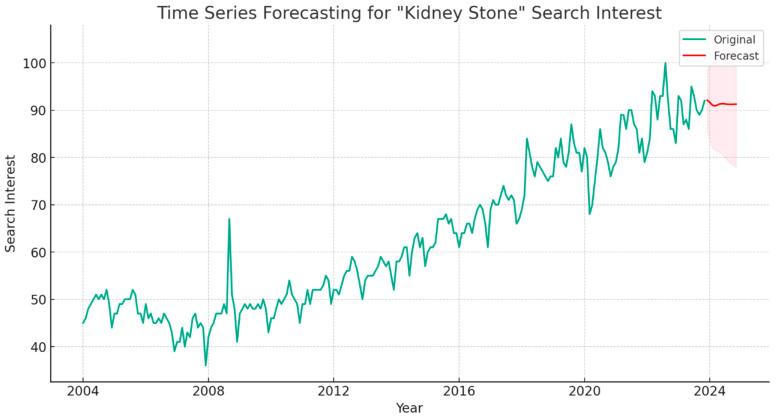
We performed time series analysis on worldwide Google monthly search data from January 2004 to November 2023. The Augmented Dickey-Fuller (ADF) test was used to assess the stationarity of the data, with a -value below 0.05 indicating stationarity. Time series forecasting was performed using the autoregressive integrated moving average to predict future trends.
RESULTS
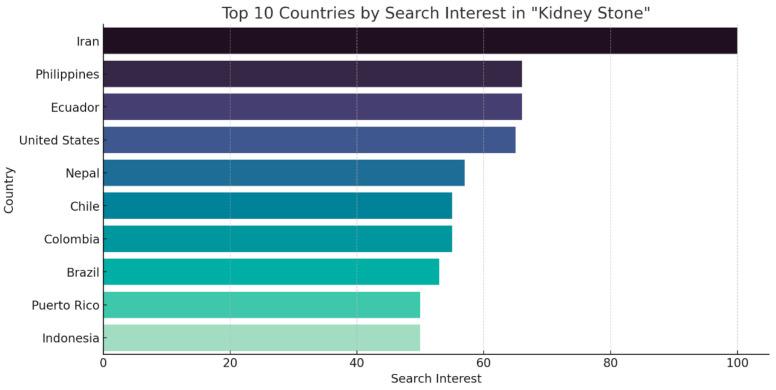
The highest search interest for "kidney stone" (score 100) was in August 2022, while the lowest was in December 2007 (score 36). As of November 2023, search interest remained high, at 92. The ADF test was significant ( = 0.023), confirming data stationarity. The time series forecasting projected continued high public interest, likely reflecting ongoing concern and awareness. Notably, diverse regions such as Iran, the Philippines, Ecuador, the United States, and Nepal showed significant interest, suggesting widespread awareness of nephrolithiasis.
CONCLUSION
This study highlighted that "kidney stone" is a consistently relevant health issue globally. The increase and stationarity of search trends, the forecasted sustained interest, and diverse regional interest emphasize the need for collaborative research and educational initiatives. This study's analysis serves as a valuable tool for shaping future healthcare policies and research directions in addressing nephrolithiasis related health challenges.
背景
尽管全球肾结石的患病率和发病率在逐渐上升,但公众对这种疾病的认知仍不明确。了解认知趋势有助于医疗保健专业人员和政策制定者规划和实施有针对性的健康干预措施。本研究通过分析谷歌趋势调查了“肾结石”的在线搜索兴趣,重点关注趋势的平稳性并预测未来趋势。
方法
我们对2004年1月至2023年11月期间全球谷歌月度搜索数据进行了时间序列分析。使用增强迪基 - 富勒(ADF)检验来评估数据的平稳性,p值低于0.05表明数据平稳。使用自回归积分移动平均法进行时间序列预测以预测未来趋势。
结果
“肾结石”的最高搜索兴趣(得分100)出现在2022年8月,而最低出现在2007年12月(得分36)。截至2023年11月,搜索兴趣仍然很高,为92。ADF检验具有显著性(p = 0.023),证实了数据的平稳性。时间序列预测显示公众兴趣将持续保持高位,这可能反映了持续的关注和认知。值得注意的是,伊朗、菲律宾、厄瓜多尔、美国和尼泊尔等不同地区都表现出了浓厚的兴趣,这表明肾结石病得到了广泛的认知。
结论
本研究强调“肾结石”在全球范围内始终是一个相关的健康问题。搜索趋势的上升和平稳性、预测的持续兴趣以及不同地区的兴趣都强调了开展合作研究和教育倡议的必要性。本研究的分析是塑造未来应对肾结石相关健康挑战的医疗政策和研究方向的宝贵工具。

 Zotero 插件