
评估常用化学处理方法对蜜蜂群体中瓦螨(Mesostigmata: Varroidae)种群复燃的季节性效果。
Evaluating the seasonal efficacy of commonly used chemical treatments on Varroa destructor (Mesostigmata: Varroidae) population resurgence in honey bee colonies.
机构信息
Entomology and Nematology Department, University of Florida, Gainesville, FL, USA.
Inside The Hive Media & Consulting Inc., Odenton, MD, USA.
出版信息
J Insect Sci. 2024 May 1;24(3). doi: 10.1093/jisesa/ieae011.
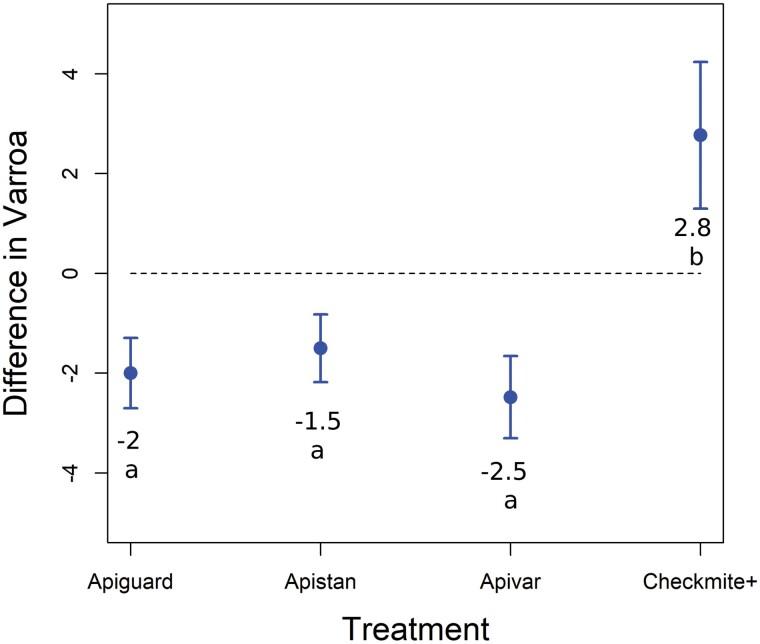
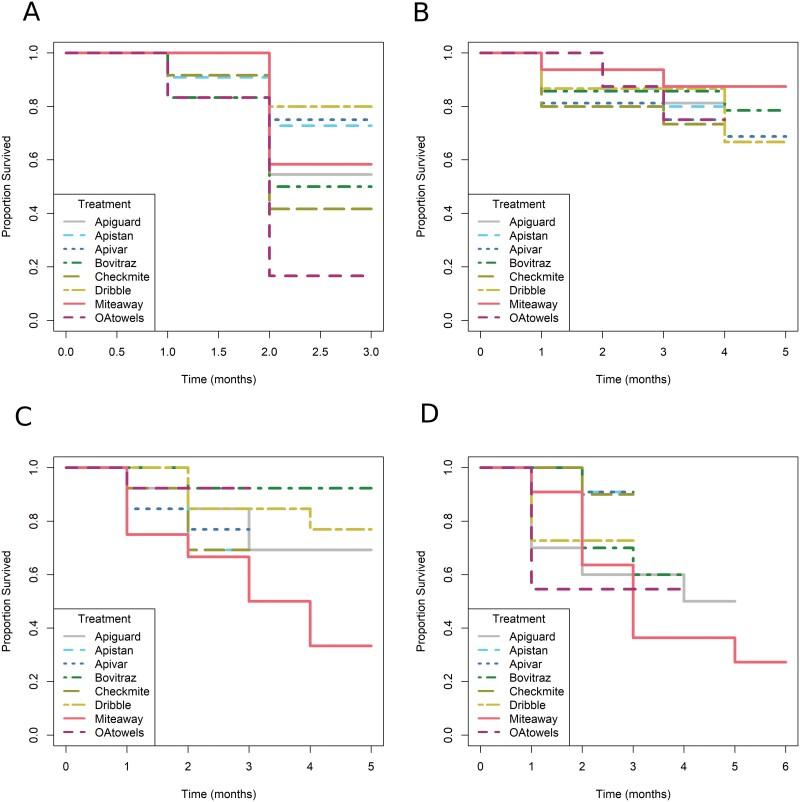
The purpose of this research was to determine how common chemical treatments influence Varroa destructor (Anderson and Trueman) population resurgence rates (defined as time posttreatment for mite populations to reach 3 mites/100 adult bees) in managed honey bee (Apis mellifera L.) colonies seasonally. We conducted 2 experiments that followed the same basic protocol to address this purpose. We established 6 treatment groups in Experiment 1 in the fall of 2014: untreated control, Apivar, Apistan, CheckMite+, ApiLifeVar, and Mite Away II applied to 10 colonies per treatment. In Experiment 2, we applied 8 chemical treatments to each of 4 seasonal (spring, summer, fall, and winter) cohorts of honey bee colonies to determine how mite populations are influenced by the treatments. The treatments/formulations tested were Apivar, Apistan, Apiguard, MAQS, CheckMite+, oxalic acid (dribble), oxalic acid (shop towels), and amitraz (shop towels soaked in Bovitraz). In Experiment 1, Apivar and Mite Away II were able to delay V. destructor resurgence for 2 and 6 months, respectively. In Experiment 2, Apiguard, MAQS, oxalic acid (dribble), and Bovitraz treatments were effective at delaying V. destructor resurgence for at least 2 months during winter and spring. Only the Bovitraz and MAQS treatments were effective at controlling V. destructor in the summer and fall. Of the 2 amitraz-based treatments, the off-label Bovitraz treatment was the only treatment to reduce V. destructor populations in every season. The data gathered through this study allow for the refinement of treatment recommendations for V. destructor, especially regarding the seasonal efficacy of each miticide and the temporal efficacy posttreatment.
本研究旨在确定常见的化学处理方法如何影响已管理的蜜蜂(Apis mellifera L.)群体中瓦螨(Varroa destructor (Anderson and Trueman))种群的复壮率(定义为螨种群达到每 100 只成年蜂 3 只螨的时间)。我们进行了 2 项实验,采用相同的基本方案来解决这个问题。我们在 2014 年秋季的实验 1 中建立了 6 个处理组:未处理对照组、Apivar、Apistan、CheckMite+、ApiLifeVar 和 Mite Away II,每个处理组应用于 10 个蜂群。在实验 2 中,我们将 8 种化学处理方法应用于 4 个季节性(春季、夏季、秋季和冬季)的蜜蜂群,以确定螨种群如何受到处理的影响。测试的处理方法和配方是 Apivar、Apistan、Apiguard、MAQS、CheckMite+、草酸(点滴)、草酸(商店毛巾)和双甲脒(商店毛巾浸泡在 Bovitraz 中)。在实验 1 中,Apivar 和 Mite Away II 分别能延迟瓦螨复壮 2 个月和 6 个月。在实验 2 中,Apiguard、MAQS、草酸(点滴)和 Bovitraz 处理在冬季和春季至少能有效延迟瓦螨复壮 2 个月。只有 Bovitraz 和 MAQS 处理在夏季和秋季能有效控制瓦螨。在 2 种基于双甲脒的处理方法中,非标签 Bovitraz 处理是唯一能在每个季节降低瓦螨种群的处理方法。通过这项研究收集的数据可以改进针对瓦螨的处理建议,特别是针对每种杀螨剂的季节性效果和处理后的时间效果。

 Zotero 插件