
不同吸气肌训练方案对慢性肾脏病患者功能运动能力及呼吸和外周肌肉力量的影响:一项随机研究。
Effects of different inspiratory muscle training protocols on functional exercise capacity and respiratory and peripheral muscle strength in patients with chronic kidney disease: a randomized study.
机构信息
Department of Physiotherapy and Rehabilitation, Faculty of Health Sciences, Hatay Mustafa Kemal University, Hatay, Turkey.
Department of Physiotherapy and Rehabilitation, Institute of Health Sciences,, Hatay Mustafa Kemal University, Hatay, Turkey.
出版信息
BMC Nephrol. 2024 May 29;25(1):184. doi: 10.1186/s12882-024-03610-1.
BACKGROUND
Pathological changes were observed in the diaphragm due to abnormal renal function in chronic kidney disease (CKD). Inspiratory muscle training (IMT) has been suggested for patients with CKD; however, the most appropriate intensity for IMT has not been determined. Therefore, this study aimed to investigate the effects of different IMT protocols on respiratory muscle strength, quadriceps femoris muscle strength (QMS), handgrip muscle strength (HGS), functional exercise capacity, quality of life (QoL), pulmonary function, dyspnoea, fatigue, balance, and physical activity (PA) levels in patients with CKD.
METHODS
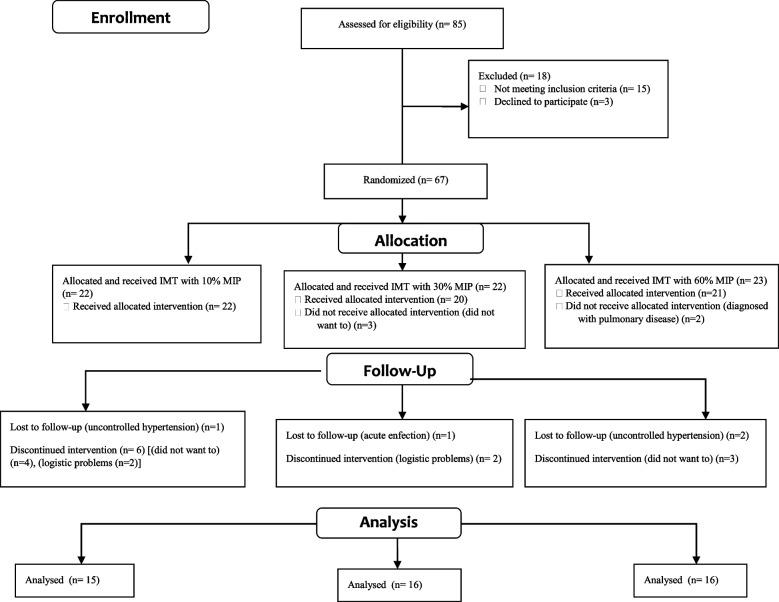
This randomized, controlled, single-blind study included 47 patients and they were divided into three groups: Group 1 (n = 15, IMT with 10% maximal inspiratory pressure (MIP)), Group 2 (n = 16, IMT with 30% MIP), and Group 3(n = 16; IMT with 60% MIP). MIP, maximal expiratory pressure (MEP), 6-min walking test (6-MWT), QMS, HGS, QoL, pulmonary function, dyspnoea, fatigue, balance, and PA levels were assessed before and after eight weeks of IMT.
RESULTS
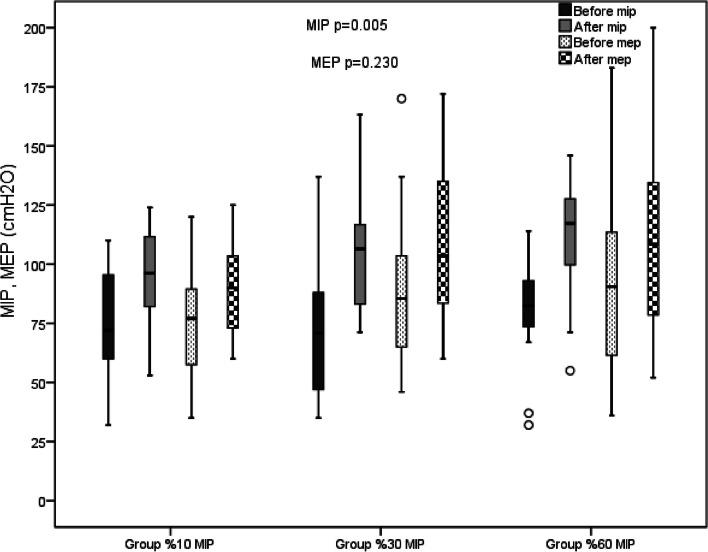
Increases in MIP, %MIP, 6-MWT distance, and %6-MWT were significantly higher in Groups 2 and 3 than in Group 1 after IMT (p < 0.05). MEP, %MEP, FEF QMS, HGS, and QoL significantly increased; dyspnoea and fatigue decreased in all groups (p < 0.05). FVC, PEF, and PA improved only in Group 2, and balance improved in Groups 1 and 2 (p < 0.05).
CONCLUSIONS
IMT with 30% and 60% MIP similarly improves inspiratory muscle strength and functional exercise capacity. IMT with 30% is more effective in increasing PA. IMT is a beneficial method to enhance peripheral and expiratory muscle strength, respiratory function, QoL and balance, and reduce dyspnoea and fatigue. IMT with %30 could be an option for patients with CKD who do not tolerate higher intensities.
TRIAL REGISTRATION
This study was retrospectively registered (NCT06401135, 06/05/2024).
背景
慢性肾脏病(CKD)患者由于肾功能异常,会出现膈肌的病理性改变。吸气肌训练(IMT)已被建议用于 CKD 患者;然而,IMT 的最佳强度尚未确定。因此,本研究旨在探讨不同 IMT 方案对 CKD 患者呼吸肌力量、股四头肌力量(QMS)、握力(HGS)、功能运动能力、生活质量(QoL)、肺功能、呼吸困难、疲劳、平衡和体力活动(PA)水平的影响。
方法
这是一项随机、对照、单盲研究,纳入了 47 名患者,他们被分为三组:第 1 组(n=15,IMT 采用 10%最大吸气压力(MIP))、第 2 组(n=16,IMT 采用 30% MIP)和第 3 组(n=16;IMT 采用 60% MIP)。在 IMT 前和 8 周后,评估 MIP、最大呼气压力(MEP)、6 分钟步行试验(6-MWT)、QMS、HGS、QoL、肺功能、呼吸困难、疲劳、平衡和 PA 水平。
结果
IMT 后,第 2 组和第 3 组的 MIP、%MIP、6-MWT 距离和 %6-MWT 均显著高于第 1 组(p<0.05)。MEP、%MEP、FEF QMS、HGS 和 QoL 均显著增加;所有组的呼吸困难和疲劳均减轻(p<0.05)。仅第 2 组的 FVC、PEF 和 PA 改善,第 1 组和第 2 组的平衡改善(p<0.05)。
结论
30%和 60% MIP 的 IMT 均可改善吸气肌力量和功能运动能力。30%的 IMT 更有效地增加 PA。IMT 是一种有益的方法,可以增强外周和呼气肌力量、呼吸功能、QoL 和平衡,减轻呼吸困难和疲劳。对于不能耐受更高强度的 CKD 患者,30%的 IMT 可能是一种选择。
试验注册
本研究为回顾性注册(NCT06401135,2024 年 06 月 05 日)。
 Zotero 插件