
预见未来:使用结局预测因素定制帕金森病症状治疗方案。
Anticipating Tomorrow: Tailoring Parkinson's Symptomatic Therapy Using Predictors of Outcome.
机构信息
Department of Neurology, Montreal Neurological Institute, McGill University, Montreal, Quebec, Canada.
Departments of Psychiatry and Neurology, Perelman School of Medicine at the University of Pennsylvania; Parkinson's Disease Research, Education and Clinical Center (PADRECC), Philadelphia Veterans Affairs Medical Center, Philadelphia, Pennsylvania, USA.
出版信息
Mov Disord Clin Pract. 2024 Aug;11(8):983-991. doi: 10.1002/mdc3.14089. Epub 2024 May 30.
BACKGROUND
Although research into Parkinson's disease (PD) subtypes and outcome predictions has continued to advance, recommendations for using outcome prediction to guide current treatment decisions remain sparse.
OBJECTIVES
To provide expert opinion-based recommendations for individually tailored PD symptomatic treatment based on knowledge of risk prediction and subtypes.
METHODS
Using a modified Delphi approach, members of the Movement Disorders Society (MDS) Task Force on PD subtypes generated a series of general recommendations around the question: "Using what you know about genetic/biological/clinical subtypes (or any individual-level predictors of outcome), what advice would you give for selecting symptomatic treatments for an individual patient now, based on what their subtype or individual characteristics predict about their future disease course?" After four iterations and revisions, those recommendations with over 75% endorsement were adopted.
RESULTS
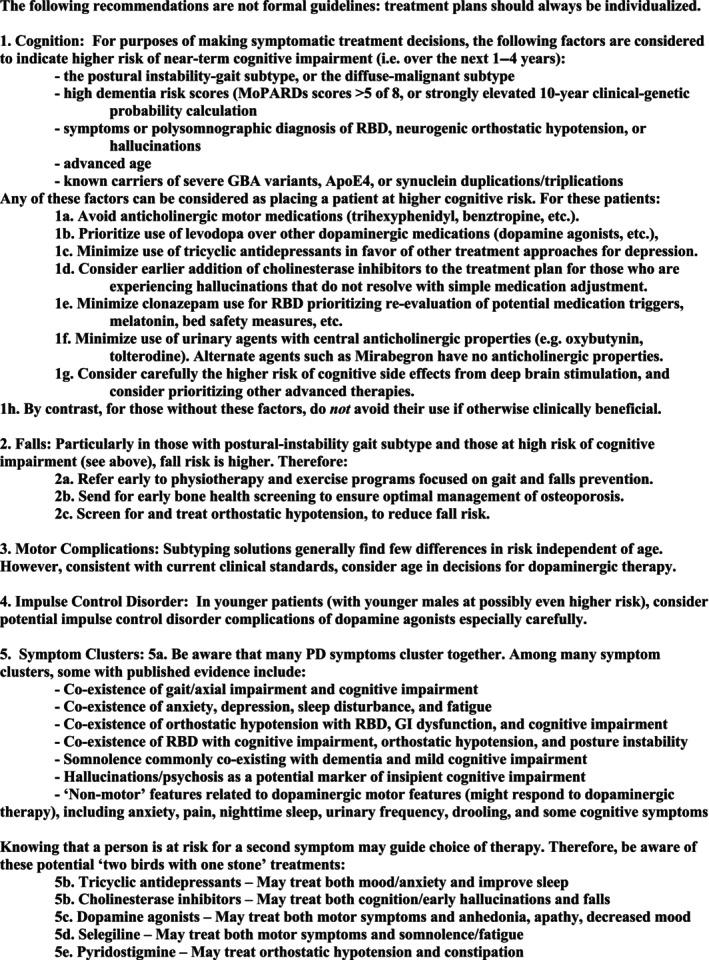
A total of 19 recommendations were endorsed by a group of 13 panelists. The recommendations primarily centered around two themes: (1) incorporating future risk of cognitive impairment into current treatment plans; and (2) identifying future symptom clusters that might be forestalled with a single medication.
CONCLUSIONS
These recommendations provide clinicians with a framework for integrating future outcomes into patient-specific treatment choices. They are not prescriptive guidelines, but adaptable suggestions, which should be tailored to each individual. They are to be considered as a first step of a process that will continue to evolve as additional stakeholders provide new insights and as new information becomes available. As individualized risk prediction advances, the path to better tailored treatment regimens will become clearer.
背景
尽管对帕金森病 (PD) 亚型和结局预测的研究不断推进,但关于使用结局预测来指导当前治疗决策的建议仍然很少。
目的
根据风险预测和亚型知识,为基于个体的 PD 症状性治疗提供基于专家意见的建议。
方法
使用改良 Delphi 方法,帕金森病亚型 MSD 工作组的成员围绕以下问题生成了一系列一般建议:“根据您对遗传/生物学/临床亚型(或任何个体水平结局预测指标)的了解,基于其亚型或个体特征对未来疾病进程的预测,您会对当前个体患者的症状性治疗方法提出什么建议?”经过四轮迭代和修订,那些获得超过 75%支持率的建议被采纳。
结果
共有 19 项建议得到了 13 位小组成员的认可。这些建议主要集中在两个主题上:(1)将未来认知障碍的风险纳入当前治疗计划;(2)识别可能因单一药物而延缓的未来症状群。
结论
这些建议为临床医生提供了将未来结局纳入患者特定治疗选择的框架。它们不是规范性指南,而是可适应的建议,应根据每个个体进行调整。它们被视为一个过程的第一步,随着更多利益相关者提供新的见解和新信息的出现,这个过程将继续发展。随着个体化风险预测的进步,为更个体化的治疗方案铺平道路将变得更加清晰。
 Zotero 插件