
癌症患者使用放松与正念移动应用程序的情况:来自一项随机对照试验的使用数据和自我报告的探索性分析。
Engagement With a Relaxation and Mindfulness Mobile App Among People With Cancer: Exploratory Analysis of Use Data and Self-Reports From a Randomized Controlled Trial.
作者信息
Schläpfer Sonja, Schneider Fabian, Santhanam Prabhakaran, Eicher Manuela, Kowatsch Tobias, Witt Claudia M, Barth Jürgen
机构信息
Institute for Complementary and Integrative Medicine, University Hospital Zurich and University of Zurich, Zurich, Switzerland.
Centre for Digital Health Interventions, Department of Management, Technology, and Economics, ETH Zurich, Zurich, Switzerland.
出版信息
JMIR Cancer. 2024 May 31;10:e52386. doi: 10.2196/52386.
BACKGROUND
Mobile health (mHealth) apps offer unique opportunities to support self-care and behavior change, but poor user engagement limits their effectiveness. This is particularly true for fully automated mHealth apps without any human support. Human support in mHealth apps is associated with better engagement but at the cost of reduced scalability.
OBJECTIVE
This work aimed to (1) describe the theory-informed development of a fully automated relaxation and mindfulness app to reduce distress in people with cancer (CanRelax app 2.0), (2) describe engagement with the app on multiple levels within a fully automated randomized controlled trial over 10 weeks, and (3) examine whether engagement was related to user characteristics.
METHODS
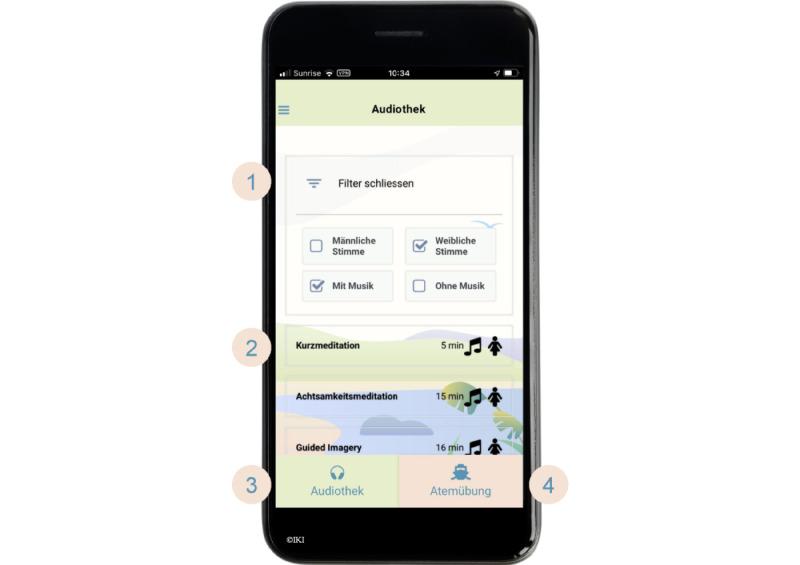
The CanRelax app 2.0 was developed in iterative processes involving input from people with cancer and relevant experts. The app includes evidence-based relaxation exercises, personalized weekly coaching sessions with a rule-based conversational agent, 39 self-enactable behavior change techniques, a self-monitoring dashboard with gamification elements, highly tailored reminder notifications, an educational video clip, and personalized in-app letters. For the larger study, German-speaking adults diagnosed with cancer within the last 5 years were recruited via the web in Switzerland, Austria, and Germany. Engagement was analyzed in a sample of 100 study participants with multiple measures on a micro level (completed coaching sessions, relaxation exercises practiced with the app, and feedback on the app) and a macro level (relaxation exercises practiced without the app and self-efficacy toward self-set weekly relaxation goals).
RESULTS
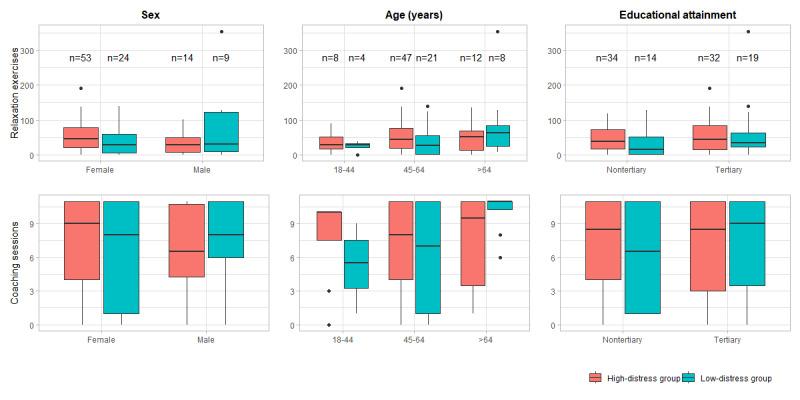
In week 10, a total of 62% (62/100) of the participants were actively using the CanRelax app 2.0. No associations were identified between engagement and level of distress at baseline, sex assigned at birth, educational attainment, or age. At the micro level, 71.88% (3520/4897) of all relaxation exercises and 714 coaching sessions were completed in the app, and all participants who provided feedback (52/100, 52%) expressed positive app experiences. At the macro level, 28.12% (1377/4897) of relaxation exercises were completed without the app, and participants' self-efficacy remained stable at a high level. At the same time, participants raised their weekly relaxation goals, which indicates a potential relative increase in self-efficacy.
CONCLUSIONS
The CanRelax app 2.0 achieved promising engagement even though it provided no human support. Fully automated social components might have compensated for the lack of human involvement and should be investigated further. More than one-quarter (1377/4897, 28.12%) of all relaxation exercises were practiced without the app, highlighting the importance of assessing engagement on multiple levels.
背景
移动健康(mHealth)应用程序为支持自我护理和行为改变提供了独特的机会,但用户参与度低限制了其有效性。对于没有任何人工支持的全自动mHealth应用程序来说尤其如此。mHealth应用程序中的人工支持与更好的参与度相关,但代价是可扩展性降低。
目的
这项工作旨在(1)描述一个用于减轻癌症患者痛苦的全自动放松和正念应用程序(CanRelax应用程序2.0)的基于理论的开发过程,(2)描述在为期10周的全自动随机对照试验中多个层面上与该应用程序的互动情况,以及(3)检查参与度是否与用户特征相关。
方法
CanRelax应用程序2.0是在迭代过程中开发的,涉及癌症患者和相关专家的意见。该应用程序包括基于证据的放松练习、与基于规则的对话代理进行的个性化每周辅导课程、39种可自我实施的行为改变技巧、带有游戏化元素的自我监测仪表板、高度定制的提醒通知、一个教育视频片段以及个性化的应用内信件。对于规模更大的研究,通过网络在瑞士、奥地利和德国招募了在过去5年内被诊断患有癌症的讲德语的成年人。在100名研究参与者的样本中分析了参与度,采用了微观层面(完成的辅导课程、使用该应用程序进行的放松练习以及对该应用程序的反馈)和宏观层面(不使用该应用程序进行的放松练习以及对自我设定的每周放松目标的自我效能感)的多种测量方法。
结果
在第10周,共有62%(62/100)的参与者在积极使用CanRelax应用程序2.0。未发现参与度与基线时的痛苦程度、出生时指定的性别、教育程度或年龄之间存在关联。在微观层面,该应用程序中完成了所有放松练习的71.88%(3520/4897)以及714次辅导课程,所有提供反馈的参与者(52/100,52%)都表达了对该应用程序的积极体验。在宏观层面,28.12%(1377/4897)的放松练习是在不使用该应用程序的情况下完成的,并且参与者的自我效能感在高水平上保持稳定。与此同时,参与者提高了他们每周的放松目标,这表明自我效能感可能有相对的提升。
结论
CanRelax应用程序2.0即使没有提供人工支持也取得了可观的参与度。全自动的社交组件可能弥补了缺乏人工参与的不足,应进一步进行研究。超过四分之一(1377/4897,28.12%)的所有放松练习是在不使用该应用程序的情况下进行的,这突出了在多个层面评估参与度的重要性。


 Zotero 插件