
面向受认知衰退影响的老年人的基于智能手机和对话代理的即时自适应整体生活方式干预:为期两周的概念验证研究。
Toward a Smartphone-Based and Conversational Agent-Delivered Just-in-Time Adaptive Holistic Lifestyle Intervention for Older Adults Affected by Cognitive Decline: Two-Week Proof-of-Concept Study.
作者信息
Brill Esther, Vinay Rasita, Nißen Marcia, Joshi Priyam, Klöppel Stefan, Kowatsch Tobias
机构信息
University Hospital of Old Age Psychiatry and Psychotherapy, University of Bern, Bern, Switzerland.
Institute of Biomedical Ethics and History of Medicine, University of Zurich, Zurich, Switzerland.
出版信息
JMIR Form Res. 2025 Jul 28;9:e66885. doi: 10.2196/66885.
BACKGROUND
Dementia is projected to impact 152 million people by 2050, making it one of the most pressing global health challenges. The neurodegenerative process initiates well before clinical symptoms manifest, advancing from subjective cognitive decline (SCD) to mild cognitive impairment (MCI) and ultimately to dementia. Despite the growing prevalence, awareness of dementia prevention is limited, and many individuals express a desire to cease living upon diagnosis. Lifestyle interventions can mitigate cognitive decline, but there is a need for effective, scalable approaches to deliver these interventions to older adults. Digital health interventions, such as app-based just-in-time adaptive interventions, offer a promising solution, but their application in cognitively impaired older populations remains underexplored.
OBJECTIVE
This formative study evaluated the plausibility, acceptability, and adherence to a smartphone-based just-in-time adaptive digital lifestyle intervention delivered by a rule-based conversational agent (CA) among older adults with SCD or MCI. The primary focus was on adherence to the CA-initiated conversational turns (measured objectively via interaction logs), and secondary objectives included perceptions of technology acceptance, working alliance with the CA, self-reported adherence to the suggested health-promoting activity, and feedback for future improvements (through a questionnaire and short interview).
METHODS
This monocentric study investigated 15 participants (mean age 70.3, SD 5.01; 10 female and 5 male participants) with SCD (n=12) or MCI (n=3). Participants used the study app that delivered daily health-promoting activities through a CA over 2 weeks. Participants received notifications to engage in 7 health-related activities, and adherence to the activities was self-reported. Post intervention, participants rated their experience with the app and assessed their working alliance with the CA through the 6-item session alliance inventory. Data on smartphone use, demographic information, and cognitive performance (via Montreal Cognitive Assessment) were collected during a preintervention visit.
RESULTS
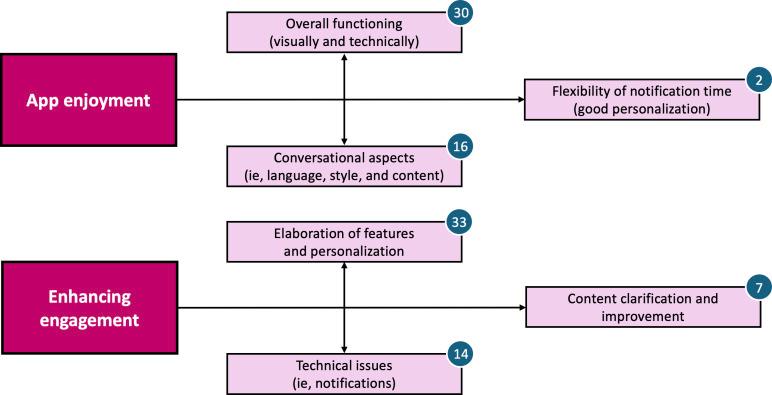
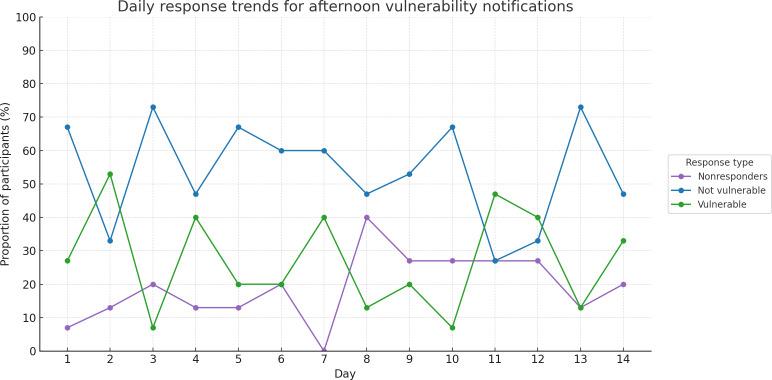
Participants rated the study app positively, especially regarding ease of use and a subset of the working alliance. Adherence to the CA-initiated conversational turn was measured at an average of 81% across 14 days. In total, 27% (mean 4.07, SD 2.27) of participants indicated being vulnerable, and 100% then responded with their state of receptivity, of which 83% (mean 3.14, SD 1.61) were receptive to completing the activity, and 69% (mean 2.86, SD 1.70) self-reported adherence to the activity. There was no significant decline in adherence across the study period. Qualitative results support these findings and present two emerging themes: app enjoyment and enhancing engagement.
CONCLUSIONS
This study demonstrates that smartphone-based just-in-time adaptive interventions are feasible and generally well-accepted by older adults with SCD or MCI. However, the findings underscore the need for robust technological infrastructure and potential personal assistance to optimize adherence. Future interventions could benefit from integrating wearables to improve real-time engagement and accurately monitor adherence, ultimately supporting healthy aging and cognitive health in older populations.
背景
预计到2050年,痴呆症将影响1.52亿人,使其成为最紧迫的全球健康挑战之一。神经退行性过程在临床症状出现之前就已开始,从主观认知衰退(SCD)发展到轻度认知障碍(MCI),最终发展为痴呆症。尽管患病率不断上升,但对痴呆症预防的认识仍然有限,许多人表示希望在确诊后不再活下去。生活方式干预可以减轻认知衰退,但需要有效的、可扩展的方法将这些干预措施提供给老年人。数字健康干预措施,如基于应用程序的即时自适应干预措施,提供了一个有前景的解决方案,但它们在认知受损的老年人群中的应用仍未得到充分探索。
目的
本形成性研究评估了基于智能手机的即时自适应数字生活方式干预措施在患有SCD或MCI的老年人中由基于规则的对话代理(CA)提供的合理性、可接受性和依从性。主要重点是对CA发起的对话轮次的依从性(通过交互日志进行客观测量),次要目标包括对技术接受度的看法、与CA的工作联盟、自我报告的对建议的促进健康活动的依从性以及对未来改进的反馈(通过问卷调查和简短访谈)。
方法
这项单中心研究调查了15名患有SCD(n = 12)或MCI(n = 3)的参与者(平均年龄70.3岁,标准差5.01;10名女性和5名男性参与者)。参与者使用该研究应用程序,该应用程序通过CA在两周内提供每日促进健康的活动。参与者收到参与7项与健康相关活动的通知,并自我报告对活动的依从性。干预后,参与者对应用程序的体验进行评分,并通过6项会话联盟量表评估他们与CA的工作联盟。在干预前访问期间收集了关于智能手机使用、人口统计信息和认知表现(通过蒙特利尔认知评估)的数据。
结果
参与者对该研究应用程序给予了积极评价,特别是在易用性和工作联盟的一个子集中。在14天内,对CA发起的对话轮次的依从性平均为81%。总共有27%(平均4.07,标准差2.27)的参与者表示脆弱,然后100%的人回复了他们的接受状态,其中83%(平均3.14,标准差1.61)愿意完成活动,69%(平均2.86,标准差1.70)自我报告依从该活动。在研究期间,依从性没有显著下降。定性结果支持这些发现,并呈现出两个新出现的主题:应用程序的乐趣和增强参与度。
结论
本研究表明,基于智能手机的即时自适应干预措施是可行的,并且通常被患有SCD或MCI的老年人所接受。然而,研究结果强调需要强大的技术基础设施和潜在的个人协助来优化依从性。未来的干预措施可以从整合可穿戴设备中受益,以改善实时参与并准确监测依从性,最终支持老年人群的健康老龄化和认知健康。


 Zotero 插件