
重症监护病房中急性胰腺炎患者的血尿素氮轨迹
Blood Urine Nitrogen Trajectories of Acute Pancreatitis Patients in Intensive Care Units.
作者信息
Wang Zichen, Wang Wen, Wang Mingqi, He Qiao, Xu Jiayue, Zou Kang, Kang Yan, Sun Xin
机构信息
Institute of Integrated Traditional Chinese and Western Medicine, Chinese Evidence-Based Medicine Center and Cochrane China Center, West China Hospital, Sichuan University, Chengdu, Sichuan, People's Republic of China.
NMPA Key Laboratory for Real World Data Research and Evaluation in Hainan, Chengdu, 610041, People's Republic of China.
出版信息
J Inflamm Res. 2024 May 28;17:3449-3458. doi: 10.2147/JIR.S460142. eCollection 2024.
OBJECTIVE
To identify subclasses of acute pancreatitis (AP) patients in the intensive care unit (ICU) by analyzing blood urea nitrogen (BUN) trajectories.
METHODS
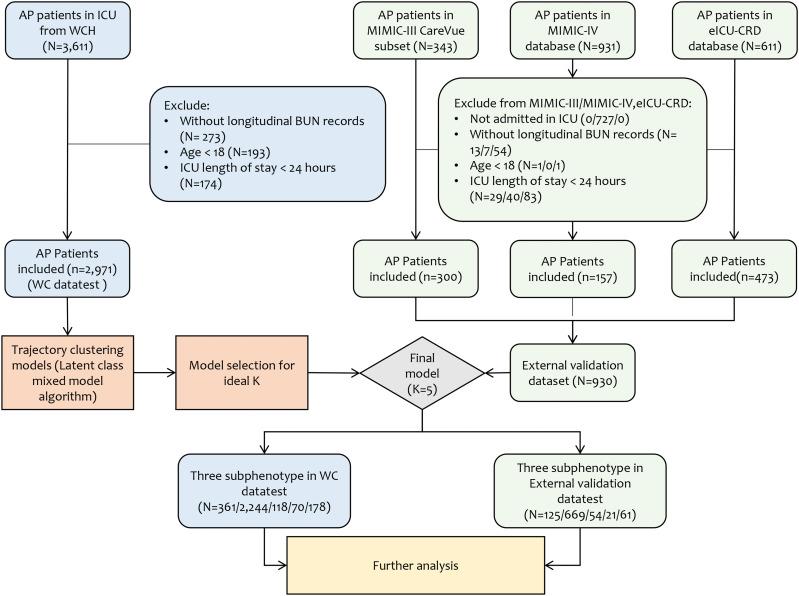
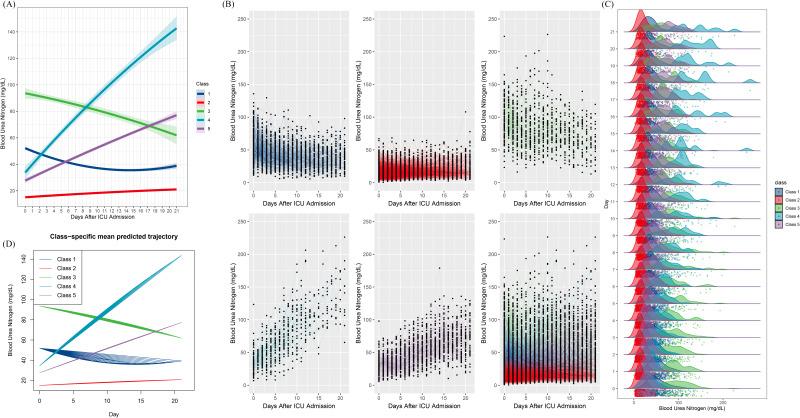
AP patients in West China Hospital System (development cohort) and three public databases in the United States (validation cohort) were included. Latent class trajectory modelling was used to identify subclasses based on BUN trajectories within the first 21 days after ICU admission. Clinical characteristics and outcomes were compared, and results were externally validated.
RESULTS
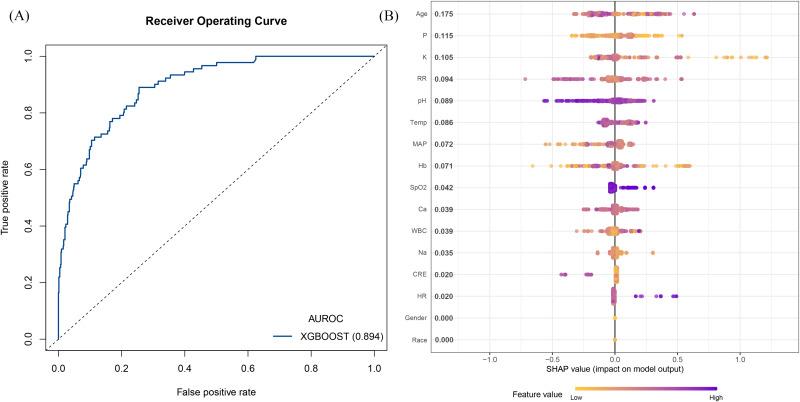
The study comprised 2971 and 930 patients in the development and validation cohorts, respectively, with five subclasses: Class 1 ("Moderate-azotemia, slow decreasing"), Class 2 ("Non-azotemia"), Class 3 ("Severe-azotemia, slow decreasing"), Class 4 ("Moderate-azotemia, rapid increasing"), and Class 5 ('Moderate-azotemia, slow increasing) identified. Azotemia patients showed significantly higher 30-day mortality risk in development and validation cohorts. Specifically, Class 4 patients exhibited notably highest mortality risk in both the development cohort (HR 5.32, 95% CI 2.62-10.82) and validation cohort (HR 6.23, 95% CI 2.93-13.22). Regarding clinical characteristics, AP patients in Class 4 showed lower mean arterial pressure and a higher proportion of renal disease. We also created an online early classification model to further identify Class 4 patients among all patients with moderate azotemia at baseline.
CONCLUSION
This multinational study uncovers heterogeneity in BUN trajectories among AP patients. Patients with "Moderate-azotemia, rapid increasing" trajectory, had a higher mortality risk than patients with severe azotemia at baseline. This finding complements studies that solely rely on baseline BUN for risk stratification and enhanced our understanding of longitudinal progression of AP.
目的
通过分析血尿素氮(BUN)轨迹来识别重症监护病房(ICU)中急性胰腺炎(AP)患者的亚类。
方法
纳入华西医院系统的AP患者(开发队列)和美国的三个公共数据库中的患者(验证队列)。采用潜在类别轨迹模型,根据ICU入院后前21天内的BUN轨迹识别亚类。比较临床特征和结局,并进行外部验证。
结果
开发队列和验证队列分别包括2971例和930例患者,识别出五个亚类:第1类(“中度氮质血症,缓慢下降”)、第2类(“无氮质血症”)、第3类(“重度氮质血症,缓慢下降”)、第4类(“中度氮质血症,快速上升”)和第5类(“中度氮质血症,缓慢上升”)。氮质血症患者在开发队列和验证队列中的30天死亡风险显著更高。具体而言,第4类患者在开发队列(HR 5.32,95%CI 2.62 - 10.82)和验证队列(HR 6.23,95%CI 2.93 - 13.22)中均表现出明显最高的死亡风险。关于临床特征,第4类AP患者平均动脉压较低,肾病比例较高。我们还创建了一个在线早期分类模型,以在所有基线时患有中度氮质血症的患者中进一步识别第4类患者。
结论
这项跨国研究揭示了AP患者BUN轨迹的异质性。具有“中度氮质血症,快速上升”轨迹的患者,其死亡风险高于基线时患有重度氮质血症的患者。这一发现补充了仅依靠基线BUN进行风险分层的研究,并增强了我们对AP纵向进展的理解。


 Zotero 插件