
潜在类别增长建模在干预效果评估中的应用:来自一项身体活动干预的实例。
Latent class growth modelling for the evaluation of intervention outcomes: example from a physical activity intervention.
机构信息
Department of Global Public Health, Karolinska Institutet, Stockholm, Sweden.
Institute of Environmental Medicine, Karolinska Institutet, Stockholm, Sweden.
出版信息
J Behav Med. 2021 Oct;44(5):622-629. doi: 10.1007/s10865-021-00216-y. Epub 2021 Mar 25.
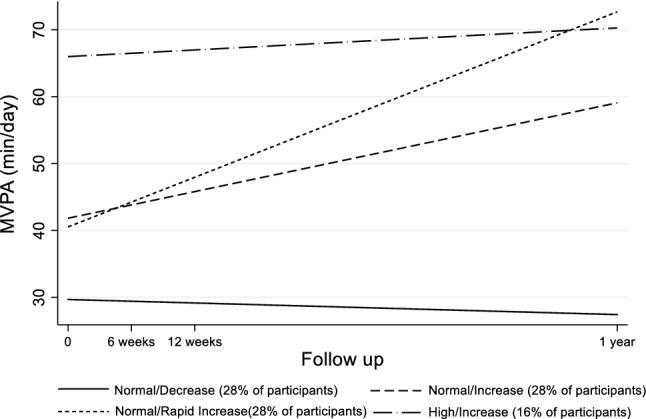
Intervention studies often assume that changes in an outcome are homogenous across the population, however this assumption might not always hold. This article describes how latent class growth modelling (LCGM) can be performed in intervention studies, using an empirical example, and discusses the challenges and potential implications of this method. The analysis included 110 young adults with mobility disability that had participated in a parallel randomized controlled trial and received either a mobile app program (n = 55) or a supervised health program (n = 55) for 12 weeks. The primary outcome was accelerometer measured moderate to vigorous physical activity (MVPA) levels in min/day assessed at baseline, 6 weeks, 12 weeks, and 1-year post intervention. The mean change of MVPA from baseline to 1-year was estimated using paired t-test. LCGM was performed to determine the trajectories of MVPA. Logistic regression models were used to identify potential predictors of trajectories. There was no significant difference between baseline and 1-year MVPA levels (4.8 min/day, 95% CI: -1.4, 10.9). Four MVPA trajectories, 'Normal/Decrease', 'Normal/Increase', 'Normal/Rapid increase', and 'High/Increase', were identified through LCGM. Individuals with younger age and higher baseline MVPA were more likely to have increasing trajectories of MVPA. LCGM uncovered hidden trajectories of physical activity that were not represented by the average pattern. This approach could provide significant insights when included in intervention studies. For higher accuracy it is recommended to include larger sample sizes.
干预研究通常假设结局的变化在整个人群中是同质的,但这种假设并非总是成立。本文通过一个实证示例介绍了如何在干预研究中使用潜在类别增长模型(LCGM),并讨论了该方法的挑战和潜在影响。分析纳入了 110 名患有运动障碍的年轻成年人,他们参加了一项平行随机对照试验,分别接受移动应用程序程序(n=55)或监督健康计划(n=55)干预 12 周。主要结局是在基线、6 周、12 周和干预后 1 年使用加速度计测量的中度到剧烈体力活动(MVPA)水平,以分钟/天表示。使用配对 t 检验估计 MVPA 从基线到 1 年的平均变化。进行 LCGM 以确定 MVPA 的轨迹。使用逻辑回归模型来识别轨迹的潜在预测因素。基线和 1 年 MVPA 水平之间没有显著差异(4.8 分钟/天,95%CI:-1.4,10.9)。通过 LCGM 确定了四种 MVPA 轨迹,分别是“正常/减少”、“正常/增加”、“正常/快速增加”和“高/增加”。年龄较小和基线 MVPA 较高的个体更有可能出现 MVPA 增加的轨迹。LCGM 揭示了未被平均模式代表的隐藏的体力活动轨迹。当包含在干预研究中时,这种方法可以提供重要的见解。为了获得更高的准确性,建议纳入更大的样本量。
 Zotero 插件