
上位效应源于在β-内酰胺酶的酶进化过程中改变限速步骤。
Epistasis arises from shifting the rate-limiting step during enzyme evolution of a β-lactamase.
作者信息
Fröhlich Christopher, Bunzel H Adrian, Buda Karol, Mulholland Adrian J, van der Kamp Marc W, Johnsen Pål J, Leiros Hanna-Kirsti S, Tokuriki Nobuhiko
机构信息
Department of Pharmacy, UiT The Arctic University of Norway, Tromsø, Norway.
Department of Biosystem Science and Engineering, ETH Zurich, Basel, Switzerland.
出版信息
Nat Catal. 2024;7(5):499-509. doi: 10.1038/s41929-024-01117-4. Epub 2024 Feb 23.
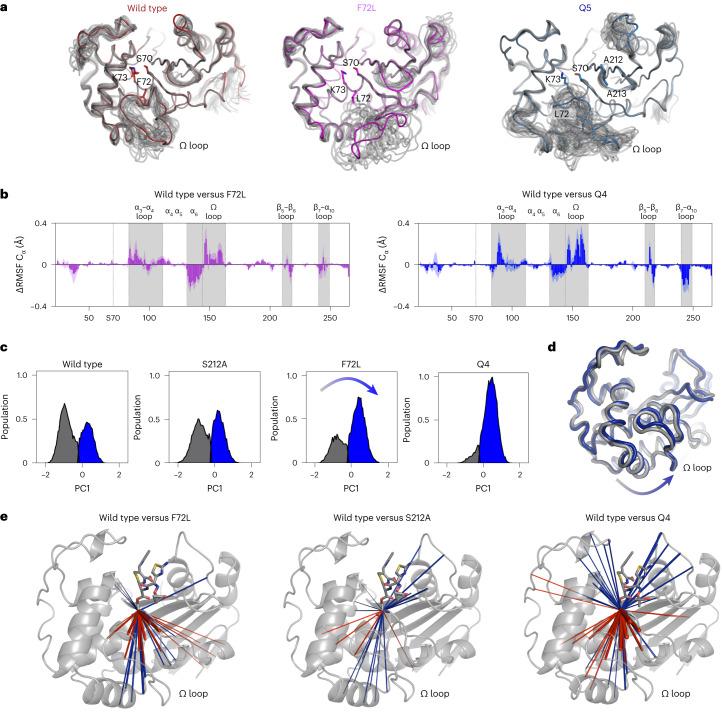
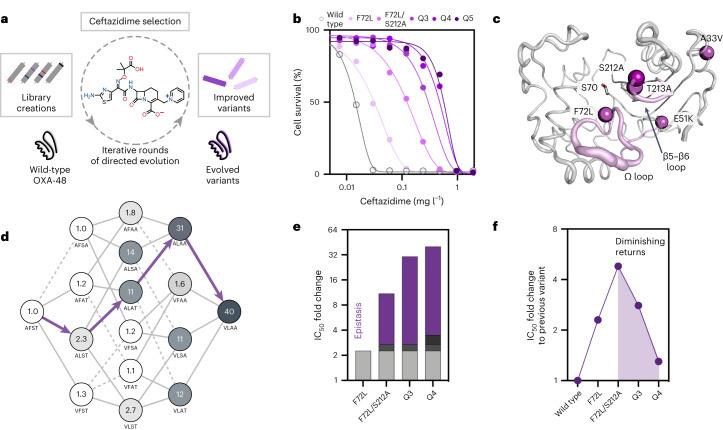
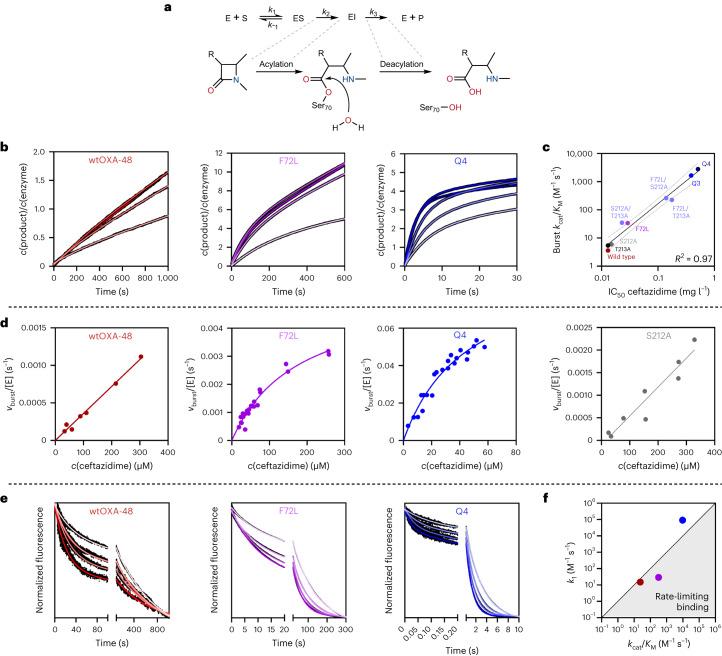
Epistasis, the non-additive effect of mutations, can provide combinatorial improvements to enzyme activity that substantially exceed the gains from individual mutations. Yet the molecular mechanisms of epistasis remain elusive, undermining our ability to predict pathogen evolution and engineer biocatalysts. Here we reveal how directed evolution of a β-lactamase yielded highly epistatic activity enhancements. Evolution selected four mutations that increase antibiotic resistance 40-fold, despite their marginal individual effects (≤2-fold). Synergistic improvements coincided with the introduction of super-stochiometric burst kinetics, indicating that epistasis is rooted in the enzyme's conformational dynamics. Our analysis reveals that epistasis stemmed from distinct effects of each mutation on the catalytic cycle. The initial mutation increased protein flexibility and accelerated substrate binding, which is rate-limiting in the wild-type enzyme. Subsequent mutations predominantly boosted the chemical steps by fine-tuning substrate interactions. Our work identifies an overlooked cause for epistasis: changing the rate-limiting step can result in substantial synergy that boosts enzyme activity.
上位性,即突变的非加性效应,能够为酶活性带来组合性改善,这种改善显著超过单个突变所带来的提升。然而,上位性的分子机制仍然难以捉摸,这削弱了我们预测病原体进化和设计生物催化剂的能力。在此,我们揭示了β-内酰胺酶的定向进化如何产生高度上位性的活性增强。进化选择了四个突变,这些突变使抗生素抗性提高了40倍,尽管它们各自的效应很小(≤2倍)。协同改进与超化学计量爆发动力学的引入同时出现,这表明上位性源于酶的构象动力学。我们的分析表明,上位性源于每个突变对催化循环的不同影响。最初的突变增加了蛋白质的灵活性并加速了底物结合,而底物结合在野生型酶中是限速步骤。随后的突变主要通过微调底物相互作用来促进化学步骤。我们的工作确定了一个被忽视的上位性原因:改变限速步骤可导致显著的协同作用,从而提高酶活性。
 Zotero 插件