
单臂临床试验:设计、伦理、原则。
Single-arm clinical trials: design, ethics, principles.
作者信息
Wang Minyan, Ma Huan, Shi Yun, Ni Haojie, Qin Chu, Ji Conghua
机构信息
Zhejiang Chinese Medical University, Hangzhou, Zhejiang, China.
Zhejiang Chinese Medical University, Hangzhou, Zhejiang, China
出版信息
BMJ Support Palliat Care. 2024 Dec 25;15(1):46-54. doi: 10.1136/spcare-2024-004984.
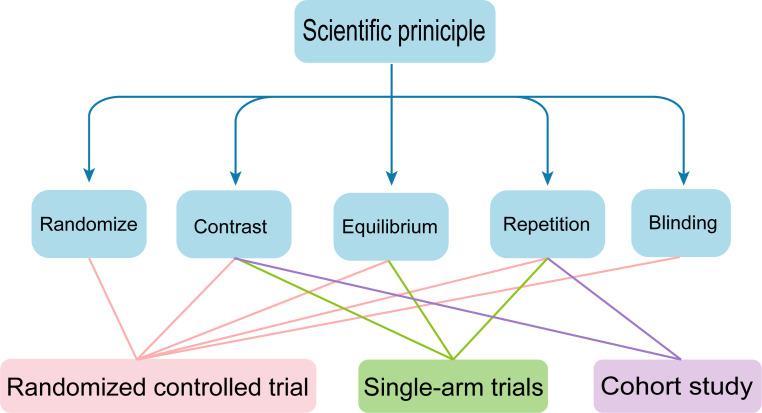
Although randomised controlled trials are considered the gold standard in clinical research, they are not always feasible due to limitations in the study population, challenges in obtaining evidence, high costs and ethical considerations. As a result, single-arm trial designs have emerged as one of the methods to address these issues. Single-arm trials are commonly applied to study advanced-stage cancer, rare diseases, emerging infectious diseases, new treatment methods and medical devices. Single-arm trials have certain ethical advantages over randomised controlled trials, such as providing equitable treatment, respecting patient preferences, addressing rare diseases and timely management of adverse events. While single-arm trials do not adhere to the principles of randomisation and blinding in terms of scientific rigour, they still incorporate principles of control, balance and replication, making the design scientifically reasonable. Compared with randomised controlled trials, single-arm trials require fewer sample sizes and have shorter trial durations, which can help save costs. Compared with cohort studies, single-arm trials involve intervention measures and reduce external interference, resulting in higher levels of evidence. However, single-arm trials also have limitations. Without a parallel control group, there may be biases in interpreting the results. In addition, single-arm trials cannot meet the requirements of randomisation and blinding, thereby limiting their evidence capacity compared with randomised controlled trials. Therefore, researchers consider using single-arm trials as a trial design method only when randomised controlled trials are not feasible.
尽管随机对照试验被认为是临床研究的金标准,但由于研究人群的局限性、获取证据的挑战、高成本以及伦理考量等因素,它们并非总是可行的。因此,单臂试验设计已成为解决这些问题的方法之一。单臂试验通常应用于研究晚期癌症、罕见疾病、新发传染病、新治疗方法和医疗设备。与随机对照试验相比,单臂试验具有一定的伦理优势,例如提供公平的治疗、尊重患者偏好、解决罕见疾病以及及时处理不良事件。虽然单臂试验在科学严谨性方面不符合随机化和盲法的原则,但它们仍然纳入了对照、平衡和重复的原则,使得设计在科学上是合理的。与随机对照试验相比,单臂试验所需的样本量更少,试验持续时间更短,这有助于节省成本。与队列研究相比,单臂试验涉及干预措施并减少外部干扰,从而具有更高的证据水平。然而,单臂试验也有局限性。由于没有平行对照组,在解释结果时可能存在偏差。此外,单臂试验无法满足随机化和盲法的要求,因此与随机对照试验相比,其证据能力受到限制。因此,研究人员仅在随机对照试验不可行时才考虑将单臂试验作为一种试验设计方法。

 Zotero 插件