
针对比例风险违背情况下受试者水平间接治疗比较中未测量混杂因素的灵活定量偏倚分析。
Flexible quantitative bias analysis for unmeasured confounding in subject-level indirect treatment comparisons with proportional hazards violation.
作者信息
Soutar Steven, Macdougall Amy, Wallis Jamie, O'Reilly Joseph E, Carpenter Lewis
机构信息
Arcturis Data, Building One, Oxford Technology Park, Technology Drive, Oxford, OX5 1GN, UK.
出版信息
BMC Med Res Methodol. 2025 May 10;25(1):131. doi: 10.1186/s12874-025-02551-z.
BACKGROUND
Indirect treatment comparisons can provide evidence of relative efficacy for novel therapies when implementation of a randomised controlled trial is infeasible. However, such comparisons are vulnerable to unmeasured confounding bias due to incomplete data collection and non-random treatment assignment. Quantitative bias analysis (QBA) is a framework used to assess the sensitivity of a study's conclusions to unmeasured confounding. As indirect comparisons between therapies with differing treatment modalities may result in violation of the proportional hazards (PH) assumption, QBA methods that are applicable in this context are required. However, few QBA methods are valid under PH violation.
METHODS
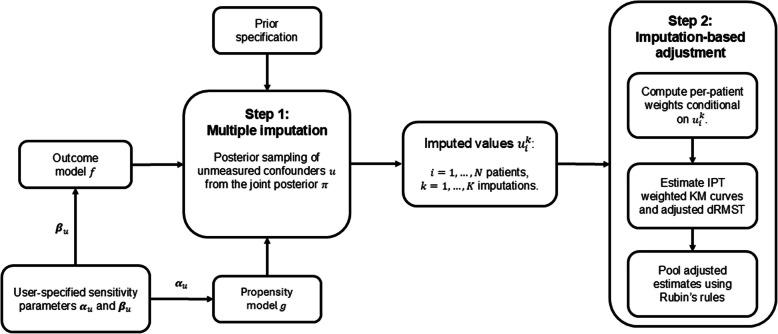
We proposed a simulation-based QBA framework which quantifies the sensitivity of the difference in restricted mean survival time (dRMST) to unmeasured confounding, and is therefore valid under violation of the PH assumption. The proposed framework utilises Bayesian data augmentation for the multiple imputation of an unmeasured confounder with user-specified characteristics. Adjustment of dRMST is then implemented in a weighted analysis using the imputed values. The accuracy and precision of our proposed imputation-based adjustment method was assessed through a simulation study. Confounded data was simulated using a common non-PH data generating process, and imputation-based effect estimates were compared against estimates obtained following adjustment for all confounders. Implementation of the proposed QBA framework was also illustrated using a data from an external control arm study demonstrating clear PH violation.
RESULTS
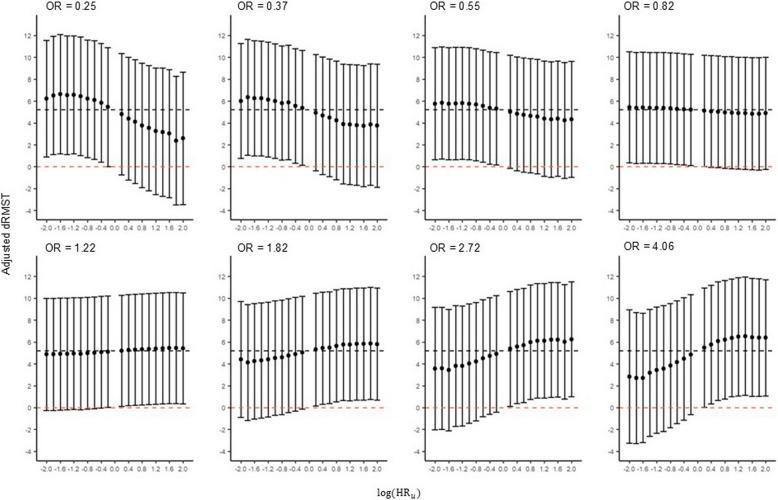
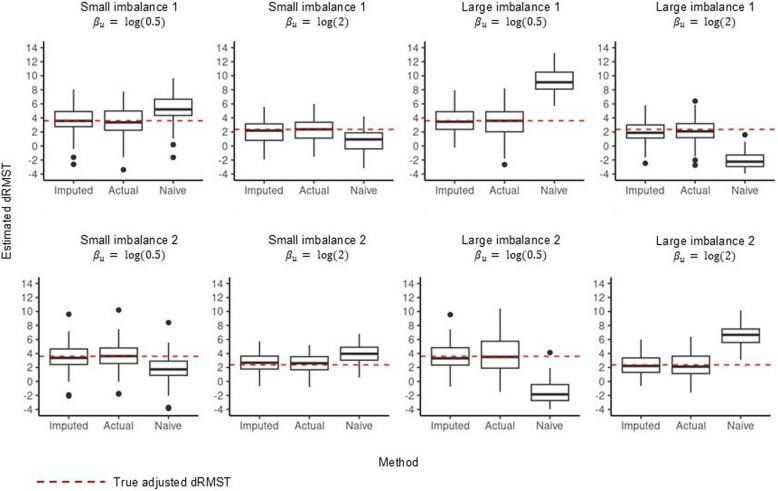
Imputation-based adjustment using Bayesian data augmentation was observed to estimate the true adjusted dRMST with minimal bias. Moreover, the bias was comparable to that observed under adjustment when all confounders were measured. Application of the proposed QBA framework to an indirect treatment comparison study enabled identification of the characteristics of an unmeasured confounder that would be required to nullify the study's conclusions.
CONCLUSIONS
Imputation-based adjustment can accurately recover the true adjusted dRMST in the presence of unmeasured confounding with known exposure and outcome associations. Therefore, the proposed QBA framework can correctly determine the characteristics required by an unmeasured confounder to invalidate a study's conclusions. Consequently, this framework enables the construction of sensitivity analyses to investigate the robustness of relative efficacy evidence derived from indirect treatment comparisons which exhibit PH violation.
背景
当随机对照试验不可行时,间接治疗比较可为新疗法的相对疗效提供证据。然而,由于数据收集不完整和治疗分配非随机,此类比较容易受到未测量混杂偏倚的影响。定量偏倚分析(QBA)是一种用于评估研究结论对未测量混杂因素敏感性的框架。由于不同治疗方式的疗法之间的间接比较可能导致违反比例风险(PH)假设,因此需要适用于这种情况的QBA方法。然而,在违反PH假设的情况下,很少有QBA方法是有效的。
方法
我们提出了一个基于模拟的QBA框架,该框架量化了受限平均生存时间差异(dRMST)对未测量混杂因素的敏感性,因此在违反PH假设的情况下也是有效的。所提出的框架利用贝叶斯数据增强对具有用户指定特征的未测量混杂因素进行多重插补。然后在加权分析中使用插补值对dRMST进行调整。通过模拟研究评估了我们提出的基于插补的调整方法的准确性和精确性。使用常见的非PH数据生成过程模拟混杂数据,并将基于插补的效应估计值与对所有混杂因素进行调整后获得的估计值进行比较。还使用来自外部对照臂研究的数据说明了所提出的QBA框架的实施情况,该研究表明明显违反了PH假设。
结果
观察到使用贝叶斯数据增强的基于插补的调整能够以最小的偏差估计真实的调整后dRMST。此外,该偏差与在测量所有混杂因素时进行调整时观察到的偏差相当一致。将所提出QBA框架应用于间接治疗比较研究能够识别出使研究结论无效所需的未测量混杂因素的特征。
结论
基于插补的调整可以在存在具有已知暴露和结局关联的未测量混杂因素的情况下准确地恢复真实的调整后dRMST。因此,所提出的QBA框架可以正确地确定未测量混杂因素使研究结论无效所需的特征。因此,该框架能够构建敏感性分析,以研究从表现出违反PH假设的间接治疗比较中得出的相对疗效证据的稳健性。

 Zotero 插件