
抗 PD-1/PD-L1 双免疫疗法与 PD-1/PD-L1 抑制剂单独治疗晚期实体瘤患者的疗效和安全性:系统评价和荟萃分析。
Efficacy and safety of anti-PD-1/PD-L1-based dual immunotherapies versus PD-1/PD-L1 inhibitor alone in patients with advanced solid tumor: a systematic review and meta-analysis.
机构信息
Department of Respiratory and Critical Care Medicine, Jinling Hospital, Affiliated Hospital of Medical School, Nanjing University, Nanjing, China.
出版信息
Cancer Immunol Immunother. 2024 Jun 4;73(8):155. doi: 10.1007/s00262-024-03734-1.
INTRODUCTION
Numerous randomized controlled trials (RCTs) have investigated PD-1/PD-L1 inhibitor-based combination therapies. The debate surrounding the potential additive clinical benefits of combination of two immune-oncology (IO) therapies for cancer patients persists.
METHODS
Both published and grey sources of randomized clinical trials that compared anti-PD-1/PD-L1-based immunotherapy combinations with monotherapy in patients with advanced or metastatic solid tumors were encompassed. The primary outcome was progression-free survival (PFS), and secondary outcomes included objective response rate (ORR), overall survival (OS) and treatment-related adverse events (TRAEs).
RESULTS
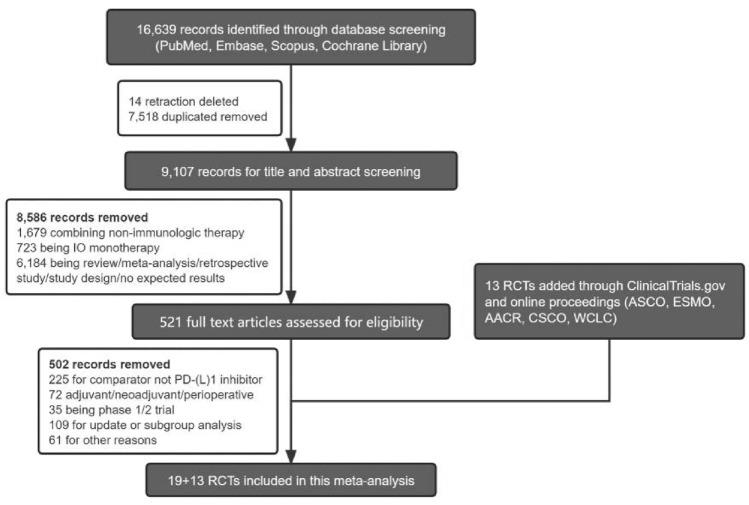
Our analysis encompassed 31 studies comprising 10,341 patients, which covered 12 distinct immune-oncology combination regimens. Across all patients, the immunotherapy combinations exhibited the capability to enhance the ORR (OR = 1.23 [95% CI 1.13-1.34]) and extend PFS (HR = 0.91 [95% CI 0.87-0.95]). However, the observed enhancement in OS (HR = 0.96 [95% CI 0.91-1.01]) was of no significance. Greater benefits in terms of PFS (HR = 0.82 [95% CI 0.72 to 0.93]) and OS (HR = 0.85 [95% CI 0.73 to 0.99]) may be particularly pronounced in cases where PD-L1 expression is negative. Notably, despite a heightened risk of any-grade TRAEs (OR = 1.72 [95% CI 1.40-2.11]) and grade greater than or equal to 3 TRAEs (OR = 2.01 [95% CI 1.67-2.43]), toxicity was generally manageable.
CONCLUSIONS
This study suggests that incorporating an additional immunotherapy agent with PD-1/PD-L1 inhibitors can elevate the response rate and reduce the risk of disease progression, all while maintaining manageable toxicity. However, there remains a challenge in translating these primary clinical benefits into extended overall survival.
简介
大量随机对照试验(RCT)已经研究了 PD-1/PD-L1 抑制剂为基础的联合疗法。对于癌症患者,两种免疫肿瘤学(IO)疗法联合应用的潜在附加临床益处的争论仍在继续。
方法
本研究纳入了比较抗 PD-1/PD-L1 免疫治疗联合与单药治疗晚期或转移性实体瘤患者的已发表和灰色来源的随机临床试验。主要结局是无进展生存期(PFS),次要结局包括客观缓解率(ORR)、总生存期(OS)和治疗相关不良事件(TRAEs)。
结果
我们的分析纳入了 31 项研究,共 10341 名患者,涵盖了 12 种不同的免疫肿瘤学联合方案。在所有患者中,免疫治疗联合显示出提高 ORR(OR=1.23[95%CI 1.13-1.34])和延长 PFS(HR=0.91[95%CI 0.87-0.95])的能力。然而,观察到的 OS 改善(HR=0.96[95%CI 0.91-1.01])没有统计学意义。在 PD-L1 表达阴性的情况下,PFS(HR=0.82[95%CI 0.72 至 0.93])和 OS(HR=0.85[95%CI 0.73 至 0.99])方面的获益可能更为显著。值得注意的是,尽管任何级别 TRAEs(OR=1.72[95%CI 1.40-2.11])和 3 级及以上 TRAEs(OR=2.01[95%CI 1.67-2.43])的风险增加,但毒性通常是可以控制的。
结论
本研究表明,在 PD-1/PD-L1 抑制剂中加入另一种免疫治疗药物可以提高反应率,降低疾病进展风险,同时保持可管理的毒性。然而,将这些主要临床获益转化为延长总生存期仍然存在挑战。

 Zotero 插件