
2015 年至 2021 年中国 151 个城市肾综合征出血热的流行特征及气象危险因素:回顾性分析。
Epidemic Characteristics and Meteorological Risk Factors of Hemorrhagic Fever With Renal Syndrome in 151 Cities in China From 2015 to 2021: Retrospective Analysis.
机构信息
Department of Epidemiology, School of Public Health, Nanjing Medical University, Nanjing, China.
Nanjing Bioengineering (Gene) Technology Center for Medicines, Nanjing, China.
出版信息
JMIR Public Health Surveill. 2024 Jun 5;10:e52221. doi: 10.2196/52221.
BACKGROUND
Hemorrhagic fever with renal syndrome (HFRS) continues to pose a significant public health threat to the population in China. Previous epidemiological evidence indicates that HFRS is climate sensitive and influenced by meteorological factors. However, past studies either focused on too-narrow geographical regions or investigated time periods that were too early. There is an urgent need for a comprehensive analysis to interpret the epidemiological patterns of meteorological factors affecting the incidence of HFRS across diverse climate zones.
OBJECTIVE
In this study, we aimed to describe the overall epidemic characteristics of HFRS and explore the linkage between monthly HFRS cases and meteorological factors at different climate levels in China.
METHODS
The reported HFRS cases and meteorological data were collected from 151 cities in China during the period from 2015 to 2021. We conducted a 3-stage analysis, adopting a distributed lag nonlinear model and a generalized additive model to estimate the interactions and marginal effects of meteorological factors on HFRS.
RESULTS
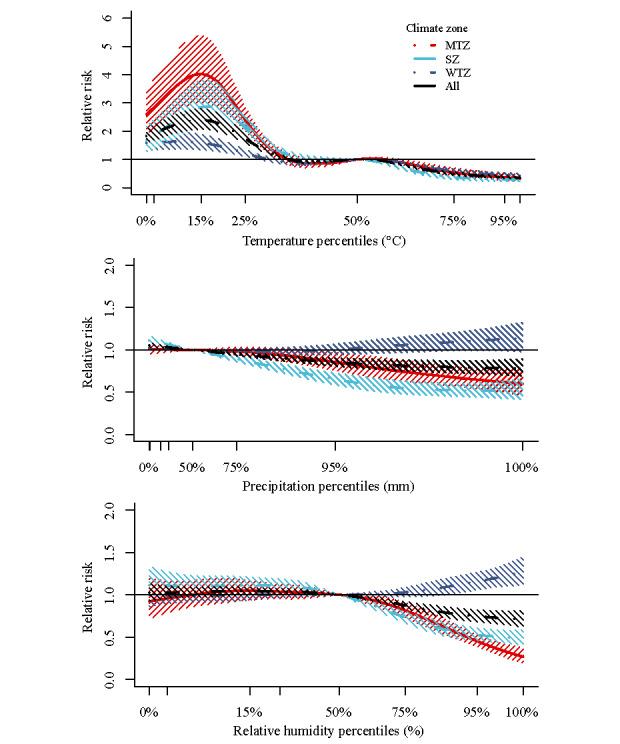
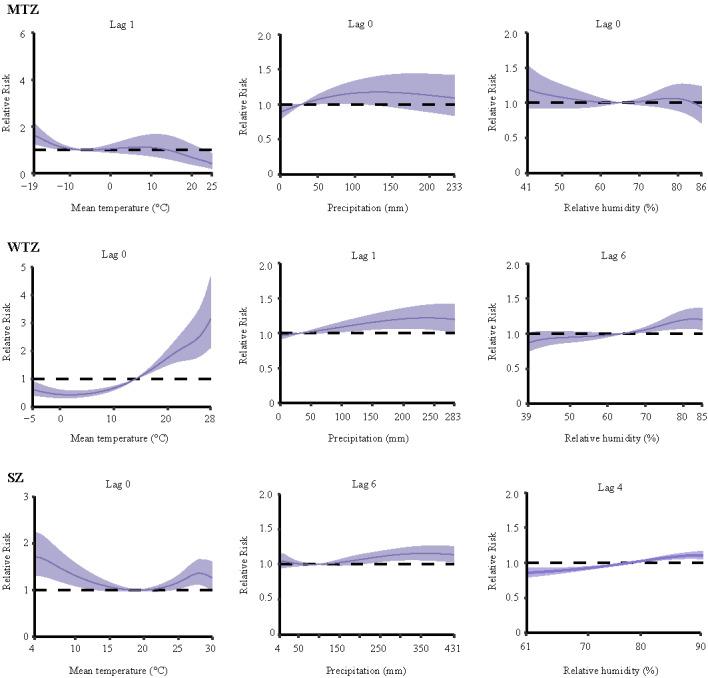
This study included a total of 63,180 cases of HFRS; the epidemic trends showed seasonal fluctuations, with patterns varying across different climate zones. Temperature had the greatest impact on the incidence of HFRS, with the maximum hysteresis effects being at 1 month (-19 ºC; relative risk [RR] 1.64, 95% CI 1.24-2.15) in the midtemperate zone, 0 months (28 ºC; RR 3.15, 95% CI 2.13-4.65) in the warm-temperate zone, and 0 months (4 ºC; RR 1.72, 95% CI 1.31-2.25) in the subtropical zone. Interactions were discovered between the average temperature, relative humidity, and precipitation in different temperature zones. Moreover, the influence of precipitation and relative humidity on the incidence of HFRS had different characteristics under different temperature layers. The hysteresis effect of meteorological factors did not end after an epidemic season, but gradually weakened in the following 1 or 2 seasons.
CONCLUSIONS
Weather variability, especially low temperature, plays an important role in epidemics of HFRS in China. A long hysteresis effect indicates the necessity of continuous intervention following an HFRS epidemic. This finding can help public health departments guide the prevention and control of HFRS and develop strategies to cope with the impacts of climate change in specific regions.
背景
肾综合征出血热(HFRS)仍对中国人群构成重大公共卫生威胁。既往流行病学证据表明,HFRS 对气候敏感,受气象因素影响。然而,既往研究要么集中在过于狭窄的地理区域,要么调查的时间太早。因此,迫切需要进行全面分析,以解释不同气候带影响 HFRS 发病率的气象因素的流行病学模式。
目的
本研究旨在描述 HFRS 的总体流行特征,并探讨中国不同气候水平下每月 HFRS 病例与气象因素之间的联系。
方法
本研究收集了 2015 年至 2021 年期间中国 151 个城市的报告 HFRS 病例和气象数据。我们进行了 3 阶段分析,采用分布式滞后非线性模型和广义加性模型来估计气象因素对 HFRS 的相互作用和边际效应。
结果
本研究共纳入 63180 例 HFRS 病例;流行趋势呈季节性波动,不同气候区模式不同。温度对 HFRS 的发病影响最大,中温带滞后 1 个月(-19℃;相对危险度[RR]1.64,95%CI 1.24-2.15)、暖温带滞后 0 个月(28℃;RR 3.15,95%CI 2.13-4.65)和亚热带滞后 0 个月(4℃;RR 1.72,95%CI 1.31-2.25)的最大滞后效应最大。在不同温度区发现了平均温度、相对湿度和降水之间的相互作用。此外,在不同温度层下,降水和相对湿度对 HFRS 发病率的影响具有不同的特征。气象因素的滞后效应在一个流行季后并未结束,而是在随后的 1 或 2 个季节逐渐减弱。
结论
天气变化,特别是低温,在中国 HFRS 流行中起着重要作用。长滞后效应表明 HFRS 流行后需要持续干预。这一发现可以帮助公共卫生部门指导 HFRS 的预防和控制,并制定应对特定地区气候变化影响的策略。


 Zotero 插件