
基于污染与气象因素的滞后联合效应分析及预测模型构建的肾综合征出血热时间序列研究。
Time series analyses based on the joint lagged effect analysis of pollution and meteorological factors of hemorrhagic fever with renal syndrome and the construction of prediction model.
机构信息
Department of Infectious Disease, Shenyang Center for Disease Control and Prevention, Shenyang, PR China.
Department of Occupational and Environmental Health, School of Public Health, China Medical University, Shenyang, Peoples' Republic of China.
出版信息
PLoS Negl Trop Dis. 2023 Jul 24;17(7):e0010806. doi: 10.1371/journal.pntd.0010806. eCollection 2023 Jul.
BACKGROUND
Hemorrhagic fever with renal syndrome (HFRS) is a rodent-related zoonotic disease induced by hantavirus. Previous studies have identified the influence of meteorological factors on the onset of HFRS, but few studies have focused on the stratified analysis of the lagged effects and interactions of pollution and meteorological factors on HFRS.
METHODS
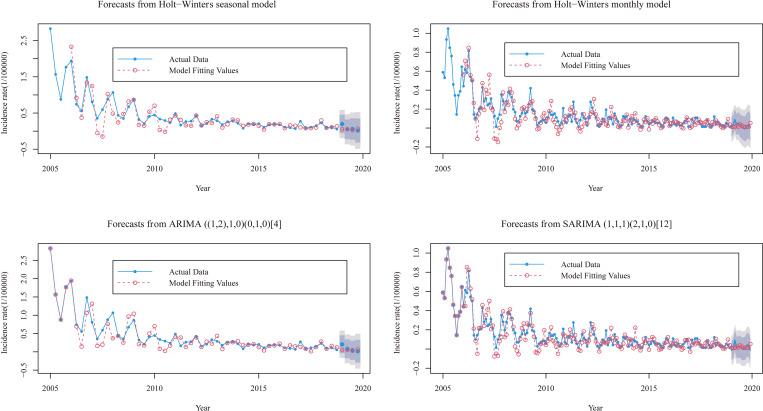
We collected meteorological, contaminant and epidemiological data on cases of HFRS in Shenyang from 2005-2019. A seasonal autoregressive integrated moving average (SARIMA) model was used to predict the incidence of HFRS and compared with Holt-Winters three-parameter exponential smoothing model. A distributed lag nonlinear model (DLNM) with a maximum lag period of 16 days was applied to assess the lag, stratification and extreme effects of pollution and meteorological factors on HFRS cases, followed by a generalized additive model (GAM) to explore the interaction of SO2 and two other meteorological factors on HFRS cases.
RESULTS
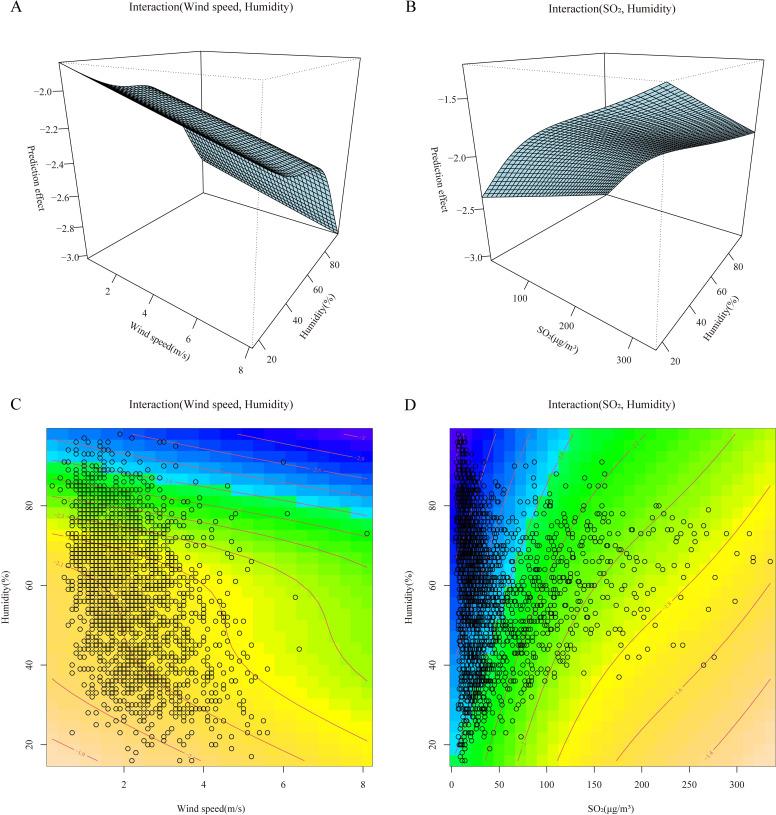
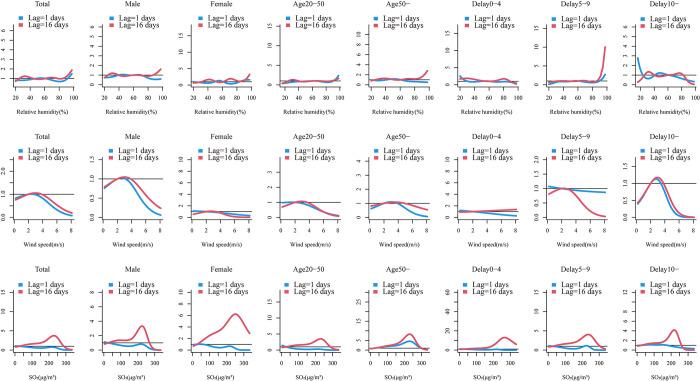
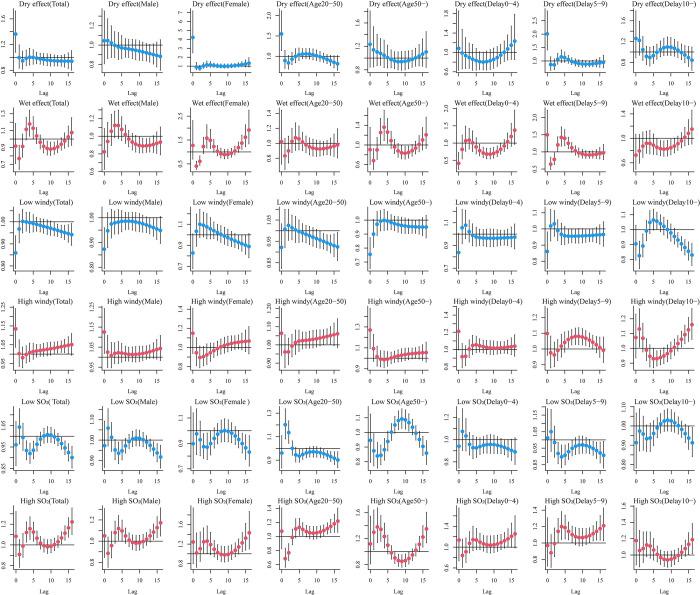
The SARIMA monthly model has better fit and forecasting power than its own quarterly model and the Holt-Winters model, with an optimal model of (1,1,0) (2,1,0)12. Overall, environmental factors including humidity, wind speed and SO2 were correlated with the onset of HFRS and there was a non-linear exposure-lag-response association. Extremely high SO2 increased the risk of HFRS incidence, with the maximum RR values: 2.583 (95%CI:1.145,5.827). Extremely low windy and low SO2 played a significant protective role on HFRS infection, with the minimum RR values: 0.487 (95%CI:0.260,0.912) and 0.577 (95%CI:0.370,0.898), respectively. Interaction indicated that the risk of HFRS infection reached its highest when increasing daily SO2 and decreasing humidity.
CONCLUSIONS
The SARIMA model may help to enhance the forecast of monthly HFRS incidence based on a long-range dataset. Our study had shown that environmental factors such as humidity and SO2 have a delayed effect on the occurrence of HFRS and that the effect of humidity can be influenced by SO2 and wind speed. Public health professionals should take greater care in controlling HFRS in low humidity, low windy conditions and 2-3 days after SO2 levels above 200 μg/m3.
背景
肾综合征出血热(HFRS)是一种由汉坦病毒引起的与啮齿动物有关的人畜共患传染病。先前的研究已经确定了气象因素对 HFRS 发病的影响,但很少有研究关注污染和气象因素对 HFRS 的滞后效应和相互作用的分层分析。
方法
我们收集了 2005-2019 年沈阳 HFRS 病例的气象、污染物和流行病学数据。采用季节性自回归综合移动平均(SARIMA)模型预测 HFRS 发病率,并与霍尔特-温特斯三参数指数平滑模型进行比较。采用最大滞后期为 16 天的分布滞后非线性模型(DLNM)评估污染和气象因素对 HFRS 病例的滞后、分层和极值效应,然后采用广义相加模型(GAM)探讨 SO2 与另外两个气象因素对 HFRS 病例的相互作用。
结果
SARIMA 月度模型比其自身的季度模型和霍尔特-温特斯模型具有更好的拟合度和预测能力,最优模型为(1,1,0)(2,1,0)12。总体而言,湿度、风速和 SO2 等环境因素与 HFRS 的发病有关,存在非线性暴露-滞后-反应关系。极高的 SO2 增加了 HFRS 发病的风险,最大 RR 值为 2.583(95%CI:1.145,5.827)。极低的风速和低 SO2 对 HFRS 感染具有显著的保护作用,最小 RR 值分别为 0.487(95%CI:0.260,0.912)和 0.577(95%CI:0.370,0.898)。交互作用表明,当每日 SO2 增加和湿度降低时,HFRS 感染的风险最高。
结论
SARIMA 模型可以帮助根据长期数据集增强对月度 HFRS 发病率的预测。我们的研究表明,湿度和 SO2 等环境因素对 HFRS 的发生有滞后效应,湿度的影响可以受到 SO2 和风速的影响。公共卫生专业人员在控制低湿度、低风速条件下以及 SO2 水平高于 200μg/m3 后 2-3 天时,应更加注意控制 HFRS。


 Zotero 插件