
污染物介导的不同类型病毒性肝炎:不同算法和时间序列模型的评估。
Pollutants-mediated viral hepatitis in different types: assessment of different algorithms and time series models.
机构信息
School of Public Health, North China University of Science of Technology, Tangshan, 062310, Hebei, China.
Hebei Key Laboratory of Immune Mechanism of Major Infectious Diseases and New Technology of Diagnosis and Treatment, The Fifth Hospital of Shijiazhuang, Shijiazhuang, China.
出版信息
Sci Rep. 2024 Sep 10;14(1):21141. doi: 10.1038/s41598-024-72047-1.
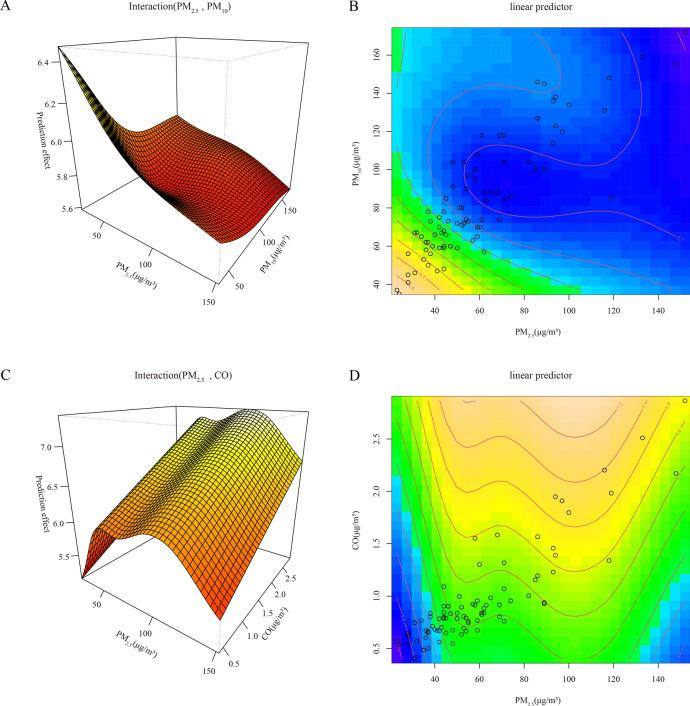
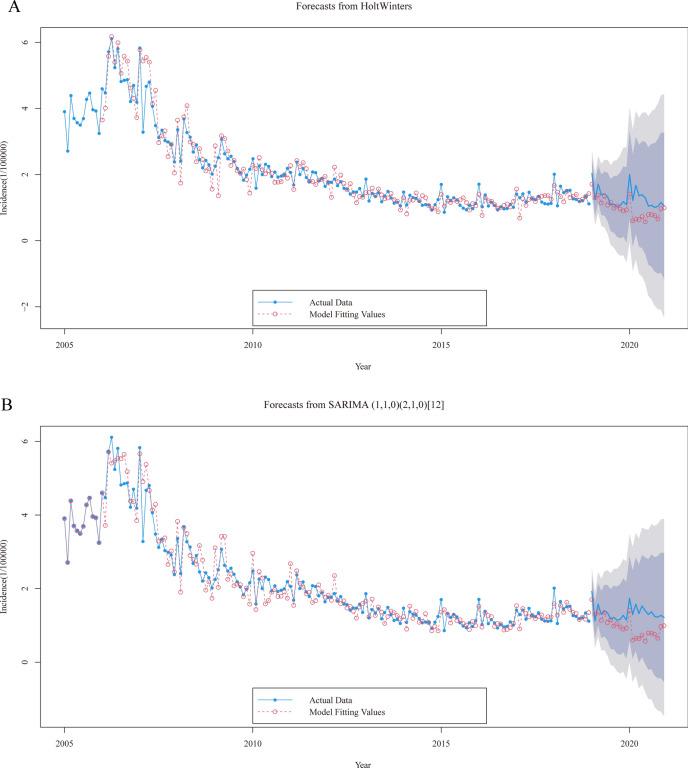
The escalating frequency of environmental pollution incidents has raised significant concerns regarding the potential health impacts of pollutant fluctuations. Consequently, a comprehensive study on the role of pollutants in the prevalence of viral hepatitis is indispensable for the advancement of innovative prevention strategies. Monthly incidence rates of viral hepatitis from 2005 to 2020 were sourced from the Chinese Center for Disease Control and Prevention Infectious Disease Surveillance Information System. Pollution data spanning 2014-2020 were obtained from the National Oceanic and Atmospheric Administration (NOAA), encompassing pollutants such as CO, NO2, and O3. Time series analysis models, including seasonal auto-regressive integrated moving average (SARIMA), Holt-Winters model, and Generalized Additive Model (GAM), were employed to explore prediction and synergistic effects related to viral hepatitis. Spearman correlation analysis was utilized to identify pollutants suitable for inclusion in these models. Concurrently, machine learning (ML) algorithms were leveraged to refine the prediction of environmental pollutant levels. Finally, a weighted quantile sum (WQS) regression framework was developed to evaluate the singular and combined impacts of pollutants on viral hepatitis cases across different demographics, age groups, and environmental strata. The incidence of viral hepatitis in Beijing exhibited a declining trend, primarily characterized by HBV and HCV types. In predicting hepatitis prevalence trends, the Holt-Winters additive seasonal model outperformed the SARIMA multiplicative model ((1,1,0) (2,1,0) ). In the prediction of environmental pollutants, the SVM model demonstrated superior performance over the GPR model, particularly with Polynomial and Besseldot kernel functions. The combined pollutant risk effect on viral hepatitis was quantified as βWQS (95% CI) = 0.066 (0.018, 0.114). Among different groups, PM emerged as the most sensitive risk factor, notably impacting patients with HCV and HEV, as well as individuals aged 35-64. CO predominantly affected HAV patients, showing a risk effect of βWQS (95% CI) = - 0.0355 (- 0.0695, - 0.0016). Lower levels of PM and PM were associated with heightened risk of viral hepatitis incidence with a lag of five months, whereas elevated levels of PM (100-120 μg/m) and CO correlated with increased hepatitis incidence risk with a lag of six months. The Holt-Winters model outperformed the SARIMA model in predicting the incidence of viral hepatitis. Among machine learning algorithms, SVM and GPR models demonstrated superior performance for analyzing pollutant data. Patients infected with HAV and HEV were primarily influenced by PM and CO, whereas SO and PM significantly impacted others. Individuals aged 35-64 years appeared particularly susceptible to these pollutants. Mixed pollutant exposures were found to affect the development of viral hepatitis with a notable lag of 5-6 months. These findings underscore the importance of long-term monitoring of pollutants in relation to viral hepatitis incidence.
环境污染事件的频率不断上升,引发了人们对污染物波动对健康潜在影响的高度关注。因此,对污染物在病毒性肝炎流行中的作用进行全面研究,对于推进创新性预防策略至关重要。2005 年至 2020 年病毒性肝炎的月度发病率数据来源于中国疾病预防控制中心传染病监测信息系统。2014 年至 2020 年的污染数据来源于美国国家海洋和大气管理局(NOAA),涵盖了 CO、NO2 和 O3 等污染物。采用季节性自回归综合移动平均(SARIMA)、Holt-Winters 模型和广义加性模型(GAM)等时间序列分析模型,探讨了病毒性肝炎相关的预测和协同效应。采用 Spearman 相关性分析来识别适合纳入这些模型的污染物。同时,利用机器学习(ML)算法来改进环境污染物水平的预测。最后,建立加权分位数总和(WQS)回归框架,以评估不同人群、年龄组和环境阶层中污染物对病毒性肝炎病例的单一和综合影响。北京的病毒性肝炎发病率呈下降趋势,主要以 HBV 和 HCV 型为主。在预测肝炎流行趋势时,Holt-Winters 加法季节性模型优于 SARIMA 乘法模型((1,1,0) (2,1,0) )。在环境污染物预测方面,SVM 模型的性能优于 GPR 模型,尤其是多项式和 Besseldot 核函数。污染物对病毒性肝炎的综合风险效应量化为βWQS(95%CI)=0.066(0.018,0.114)。在不同组别中,PM 是最敏感的风险因素,对 HCV 和 HEV 患者以及 35-64 岁人群的影响尤为显著。CO 主要影响 HAV 患者,其βWQS(95%CI)=−0.0355(−0.0695,−0.0016)。PM 和 PM 浓度较低与病毒性肝炎发病风险增加相关,且具有五个月的滞后效应,而 PM(100-120μg/m)和 CO 浓度升高与六个月的滞后效应相关,与肝炎发病风险增加相关。Holt-Winters 模型在预测病毒性肝炎发病率方面优于 SARIMA 模型。在机器学习算法中,SVM 和 GPR 模型在分析污染物数据方面表现出优异的性能。HAV 和 HEV 感染患者主要受 PM 和 CO 影响,而 SO 和 PM 则显著影响其他患者。35-64 岁的人群对这些污染物特别敏感。混合污染物暴露与病毒性肝炎的发展有关,且具有五个月至六个月的显著滞后效应。这些发现强调了长期监测污染物与病毒性肝炎发病率之间关系的重要性。
 Zotero 插件