
生物活性皂苷组分的去重复化:隐藏的皂苷
Dereplication of Bioactive Saponin Fractions: The Hidden Saponins.
作者信息
Simonet Ana M, Durán Alexandra G, Macías Francisco A
机构信息
Allelopathy Group, Department of Organic Chemistry, Institute of Biomolecules (INBIO), Campus de Excelencia Internacional (ceiA3), School of Science, University of Cadiz, C/República Saharaui n° 7, Puerto Real, Cadiz 11510, Spain.
出版信息
J Agric Food Chem. 2024 Jun 5;72(24):13740-56. doi: 10.1021/acs.jafc.4c02308.
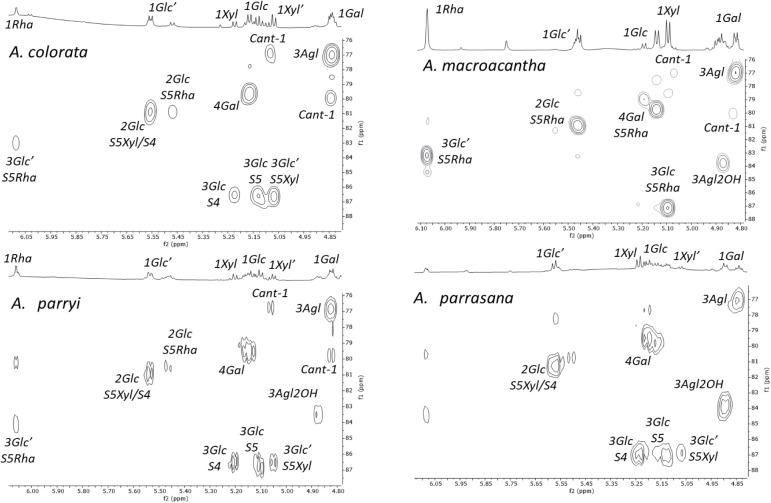
The good phytotoxicity and selectivity against weeds versus tomato or cress make saponin-rich fractions from , , , and attractive candidates as bioherbicides. The saponin contents have only previously been reported for , and as a consequence, simultaneous dereplication has been performed on saponin-rich fractions from the other plants by mass spectrometry (MS) and nuclear magnetic resonance (NMR) spectroscopy. This strategy enables the identification of a total of 26 saponins, 14 of which have been described previously and 12 of which are proposed as new saponins. They include isomers and a new sugar chain with a β-d-apiofuranose unit. The method is corroborated by the isolation of eight dereplicated saponins from .
与番茄或水芹相比,来自[具体植物名称1]、[具体植物名称2]、[具体植物名称3]和[具体植物名称4]的富含皂苷的馏分具有良好的植物毒性和对杂草的选择性,使其成为生物除草剂的有吸引力的候选物。之前仅报道了[具体植物名称5]中的皂苷含量,因此,通过质谱(MS)和核磁共振(NMR)光谱对其他植物中富含皂苷的馏分进行了同步去重复分析。该策略总共鉴定出26种皂苷,其中14种先前已有描述,12种被提议为新皂苷。它们包括异构体和带有β - D - 阿吡喃糖单元的新糖链。从[具体植物名称6]中分离出8种去重复的皂苷,证实了该方法的有效性。




 Zotero 插件