
X 染色体丢失可挽救克氏综合征中支持细胞的成熟和精子发生。
X‑chromosome loss rescues Sertoli cell maturation and spermatogenesis in Klinefelter syndrome.
机构信息
Department of Growth and Reproduction and the International Center for Research and Research Training in Endocrine Disruption of Male Reproduction and Child Health, Copenhagen, 2100, Denmark.
Research group Genetics, Reproduction and Development (GRAD), Biology of the Testis team, Vrije Universiteit Brussel, Brussels, 1090, Belgium.
出版信息
Cell Death Dis. 2024 Jun 5;15(6):396. doi: 10.1038/s41419-024-06792-6.
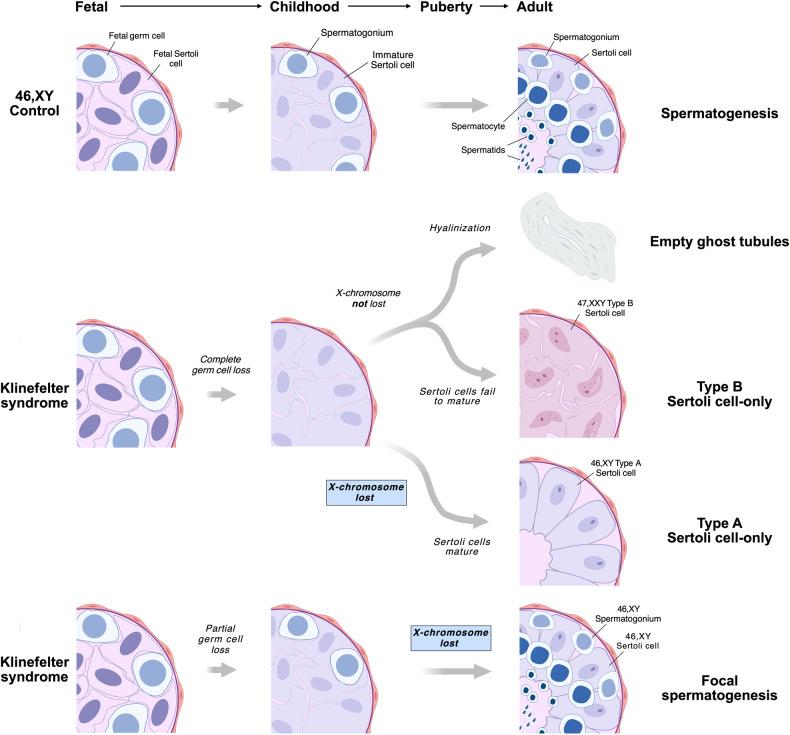
Klinefelter syndrome (47,XXY) causes infertility with a testicular histology comprising two types of Sertoli cell-only tubules, representing mature and immature-like Sertoli cells, and occasionally focal spermatogenesis. Here, we show that the immature-like Sertoli cells highly expressed XIST and had two X-chromosomes, while the mature Sertoli cells lacked XIST expression and had only one X-chromosome. Sertoli cells supporting focal spermatogenesis also lacked XIST expression and the additional X-chromosome, while the spermatogonia expressed XIST despite having only one X-chromosome. XIST was expressed in Sertoli cells until puberty, where a gradual loss was observed. Our results suggest that a micro-mosaic loss of the additional X-chromosome is needed for Sertoli cells to mature and to allow focal spermatogenesis.
克莱恩费尔特综合征(47,XXY)导致不育,睾丸组织学表现为两种类型的唯支持细胞性小管,代表成熟和类似幼稚的支持细胞,偶尔有局灶性生精。在这里,我们表明类似幼稚的支持细胞高表达 XIST 并具有两条 X 染色体,而成熟的支持细胞缺乏 XIST 表达且仅有一条 X 染色体。支持局灶性生精的支持细胞也缺乏 XIST 表达和额外的 X 染色体,而精原细胞尽管只有一条 X 染色体,仍表达 XIST。XIST 在支持细胞中表达至青春期,此时观察到逐渐丢失。我们的结果表明,额外 X 染色体的微嵌合缺失是支持细胞成熟和允许局灶性生精所必需的。


 Zotero 插件