
抗 PD-1 时代局限性黑色素瘤的治疗。
Management of Localized Melanoma in the Anti-PD-1 Era.
机构信息
Melanoma Institute Australia, 40 Rocklands Road, Wollstonecraft, North Sydney, Sydney, NSW, 2060, Australia.
Department of Melanoma and Surgical Oncology, Royal Prince Alfred Hospital, Sydney, NSW, Australia.
出版信息
Curr Oncol Rep. 2024 Aug;26(8):924-933. doi: 10.1007/s11912-024-01556-z. Epub 2024 Jun 6.
PURPOSE OF REVIEW
The management of cutaneous melanoma has rapidly progressed over the past decade following the introduction of effective systemic therapies. Given the large number of recent clinical trials which have dramatically altered the management of these patients, an updated review of the current evidence regarding the management of localized melanoma is needed.
RECENT FINDINGS
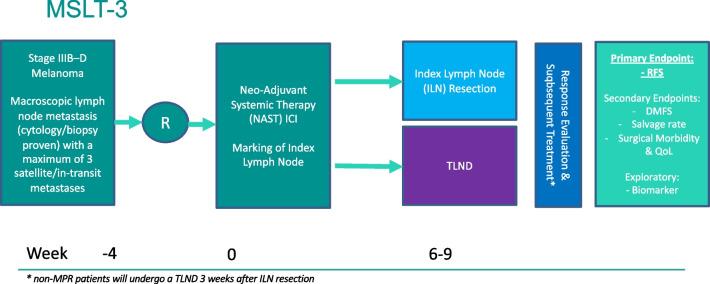
The role of effective systemic therapies in earlier stages (I-III) melanoma, both in adjuvant and neoadjuvant settings is rapidly changing the role of surgery in the management cutaneous melanoma, particularly regarding surgical safety margins for wide local excision (WLE), the role of sentinel lymph node biopsy (SLNB) and the extent of lymph node dissections. The randomized phase 2 SWOG1801 trial has demonstrated superiority of neoadjuvant-adjuvant anti-PD1 therapy in improving event-free survival by 23% at 2-years over adjuvant anti-PD-1 therapy only. Furthermore, the PRADO trial has suggested a more tailored approach both the extent of surgery as well as adjuvant therapy can safely and effectively be done, depending on the response to initial neoadjuvant immunotherapy. These results await validation and it is expected that in 2024 the phase 3 Nadina trial (NCT04949113) will definitively establish neo-adjuvant combination immunotherapy as the novel standard. This will further redefine the management of localized melanoma. The use of effective systemic therapies will continue to evolve in the next decade and, together with new emerging diagnostic and surveillance techniques, will likely reduce the extent of routine surgery for stage I-III melanoma.
目的综述
在过去十年中,随着有效的系统治疗方法的出现,皮肤黑色素瘤的治疗取得了迅速进展。鉴于大量最近的临床试验极大地改变了这些患者的治疗方法,因此需要对局部黑色素瘤的当前管理证据进行更新审查。
最新发现
有效的系统疗法在早期(I-III 期)黑色素瘤中的作用,无论是在辅助治疗还是新辅助治疗中,都在迅速改变手术在皮肤黑色素瘤治疗中的作用,特别是在广泛局部切除(WLE)的手术安全边界、前哨淋巴结活检(SLNB)的作用以及淋巴结清扫的范围。随机 2 期 SWOG1801 试验表明,与仅接受辅助抗 PD-1 治疗相比,新辅助-辅助抗 PD1 治疗可使 2 年时无事件生存率提高 23%,具有优越性。此外,PRADO 试验表明,根据初始新辅助免疫治疗的反应,可以更有针对性地进行手术范围和辅助治疗,从而安全有效地进行。这些结果有待验证,预计 2024 年,3 期 Nadina 试验(NCT04949113)将明确确立新辅助联合免疫治疗作为新的标准。这将进一步重新定义局部黑色素瘤的治疗方法。在未来十年中,有效的系统治疗方法将继续发展,并且与新出现的诊断和监测技术一起,可能会减少 I-III 期黑色素瘤的常规手术范围。
 Zotero 插件