
SMuRF 缺失型急性冠状动脉综合征患者行经皮冠状动脉介入治疗的患病率和结局。
Prevalence and outcomes of patients with SMuRF-less acute coronary syndrome undergoing percutaneous coronary intervention.
机构信息
Centre of Cardiovascular Research and Education in Therapeutics, School of Public Health and Preventive Medicine, Monash University, Melbourne, Victoria, Australia
Baker Heart and Diabetes Institute, Melbourne, Victoria, Australia.
出版信息
Open Heart. 2024 Jun 5;11(1):e002733. doi: 10.1136/openhrt-2024-002733.
BACKGROUND
There is increasing awareness that patients without standard modifiable risk factors (SMuRFs; diabetes, hypercholesterolaemia, hypertension and smoking) may represent a unique subset of patients with acute coronary syndrome (ACS). We aimed to investigate the prevalence and outcomes of patients with SMuRF-less ACS undergoing percutaneous coronary intervention (PCI) compared with those with SMuRFs.
METHODS
We analysed data from the Melbourne Interventional Group PCI Registry. Patients with coronary artery disease were excluded. The primary outcome was 30-day mortality. Secondary outcomes included in-hospital and 30-day events. Long-term mortality was investigated using Cox-proportional hazards regression.
RESULTS
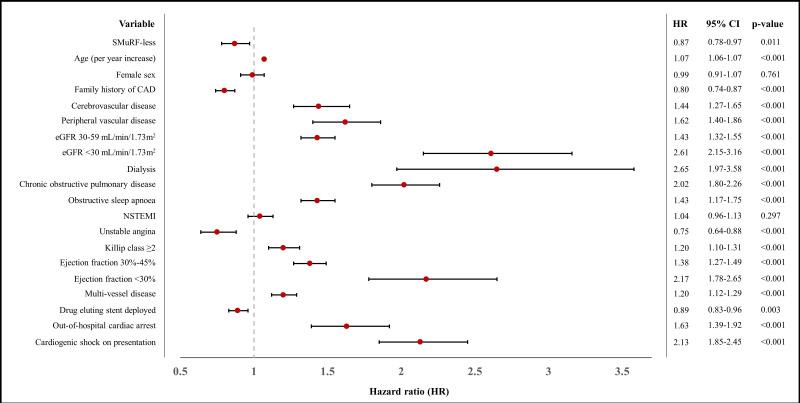
From 1 January 2005 to 31 December 2020, 2727/18 988 (14.4%) patients were SMuRF less, with the proportion increasing over time. Mean age was similar for patients with and without SMuRFs (63 years), and fewer females were SMuRF-less (19.8% vs 25.4%, p<0.001). SMuRF-less patients were more likely to present with cardiac arrest (6.6% vs 3.9%, p<0.001) and ST-elevation myocardial infarction (59.1% vs 50.8%, p<0.001) and were more likely to experience postprocedural cardiogenic shock (4.5% vs 3.6%, p=0.019) and arrhythmia (11.2% vs 9.9%, p=0.029). At 30 days, mortality, myocardial infarction, revascularisation and major adverse cardiac and cerebrovascular events did not differ between the groups. During median follow-up of 7 years, SMuRF-less patients had an adjusted 13% decreased rate of mortality (HR 0.87 (95% CI 0.78 to 0.97)).
CONCLUSIONS
The proportion of SMuRF-less patients increased over time. Presentation was more often a devastating cardiac event compared with those with SMuRFs. No difference in 30-day outcomes was observed and SMuRF-less patients had lower hazard for long-term mortality.
背景
越来越多的人意识到,没有标准可调节风险因素(SMuRFs;糖尿病、高胆固醇血症、高血压和吸烟)的患者可能代表急性冠状动脉综合征(ACS)的一个独特亚组。我们旨在研究接受经皮冠状动脉介入治疗(PCI)的 SMuRF 阴性 ACS 患者与 SMuRF 阳性 ACS 患者的患病率和结局。
方法
我们分析了墨尔本介入组 PCI 登记处的数据。排除有冠状动脉疾病的患者。主要结局为 30 天死亡率。次要结局包括住院期间和 30 天内的事件。使用 Cox 比例风险回归分析长期死亡率。
结果
2005 年 1 月 1 日至 2020 年 12 月 31 日,2727/18988(14.4%)例患者无 SMuRFs,比例随时间增加。有和无 SMuRFs 的患者平均年龄相似(63 岁),无 SMuRFs 的女性较少(19.8%比 25.4%,p<0.001)。无 SMuRFs 的患者更可能出现心脏骤停(6.6%比 3.9%,p<0.001)和 ST 段抬高型心肌梗死(59.1%比 50.8%,p<0.001),更可能经历术后心源性休克(4.5%比 3.6%,p=0.019)和心律失常(11.2%比 9.9%,p=0.029)。30 天时,两组死亡率、心肌梗死、血运重建和主要心脏和脑血管不良事件无差异。在中位 7 年的随访期间,无 SMuRFs 的患者死亡率降低了 13%(HR 0.87(95%CI 0.78 至 0.97))。
结论
无 SMuRFs 的患者比例随时间增加。与有 SMuRFs 的患者相比,他们的表现更常是灾难性的心脏事件。30 天的结果没有差异,无 SMuRFs 的患者长期死亡率较低。

 Zotero 插件