
抑郁与关节炎风险:一项孟德尔随机化研究。
Depression and risk of arthritis: A Mendelian randomization study.
机构信息
Department of Radiology, Guangzhou Panyu Central Hospital, Guangzhou, China.
出版信息
Brain Behav. 2024 Jun;14(6):e3551. doi: 10.1002/brb3.3551.
INTRODUCTION
Observational studies have found that most patients with arthritis have depression. We aimed to determine the causal relationship between various types of arthritis and depression.
METHODS
We conducted a two-sample bidirectional Mendelian randomized (MR) analysis to determine whether there was a significant causal relationship between depression and multiple types of arthritis. The data of our study were derived from the publicly released genome-wide association studies (GWASs) and the largest GWAS meta-analysis. MR analysis mainly used inverse-variance weighted method; supplementary methods included weighted median, weighted mode, and MR-Egger using MR pleiotropy residual sum and outlier to detect and correct for the presence of pleiotropy.
RESULTS
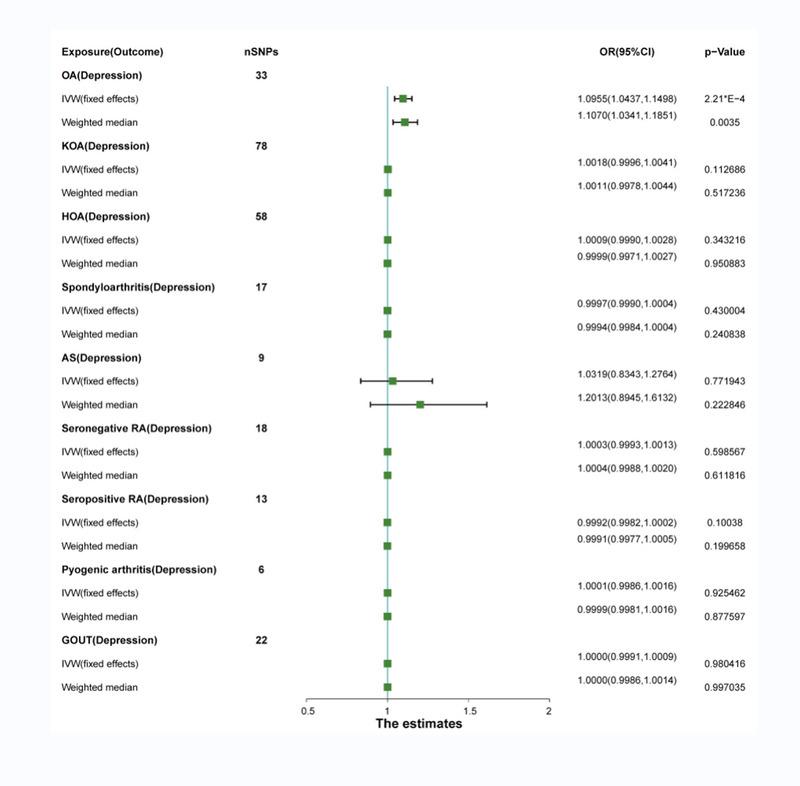
After adjusting for heterogeneity and horizontal pleiotropy, we found that depression was associated with an increased risk of osteoarthritis (OA) (OR = 1.02, 95%CI: 1.01-1.02, p = 2.96 × E - 5). In the reverse analysis, OA was also found to increase the risk of depression (OR = 1.10, 95%CI: 1.04-1.15, p = .0002). Depression only increased the risk of knee OA (KOA) (OR = 1.25, 95%CI: 1.10-1.42, p = 6.46 × E - 4). Depression could potentially increase the risk of spondyloarthritis (OR = 1.52, 95%CI: 1.19-1.94, p ≤ 8.94 × E - 4).
CONCLUSION
There is a bidirectional causal relationship of depression with OA. However, depression only augments the risk of developing KOA. Depression may increase the risk of spondyloarthritis and gout.
简介
观察性研究发现,大多数关节炎患者都患有抑郁症。我们旨在确定各种类型的关节炎与抑郁症之间是否存在因果关系。
方法
我们进行了两样本双向孟德尔随机化(MR)分析,以确定抑郁症与多种类型的关节炎之间是否存在显著的因果关系。我们研究的数据来自公开发布的全基因组关联研究(GWAS)和最大的 GWAS 荟萃分析。MR 分析主要使用逆方差加权法;补充方法包括加权中位数、加权众数和使用 MR 偏倚残差和异常值检测和校正的 MR-Egger。
结果
在调整了异质性和水平偏倚后,我们发现抑郁症与骨关节炎(OA)的风险增加相关(OR=1.02,95%CI:1.01-1.02,p=2.96×E-5)。在反向分析中,OA 也被发现增加了患抑郁症的风险(OR=1.10,95%CI:1.04-1.15,p=0.0002)。抑郁症仅增加了膝骨关节炎(KOA)的风险(OR=1.25,95%CI:1.10-1.42,p=6.46×E-4)。抑郁症可能会增加患脊柱关节炎(OR=1.52,95%CI:1.19-1.94,p≤8.94×E-4)的风险。
结论
抑郁症与 OA 之间存在双向因果关系。然而,抑郁症仅增加了患 KOA 的风险。抑郁症可能会增加患脊柱关节炎和痛风的风险。


 Zotero 插件