
基于高分辨率滤波反投影重建的肝脏转移瘤模拟深部CT特征分析
Simulated deep CT characterization of liver metastases with high-resolution filtered back projection reconstruction.
作者信息
Wiedeman Christopher, Lorraine Peter, Wang Ge, Do Richard, Simpson Amber, Peoples Jacob, De Man Bruno
机构信息
Department of Electrical and Computer Engineering, Rensselaer Polytechnic Institute, Troy, NY, 12180, USA.
GE Research - Healthcare, Niskayuna, NY, 12309, USA.
出版信息
Vis Comput Ind Biomed Art. 2024 Jun 11;7(1):13. doi: 10.1186/s42492-024-00161-y.
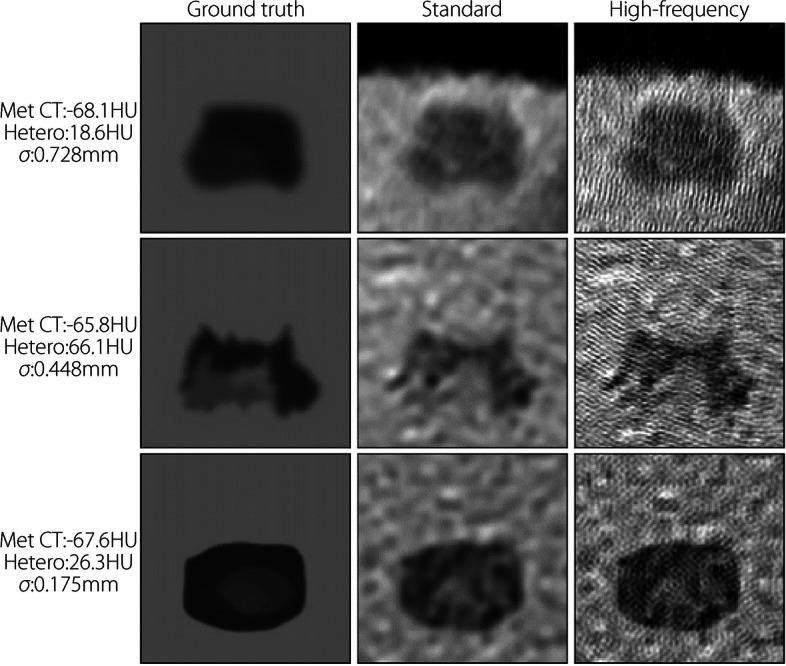
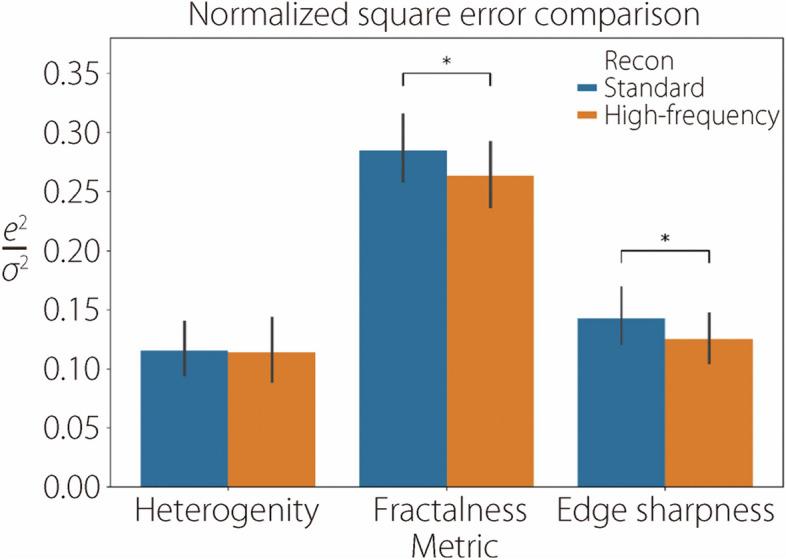
Early diagnosis and accurate prognosis of colorectal cancer is critical for determining optimal treatment plans and maximizing patient outcomes, especially as the disease progresses into liver metastases. Computed tomography (CT) is a frontline tool for this task; however, the preservation of predictive radiomic features is highly dependent on the scanning protocol and reconstruction algorithm. We hypothesized that image reconstruction with a high-frequency kernel could result in a better characterization of liver metastases features via deep neural networks. This kernel produces images that appear noisier but preserve more sinogram information. A simulation pipeline was developed to study the effects of imaging parameters on the ability to characterize the features of liver metastases. This pipeline utilizes a fractal approach to generate a diverse population of shapes representing virtual metastases, and then it superimposes them on a realistic CT liver region to perform a virtual CT scan using CatSim. Datasets of 10,000 liver metastases were generated, scanned, and reconstructed using either standard or high-frequency kernels. These data were used to train and validate deep neural networks to recover crafted metastases characteristics, such as internal heterogeneity, edge sharpness, and edge fractal dimension. In the absence of noise, models scored, on average, 12.2% ( ) and 7.5% ( lower squared error for characterizing edge sharpness and fractal dimension, respectively, when using high-frequency reconstructions compared to standard. However, the differences in performance were statistically insignificant when a typical level of CT noise was simulated in the clinical scan. Our results suggest that high-frequency reconstruction kernels can better preserve information for downstream artificial intelligence-based radiomic characterization, provided that noise is limited. Future work should investigate the information-preserving kernels in datasets with clinical labels.
结直肠癌的早期诊断和准确预后对于确定最佳治疗方案和最大化患者治疗效果至关重要,尤其是当疾病发展为肝转移时。计算机断层扫描(CT)是完成这项任务的一线工具;然而,预测性放射组学特征的保留高度依赖于扫描协议和重建算法。我们假设使用高频内核进行图像重建可以通过深度神经网络更好地表征肝转移特征。这种内核生成的图像看起来噪声更大,但保留了更多的正弦图信息。开发了一个模拟流程来研究成像参数对肝转移特征表征能力的影响。该流程利用分形方法生成代表虚拟转移灶的各种形状,然后将它们叠加在真实的CT肝脏区域上,使用CatSim进行虚拟CT扫描。生成了10000个肝转移灶的数据集,使用标准或高频内核进行扫描和重建。这些数据用于训练和验证深度神经网络,以恢复精心设计的转移灶特征,如内部异质性、边缘清晰度和边缘分形维数。在无噪声情况下,与标准重建相比,使用高频重建时,模型在表征边缘清晰度和分形维数时的平均得分分别低12.2%( )和7.5%( )的平方误差。然而,在临床扫描中模拟典型水平的CT噪声时,性能差异在统计学上不显著。我们的结果表明,只要噪声有限,高频重建内核可以更好地保留信息,用于基于人工智能的下游放射组学表征。未来的工作应该研究具有临床标签的数据集中的信息保留内核。




 Zotero 插件