
在色觉适应光传感器中的绿光/红光感应机制。
Green/red light-sensing mechanism in the chromatic acclimation photosensor.
机构信息
Department of Molecular Biophysics, School of Pharmacy, Tokyo University of Pharmacy and Life Sciences, Hachioji, Tokyo 192-0392, Japan.
Department of Applied Chemistry and Life Science, Toyohashi University of Technology, Toyohashi, Aichi 441-8580, Japan.
出版信息
Sci Adv. 2024 Jun 14;10(24):eadn8386. doi: 10.1126/sciadv.adn8386. Epub 2024 Jun 12.
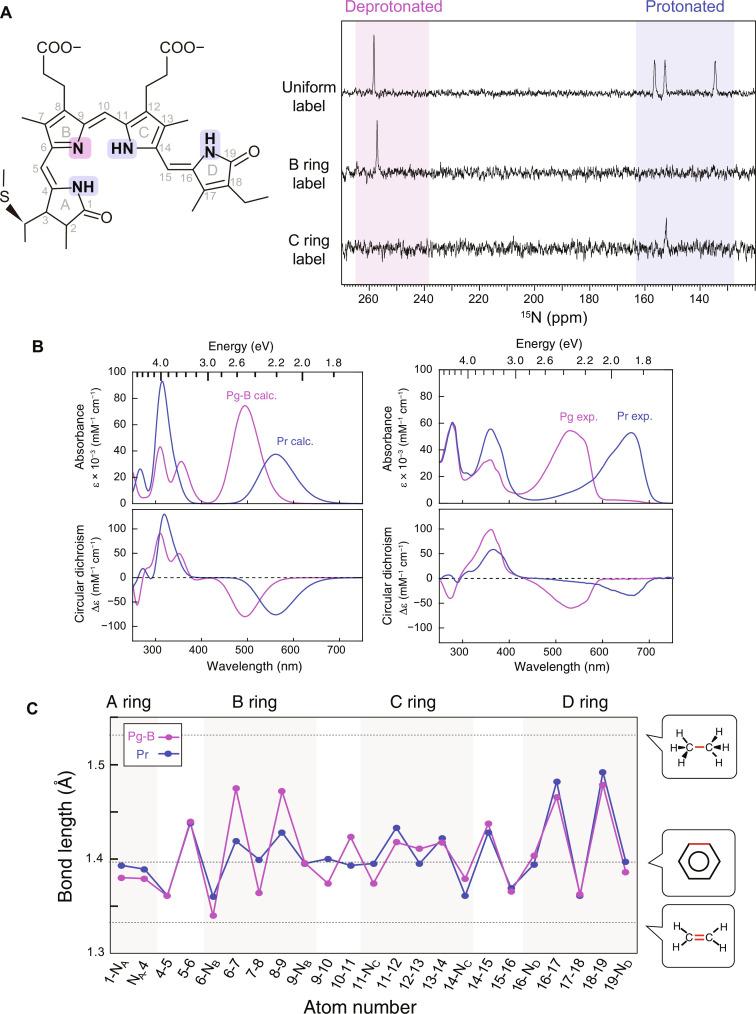
Certain cyanobacteria alter their photosynthetic light absorption between green and red, a phenomenon called complementary chromatic acclimation. The acclimation is regulated by a cyanobacteriochrome-class photosensor that reversibly photoconverts between green-absorbing (Pg) and red-absorbing (Pr) states. Here, we elucidated the structural basis of the green/red photocycle. In the Pg state, the bilin chromophore adopted the extended C15-, structure within a hydrophobic pocket. Upon photoconversion to the Pr state, the bilin is isomerized to the cyclic C15-, structure, forming a water channel in the pocket. The solvation/desolvation of the bilin causes changes in the protonation state and the stability of π-conjugation at the B ring, leading to a large absorption shift. These results advance our understanding of the enormous spectral diversity of the phytochrome superfamily.
某些蓝藻在绿光和红光之间改变其光合作用的光吸收,这种现象称为补色光适应。这种适应受一种蓝藻视紫红质类光传感器的调控,该传感器在绿光吸收态(Pg)和红光吸收态(Pr)之间可逆地光转化。在这里,我们阐明了绿光/红光光循环的结构基础。在 Pg 态,类菌胞素发色团在一个疏水性口袋内采取扩展的 C15-构象。在光转化为 Pr 态时,类菌胞素发色团异构化为环化的 C15-构象,在口袋内形成一个水通道。类菌胞素发色团的溶剂化/去溶剂化导致 B 环上的质子化状态和π共轭稳定性的变化,导致较大的吸收位移。这些结果增进了我们对光受体超家族巨大光谱多样性的理解。


 Zotero 插件