Wang Qianhui, Xi Linqiang, Yang Na, Song Jie, Taiwaikul Dilare, Zhang Xiaoxue, Bo Yakun, Tang Baopeng, Zhou Xianhui
Department of Cardiac Pacing and Electrophysiology, The First Affiliated Hospital of Xinjiang Medical University, No. 137, Liyushan Road, Urumqi, 830054, PR China.
Aging Clin Exp Res. 2024 Jun 13;36(1):131. doi: 10.1007/s40520-024-02773-z.
Leukocyte telomere length (LTL) shorting was significantly associated with mortality. This study aimed to investigate the potential association between LTL and all-cause mortality as well as cardiovascular disease (CVD) mortality in middle-aged or older individuals without a history of CVD.
A total of 4174 participants from the National Health and Nutrition Examination Survey (NHANES) conducted between 1999 and 2002 were included in this analysis. Cox proportional hazards regression models were utilized to estimate the association between LTL and mortality outcomes. Restricted cubic spline (RCS) curves were employed to evaluate the potential non-linear association.
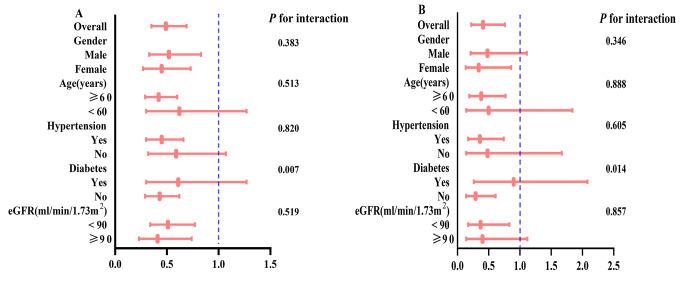
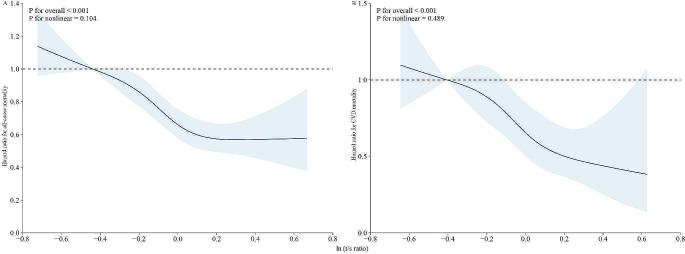
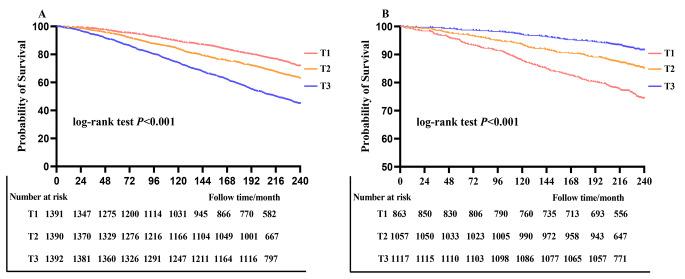
Over a median follow-up period of 217 months, the weighted rates of all-cause mortality and CVD mortality were 28.58% and 8.32% respectively. Participants in the highest LTL group exhibited a significantly decreased risk of both all-cause mortality (HR: 0.65, 95% CI: 0.54-0.78, P < 0.001) and CVD mortality (HR: 0.64, 95% CI: 0.45-0.93, P < 0.001) compared to those in the lowest group. Kaplan-Meier survival curves further supported a significant association between shorter telomere length and increased risks of both all-cause and CVD mortality (log-rank test P < 0.001). RCS curves demonstrated a linear dose-response relationship between LTL and all-cause mortality as well as CVD mortality. Subgroup and sensitivity analyses confirmed the robustness of the results.
Shorter leukocyte telomere length could serve as a potential biomarker for risk stratification of all-cause and CVD mortality among middle-aged and older individuals without a history of CVD.
白细胞端粒长度(LTL)缩短与死亡率显著相关。本研究旨在探讨无心血管疾病(CVD)病史的中老年人中LTL与全因死亡率以及CVD死亡率之间的潜在关联。
本分析纳入了1999年至2002年期间进行的美国国家健康与营养检查调查(NHANES)中的4174名参与者。采用Cox比例风险回归模型来估计LTL与死亡率结局之间的关联。使用受限立方样条(RCS)曲线来评估潜在的非线性关联。
在中位随访期217个月内,全因死亡率和CVD死亡率的加权率分别为28.58%和8.32%。与最低LTL组的参与者相比,最高LTL组的参与者全因死亡率(风险比:0.65,95%置信区间:0.54 - 0.78,P < 0.001)和CVD死亡率(风险比:0.64,95%置信区间:0.45 - 0.93,P < 0.001)的风险均显著降低。Kaplan-Meier生存曲线进一步支持了较短的端粒长度与全因和CVD死亡率风险增加之间的显著关联(对数秩检验P < 0.001)。RCS曲线显示LTL与全因死亡率以及CVD死亡率之间存在线性剂量反应关系。亚组分析和敏感性分析证实了结果的稳健性。
较短的白细胞端粒长度可作为无CVD病史的中老年人全因和CVD死亡率风险分层的潜在生物标志物。

 Zotero 插件