
不同治疗方式对 IV 期上皮性卵巢癌预后的影响:SEER 数据库分析。
Effect of different treatment modalities on the prognosis of stage IV epithelial ovarian cancer: analysis of the SEER database.
机构信息
Department of Obstetrics and Gynecology, Union Hospital, Tongji Medical College, Huazhong University of Science and Technology, No 1277 JieFang Avenue, Jiang'an District, Wuhan, 420022, China.
Department of Hematology, Union Hospital, Tongji Medical College, Huazhong University of Science and Technology, Wuhan, China.
出版信息
BMC Womens Health. 2024 Jun 15;24(1):345. doi: 10.1186/s12905-024-03199-5.
BACKGROUND
The prognosis of advanced ovarian cancer is often poor. Although there are several treatment options for stage IV epithelial ovarian cancer, it is not clear which treatment will benefit the patient's prognosis.We conducted an analysis using the SEER database to compare the impact of different treatment modalities on the prognosis of advanced ovarian cancer.
METHODS
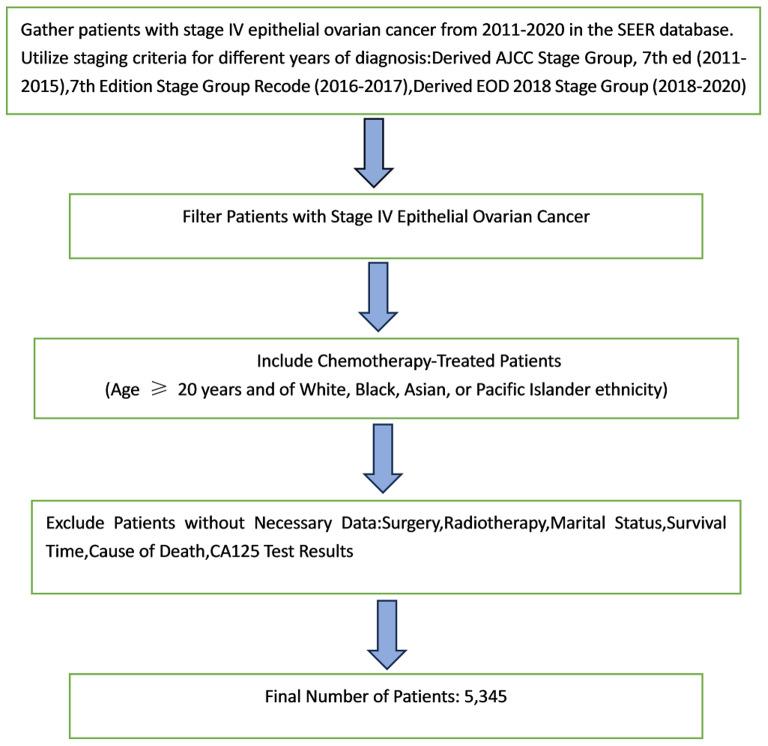
The present study conducts a retrospective analysis of relevant data from the SEER database pertaining to patients diagnosed with stage IV epithelial ovarian cancer between 2011 and 2020 (n = 5345). Statistical methods including Kaplan-Meier curves, log-rank tests, and Cox regression analysis are employed to ascertain the impact of different treatment regimens on the prognosis of patients with stage IV epithelial ovarian cancer.
RESULTS
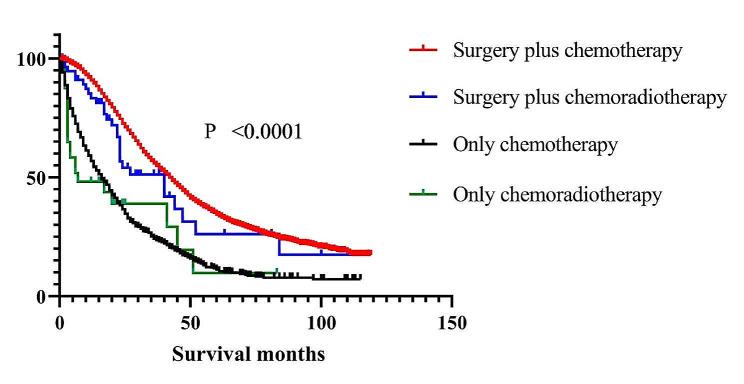
Among patients with stage IV epithelial ovarian cancer, age ≥ 60 and the presence of lung metastases or multiple metastases were identified as poor prognostic factors. Conversely, being Asian or Pacific Islander, married, and testing negative for CA125 were associated with favorable prognoses. In terms of the choice of treatment for patients, surgery plus chemotherapy was the best treatment modality, and timely surgery could significantly improve the prognosis of patients, but there was no difference between chemoradiotherapy alone and the surgery group among patients with lung metastases.
CONCLUSION
The prognosis of patients with stage IV epithelial ovarian cancer is influenced by many factors. In terms of the choice of treatment, patients with surgery plus chemotherapy have the best prognosis. In cases where lung metastases are inoperable, a combination of radiotherapy and chemotherapy can be used. In other cases, radiotherapy does not improve outcomes in patients with stage IV epithelial ovarian cancer. This study provides a basis for the choice of treatment for patients with stage IV epithelial ovarian cancer.
背景
晚期卵巢癌的预后通常较差。尽管有几种治疗方法可用于 IV 期上皮性卵巢癌,但尚不清楚哪种治疗方法对患者的预后有益。我们使用 SEER 数据库进行了分析,以比较不同治疗方式对晚期卵巢癌预后的影响。
方法
本研究对 2011 年至 2020 年期间诊断为 IV 期上皮性卵巢癌的 SEER 数据库中的相关数据进行回顾性分析(n=5345)。采用 Kaplan-Meier 曲线、对数秩检验和 Cox 回归分析等统计方法,确定不同治疗方案对 IV 期上皮性卵巢癌患者预后的影响。
结果
在 IV 期上皮性卵巢癌患者中,年龄≥60 岁和存在肺转移或多发转移被确定为不良预后因素。相反,亚裔或太平洋岛民、已婚和 CA125 阴性与良好的预后相关。在患者治疗选择方面,手术联合化疗是最佳治疗方式,及时手术可显著改善患者的预后,但在肺转移患者中,单纯放化疗与手术组之间无差异。
结论
IV 期上皮性卵巢癌患者的预后受多种因素影响。在治疗选择方面,手术联合化疗的患者预后最佳。对于无法手术的肺转移患者,可采用放化疗联合治疗。在其他情况下,放疗不能改善 IV 期上皮性卵巢癌患者的结局。本研究为 IV 期上皮性卵巢癌患者的治疗选择提供了依据。
 Zotero 插件