
基于深度学习模型预测上皮性卵巢癌患者的预后。
Predicting the prognosis of epithelial ovarian cancer patients based on deep learning models.
作者信息
Li Zihan, Wang Jiao, Zhang Yixin, Yang Zhen, Zhou Fanchen, Bai Xueting, Zhang Qian, Zhen Wenchong, Xu Rongxuan, Wu Wei, Yao Zhihan, Li Xiaofeng, Yang Yiming
机构信息
Department of Epidemiology and Health Statistics, Dalian Medical University, Dalian, China.
Dalian Municipal Central Hospital, Central Hospital of Dalian University of Technology, Dalian, China.
出版信息
Front Oncol. 2025 Jul 25;15:1592746. doi: 10.3389/fonc.2025.1592746. eCollection 2025.
BACKGROUND
Epithelial ovarian cancer(EOC) has a higher mortality and morbidity rate than other types, and it has a dramatic impact on the survival of ovarian cancer(OC) patients. Therefore, investigating, developing and validating prognostic models to predict overall survival(OS) in patients with epithelial ovarian cancer represents an area of research with significant clinical implications.
METHODS
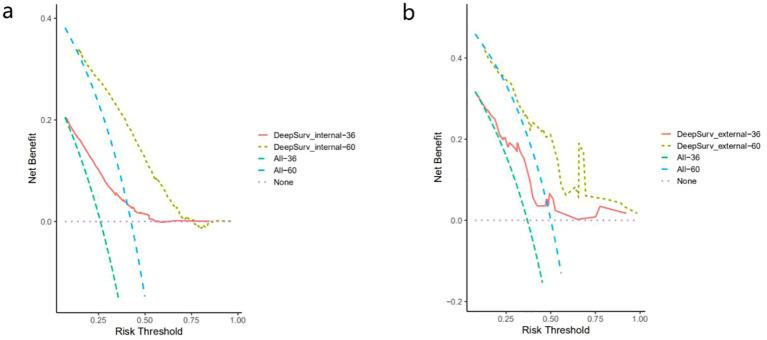
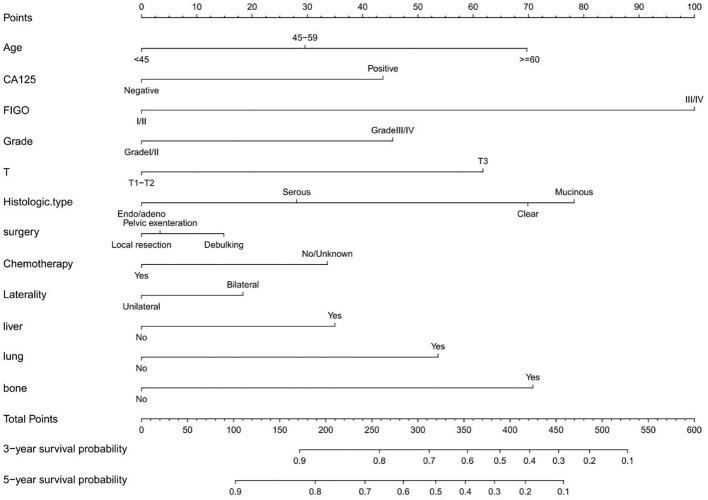
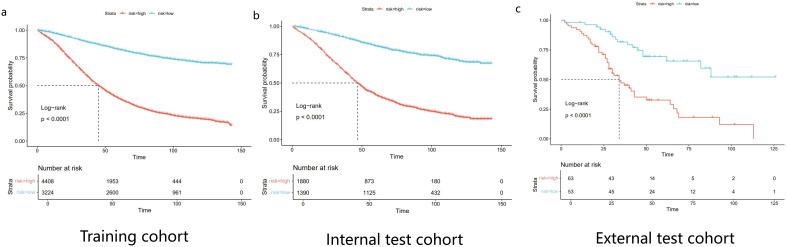
Patients with a confirmed diagnosis of epithelial ovarian cancer from 2010 to 2017 in The Surveillance, Epidemiology, and End Results(SEER) database were identified for enrollment based on inclusion and exclusion criteria(N=10902). Patients with epithelial ovarian cancer diagnosed from 2010 to 2022 were selected from Dalian Municipal Central Hospital as an external validation cohort based on the same criteria (N=116). COX proportional risk regression for screening independent prognostic factors. Survival outcomes were compared between different risk subgroups based on Kaplan-Meier analysis. Three predictive models were developed using machine learning(ML) techniques, and another was a nomogram based on COX proportional risk regression for estimating 3-year and 5-year overall survival in patients with epithelial ovarian cancer. Evaluation of several models based on multiple metrics including C-index, ROC curve, calibration curve and decision curve analysis (DCA).
RESULTS
Through univariate and multivariate COX proportional risk regression analyses, we selected 12 significantly independent prognostic factors affecting overall survival (P<0.05). In conclusion, comparing several models cited, it was found that DeepSurv (Deep Survival) model had the best performance in both internal validation set and external validation set. The C-index for internal validation was 0.715, and the 3-year and 5-year ROC curves were 0.746 and 0.766; the C-index for external validation was 0.672, and the 3-year and 5-year ROC curves were 0.731 and 0.756.
CONCLUSION
This study successfully developed a nomogram and three machine learning models, which collectively served as important predictive instruments to support clinical decision making.
背景
上皮性卵巢癌(EOC)的死亡率和发病率高于其他类型,对卵巢癌(OC)患者的生存有巨大影响。因此,研究、开发和验证预测上皮性卵巢癌患者总生存期(OS)的预后模型是一个具有重要临床意义的研究领域。
方法
根据纳入和排除标准,在监测、流行病学和最终结果(SEER)数据库中确定2010年至2017年确诊为上皮性卵巢癌的患者进行入组(N = 10902)。基于相同标准,从大连市中心医院选取2010年至2022年诊断为上皮性卵巢癌的患者作为外部验证队列(N = 116)。采用COX比例风险回归筛选独立预后因素。基于Kaplan-Meier分析比较不同风险亚组之间的生存结局。使用机器学习(ML)技术开发了三种预测模型,另一种是基于COX比例风险回归的列线图,用于估计上皮性卵巢癌患者的3年和5年总生存期。基于包括C指数、ROC曲线、校准曲线和决策曲线分析(DCA)在内的多个指标对几种模型进行评估。
结果
通过单因素和多因素COX比例风险回归分析,我们选择了12个影响总生存期的显著独立预后因素(P < 0.05)。总之,比较所引用的几种模型发现,DeepSurv(深度生存)模型在内部验证集和外部验证集中均表现最佳。内部验证的C指数为0.715,3年和5年ROC曲线分别为0.746和0.766;外部验证的C指数为0.672,3年和5年ROC曲线分别为0.731和0.756。
结论
本研究成功开发了一个列线图和三种机器学习模型,它们共同作为支持临床决策的重要预测工具。



 Zotero 插件