
配备齐全的嵌合抗原受体(CARs)可解决肿瘤异质性问题,增强安全性,并提高细胞免疫疗法的功能。
Fully equipped CARs to address tumor heterogeneity, enhance safety, and improve the functionality of cellular immunotherapies.
机构信息
Tettamanti Center and Pediatrics, Fondazione IRCCS San Gerardo dei Tintori, Monza, Italy.
School of Medicine and Surgery, University of Milano-Bicocca, Monza, Italy.
出版信息
Front Immunol. 2024 Jun 3;15:1407992. doi: 10.3389/fimmu.2024.1407992. eCollection 2024.
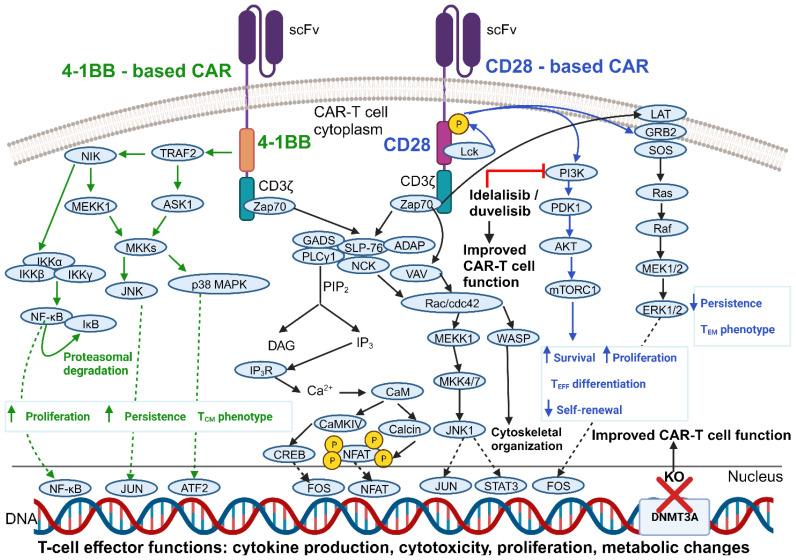
Although adoptive transfer of chimeric antigen receptor (CAR)-engineered T cells has achieved unprecedented response rates in patients with certain hematological malignancies, this therapeutic modality is still far from fulfilling its remarkable potential, especially in the context of solid cancers. Antigen escape variants, off-tumor destruction of healthy tissues expressing tumor-associated antigens (TAAs), poor CAR-T cell persistence, and the occurrence of functional exhaustion represent some of the most prominent hurdles that limit CAR-T cell ability to induce long-lasting remissions with a tolerable adverse effect profile. In this review, we summarize the main approaches that have been developed to face such bottlenecks, including the adapter CAR (AdCAR) system, Boolean-logic gating, epitope editing, the modulation of cell-intrinsic signaling pathways, and the incorporation of safety switches to precisely control CAR-T cell activation. We also discuss the most pressing issues pertaining to the selection of co-stimulatory domains, with a focus on strategies aimed at promoting CAR-T cell persistence and optimal antitumor functionality.
尽管嵌合抗原受体 (CAR)-工程 T 细胞的过继转移在某些血液恶性肿瘤患者中已取得了前所未有的反应率,但这种治疗方式仍远未充分发挥其显著的潜力,尤其是在实体瘤方面。抗原逃逸变体、表达肿瘤相关抗原 (TAA) 的健康组织的脱靶破坏、CAR-T 细胞持续存在不良以及功能衰竭的发生,是一些限制 CAR-T 细胞诱导持久缓解且具有可耐受不良事件谱的能力的最突出障碍。在这篇综述中,我们总结了为应对这些瓶颈而开发的主要方法,包括衔接器 CAR(AdCAR)系统、布尔逻辑门控、表位编辑、细胞内信号通路的调节以及安全开关的整合,以精确控制 CAR-T 细胞的激活。我们还讨论了与共刺激结构域选择相关的最紧迫问题,重点讨论了旨在促进 CAR-T 细胞持久性和最佳抗肿瘤功能的策略。


 Zotero 插件