
丁香精油及其主要成分:抗念珠菌属活性和毒性评估。
Syzygium aromaticum essential oil and its major constituents: Assessment of activity against Candida spp. and toxicity.
机构信息
Department of Dentistry, Postgraduate Program in Dentistry, State University of Paraiba, Campina Grande, Paraíba, Brazil.
Department of Foundational Sciences, School of Dental Medicine, East Carolina University, Greenville, North Carolina, United States of America.
出版信息
PLoS One. 2024 Jun 18;19(6):e0305405. doi: 10.1371/journal.pone.0305405. eCollection 2024.
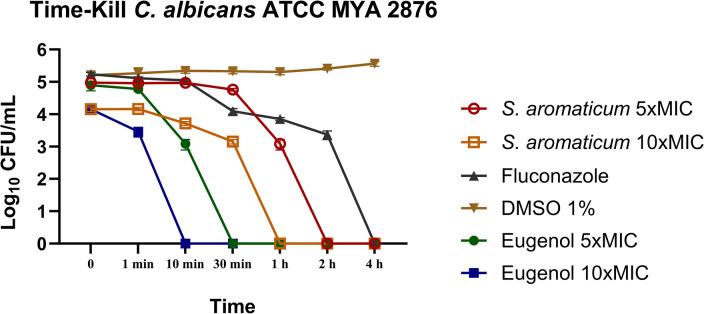
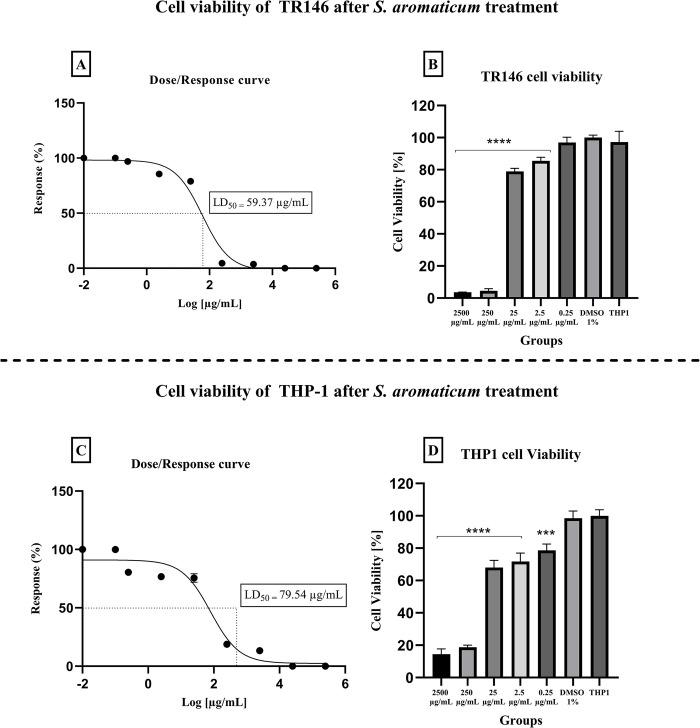
Syzigium aromaticum essential oil (EO), eugenol, and β-caryophyllene were evaluated regarding antifungal, antibiofilm, and in vitro toxicity. Additionally, in vivo toxicity of EO was observed. Anti-Candida activity was assessed through broth microdilution assay for all compounds. Time-kill assay (0, 1, 10, 30 min, 1, 2, and 4 h) was used to determine the influence of EO and eugenol on Candida Growth kinetics. Thereafter, both compounds were evaluated regarding their capacity to act on a biofilm formation and on mature biofilm, based on CFU/ml/g of dry weight. Cell Titer Blue Viability Assay was used for in vitro cytotoxicity, using oral epithelial cells (TR146) and human monocytes (THP-1). Lastly, Galleria mellonella model defined the EO in vivo acute toxicity. All compounds, except β-cariofilene (MIC > 8000 μg/ml), presented antifungal activity against Candida strains (MIC 500-1000 μg/ml). The growth kinetics of Candida was affected by the EO (5xMIC 30 min onward; 10xMIC 10 min onward) and eugenol (5xMIC 10 min onward; 10xMIC 1 min onward). Fungal viability was also affected by 5xMIC and 10xMIC of both compounds during biofilm formation and upon mature biofilms. LD50 was defined for TR146 and THP1 cells at, respectively, 59.37 and 79.54 μg/ml for the EO and 55.35 and 84.16 μg/ml for eugenol. No sign of toxicity was seen in vivo up to 10mg/ml (20 x MIC) for the EO. S. aromaticum and eugenol presented antifungal and antibiofilm activity, with action on cell growth kinetics. In vivo acute toxicity showed a safe parameter for the EO up to 10 mg/ml.
山苍子精油(EO)、丁香酚和β-石竹烯的抗真菌、抗生物膜和体外毒性进行了评估。此外,还观察了 EO 的体内毒性。所有化合物均通过肉汤微量稀释法评估抗念珠菌活性。时间杀伤试验(0、1、10、30 min、1、2 和 4 h)用于确定 EO 和丁香酚对念珠菌生长动力学的影响。之后,根据干重 CFU/ml/g,评估这两种化合物在生物膜形成和成熟生物膜上的作用。细胞毒性蓝试验(Cell Titer Blue Viability Assay)用于评估体外细胞毒性,使用口腔上皮细胞(TR146)和人单核细胞(THP-1)。最后,使用大蜡螟模型定义 EO 的体内急性毒性。除β-石竹烯(MIC > 8000 μg/ml)外,所有化合物对念珠菌菌株均具有抗真菌活性(MIC 500-1000 μg/ml)。EO(30 min 后 5xMIC;10 min 后 10xMIC)和丁香酚(1 min 后 10xMIC)均影响念珠菌的生长动力学。在生物膜形成和成熟生物膜时,5xMIC 和 10xMIC 的两种化合物也影响真菌的活力。TR146 和 THP1 细胞的 LD50 分别为 EO 的 59.37 和 79.54 μg/ml,丁香酚的 55.35 和 84.16 μg/ml。体内研究中,EO 最高剂量 10mg/ml(20xMIC)未见毒性迹象。山苍子和丁香酚具有抗真菌和抗生物膜活性,对细胞生长动力学有作用。体内急性毒性显示 EO 在高达 10mg/ml 时具有安全参数。


 Zotero 插件