
鉴定一位同时感染两种不同 SARS-CoV-2 变异株患者的多种重组体。
Identification of Various Recombinants in a Patient Coinfected With the Different SARS-CoV-2 Variants.
机构信息
Department of Virology, Tohoku University of Graduate School of Medicine, Sendai, Miyagi, Japan.
Department of Microbiology, Miyagi Prefectural Institute of Public Health and Environment, Sendai, Miyagi, Japan.
出版信息
Influenza Other Respir Viruses. 2024 Jun;18(6):e13340. doi: 10.1111/irv.13340.
BACKGROUND
Viral recombination that occurs by exchanging genetic materials between two viral genomes coinfecting the same host cells is associated with the emergence of new viruses with different virulence. Herein, we detected a patient coinfected with severe acute respiratory syndrome coronavirus 2 (SARS-CoV-2) Delta and Omicron variants and identified various recombinants in the SARS-CoV-2 full-length spike gene using long-read and Sanger sequencing.
METHODS
Samples from five patients in Japan with household transmission of coronavirus disease 2019 (COVID-19) were analyzed using molecular assays for detection and identification of SARS-CoV-2. Whole-genome sequencing was conducted using multiplex PCR with short-read sequencing.
RESULTS
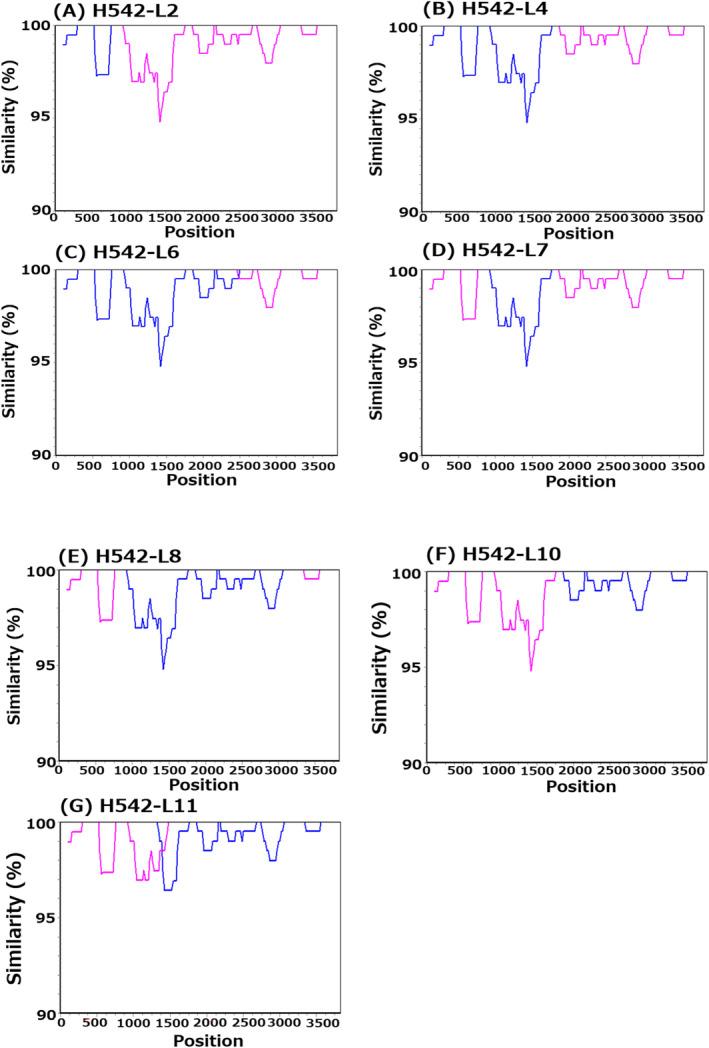
Among the five SARS-CoV-2-positive patients, the mutation-specific assay identified the Delta variant in three, the Omicron variant in one, and an undetermined in one. The undermined patient was identified as Delta using whole-genome sequencing, but samples showed a mixed population of Delta and Omicron variants. This patient was analyzed for viral quasispecies by long-read and Sanger sequencing using a full-length spike gene amplicon. In addition to the Delta and Omicron sequences, the viral quasispecies analysis identified nine different genetic recombinant sequences with various breakpoints between Delta and Omicron sequences. The nine detected recombinant sequences in the spike gene showed over 99% identity with viruses that were detected during the Delta and Omicron cocirculation period from the United States and Europe.
CONCLUSIONS
This study demonstrates that patients coinfected with different SARS-CoV-2 variants can generate various viral recombinants and that various recombinant viruses may be produced during the cocirculation of different variants.
背景
在同一宿主细胞中感染两种病毒的病毒重组会发生基因物质交换,由此产生具有不同毒力的新病毒。在此,我们检测到一名同时感染严重急性呼吸综合征冠状病毒 2(SARS-CoV-2)Delta 和奥密克戎变异株的患者,并通过长读长和 Sanger 测序鉴定了 SARS-CoV-2 全长刺突基因中的各种重组体。
方法
采用分子检测方法对日本 5 名家庭传播的 2019 年冠状病毒病(COVID-19)患者的样本进行了检测和 SARS-CoV-2 鉴定。采用短读长测序的多重 PCR 进行全基因组测序。
结果
在 5 名 SARS-CoV-2 阳性患者中,3 名患者的突变特异性检测鉴定为 Delta 变异株,1 名患者的检测鉴定为奥密克戎变异株,1 名患者的检测鉴定为未确定变异株。全基因组测序确定该未确定变异株患者为 Delta 变异株,但样本显示 Delta 和奥密克戎变异株的混合种群。对全长刺突基因扩增子使用长读长和 Sanger 测序对该患者的病毒准种进行了分析。除了 Delta 和奥密克戎序列外,病毒准种分析还鉴定了 9 种不同遗传重组序列,它们在 Delta 和奥密克戎序列之间具有不同的断点。在 spike 基因中检测到的 9 种重组序列与在美国和欧洲检测到的 Delta 和奥密克戎共同流行期间的病毒具有 99%以上的同一性。
结论
本研究表明,同时感染不同 SARS-CoV-2 变异株的患者可产生各种病毒重组体,并且在不同变异株共同流行期间可能会产生各种重组病毒。


 Zotero 插件