
骨关节炎中的纤维化途径和纤维母细胞样滑膜细胞表型。
Fibrotic pathways and fibroblast-like synoviocyte phenotypes in osteoarthritis.
机构信息
Department of Rheumatology and Clinical Immunology, Charité - Universitätsmedizin Berlin, corporate member of Freie Universität Berlin and Humboldt Universität zu Berlin, Berlin, Germany.
German Rheumatism Research Center Berlin, a Leibniz Institute, Glucocorticoids - Bioenergetics - 3R Research Lab, Berlin, Germany.
出版信息
Front Immunol. 2024 Jun 4;15:1385006. doi: 10.3389/fimmu.2024.1385006. eCollection 2024.
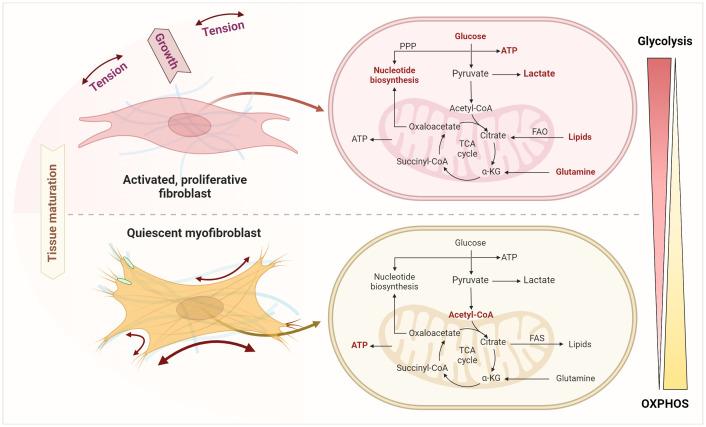
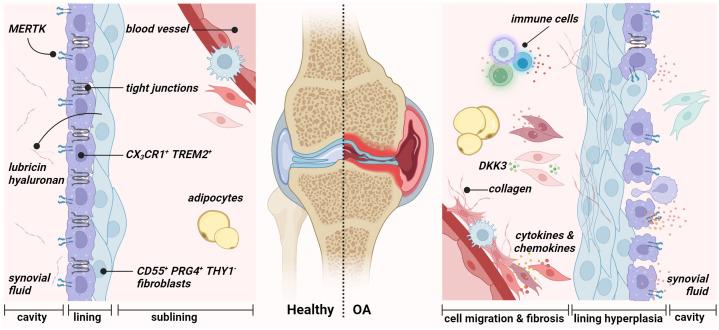
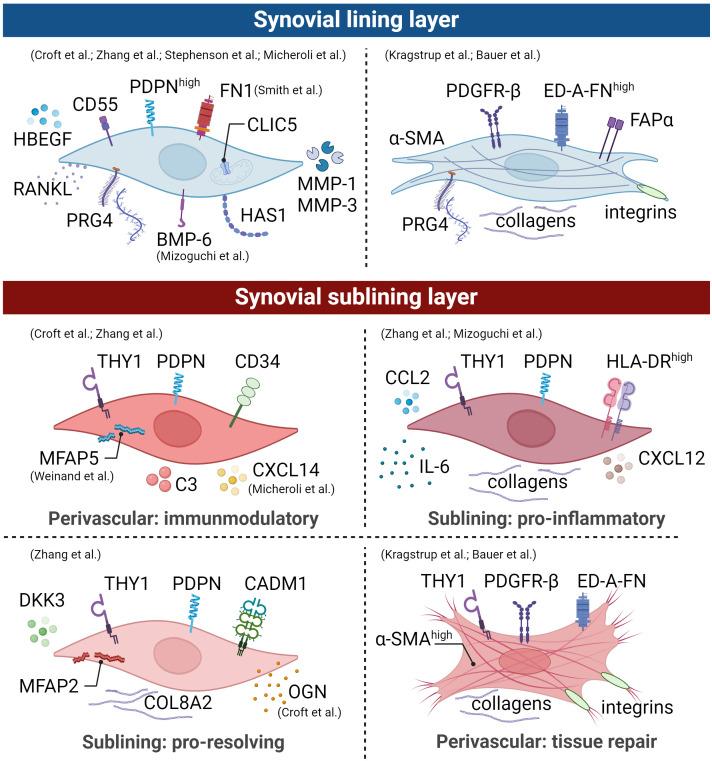
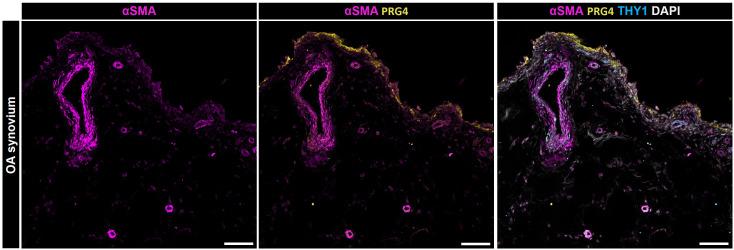
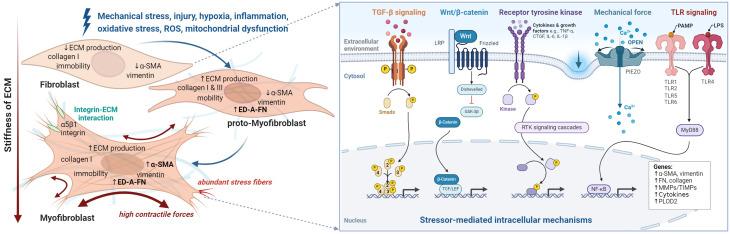
Osteoarthritis (OA) is the most common form of arthritis, characterized by osteophyte formation, cartilage degradation, and structural and cellular alterations of the synovial membrane. Activated fibroblast-like synoviocytes (FLS) of the synovial membrane have been identified as key drivers, secreting humoral mediators that maintain inflammatory processes, proteases that cause cartilage and bone destruction, and factors that drive fibrotic processes. In normal tissue repair, fibrotic processes are terminated after the damage has been repaired. In fibrosis, tissue remodeling and wound healing are exaggerated and prolonged. Various stressors, including aging, joint instability, and inflammation, lead to structural damage of the joint and micro lesions within the synovial tissue. One result is the reduced production of synovial fluid (lubricants), which reduces the lubricity of the cartilage areas, leading to cartilage damage. In the synovial tissue, a wound-healing cascade is initiated by activating macrophages, Th2 cells, and FLS. The latter can be divided into two major populations. The destructive thymocyte differentiation antigen (THY)1 phenotype is restricted to the synovial lining layer. In contrast, the THY1 phenotype of the sublining layer is classified as an invasive one with immune effector function driving synovitis. The exact mechanisms involved in the transition of fibroblasts into a myofibroblast-like phenotype that drives fibrosis remain unclear. The review provides an overview of the phenotypes and spatial distribution of FLS in the synovial membrane of OA, describes the mechanisms of fibroblast into myofibroblast activation, and the metabolic alterations of myofibroblast-like cells.
骨关节炎(OA)是最常见的关节炎形式,其特征为骨赘形成、软骨降解以及滑膜的结构和细胞改变。已鉴定出滑膜中的活化成纤维细胞样滑膜细胞(FLS)是关键驱动因素,其分泌的体液介质维持炎症过程、破坏软骨和骨的蛋白酶以及驱动纤维化过程的因子。在正常组织修复中,纤维化过程在损伤修复后终止。在纤维化中,组织重塑和伤口愈合被夸大并延长。各种应激源,包括衰老、关节不稳定和炎症,导致关节结构损伤和滑膜组织内的微损伤。结果之一是滑膜液(润滑剂)的产生减少,这降低了软骨区域的润滑性,导致软骨损伤。在滑膜组织中,通过激活巨噬细胞、Th2 细胞和 FLS 启动伤口愈合级联反应。后者可分为两个主要群体。破坏性胸腺细胞分化抗原(THY)1 表型仅限于滑膜衬里层。相比之下,衬里下层的 THY1 表型被归类为具有免疫效应功能驱动滑膜炎的侵袭性表型。纤维化驱动的成纤维细胞向肌成纤维细胞样表型转化的确切机制尚不清楚。综述提供了 OA 滑膜中 FLS 的表型和空间分布的概述,描述了成纤维细胞向肌成纤维细胞激活的机制以及肌成纤维细胞样细胞的代谢改变。



 Zotero 插件