
“找我”和“吃我”信号:用于调节抗肿瘤免疫的吞噬过程的工具。
"Find Me" and "Eat Me" signals: tools to drive phagocytic processes for modulating antitumor immunity.
机构信息
State Key Laboratory of Pharmaceutical Biotechnology, National Institute of Healthcare Data Science at Nanjing University, Jiangsu Key Laboratory of Molecular Medicine, Medical School, Nanjing University, Nanjing, Jiangsu, P. R. China.
Jinan Microecological Biomedicine Shandong Laboratory, Jinan, Shandong, P. R. China.
出版信息
Cancer Commun (Lond). 2024 Jul;44(7):791-832. doi: 10.1002/cac2.12579. Epub 2024 Jun 23.
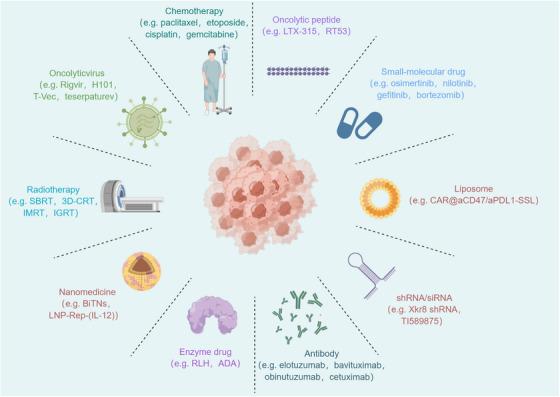
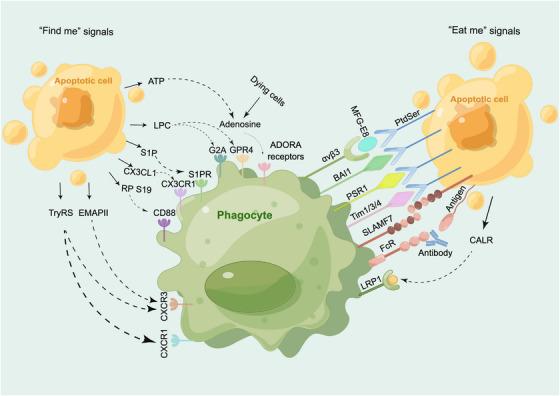
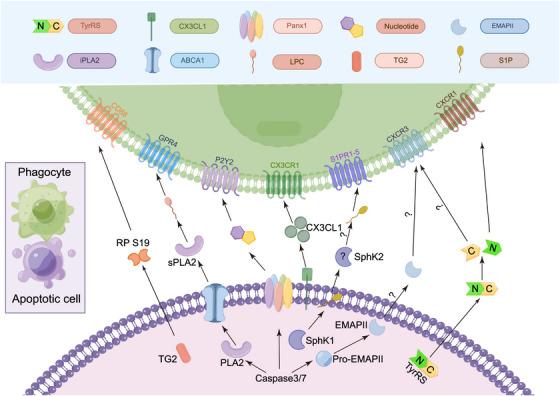
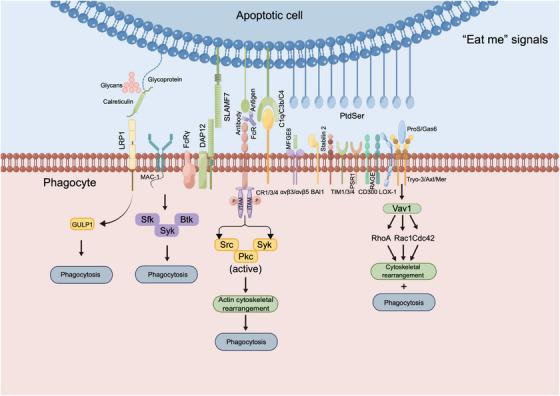
Phagocytosis, a vital defense mechanism, involves the recognition and elimination of foreign substances by cells. Phagocytes, such as neutrophils and macrophages, rapidly respond to invaders; macrophages are especially important in later stages of the immune response. They detect "find me" signals to locate apoptotic cells and migrate toward them. Apoptotic cells then send "eat me" signals that are recognized by phagocytes via specific receptors. "Find me" and "eat me" signals can be strategically harnessed to modulate antitumor immunity in support of cancer therapy. These signals, such as calreticulin and phosphatidylserine, mediate potent pro-phagocytic effects, thereby promoting the engulfment of dying cells or their remnants by macrophages, neutrophils, and dendritic cells and inducing tumor cell death. This review summarizes the phagocytic "find me" and "eat me" signals, including their concepts, signaling mechanisms, involved ligands, and functions. Furthermore, we delineate the relationships between "find me" and "eat me" signaling molecules and tumors, especially the roles of these molecules in tumor initiation, progression, diagnosis, and patient prognosis. The interplay of these signals with tumor biology is elucidated, and specific approaches to modulate "find me" and "eat me" signals and enhance antitumor immunity are explored. Additionally, novel therapeutic strategies that combine "find me" and "eat me" signals to better bridge innate and adaptive immunity in the treatment of cancer patients are discussed.
吞噬作用是一种重要的防御机制,涉及细胞识别和清除外来物质。吞噬细胞,如中性粒细胞和巨噬细胞,能够迅速对入侵者做出反应;而巨噬细胞在免疫反应的后期阶段尤为重要。它们通过特定的受体识别“找我”信号,以定位凋亡细胞并向其迁移。凋亡细胞随后会发出“吃我”信号,被吞噬细胞识别。可以通过策略性地利用“找我”和“吃我”信号来调节抗肿瘤免疫,以支持癌症治疗。这些信号,如钙网织蛋白和磷脂酰丝氨酸,介导强烈的促吞噬作用,从而促进巨噬细胞、中性粒细胞和树突状细胞吞噬死亡细胞或其残片,并诱导肿瘤细胞死亡。本文综述了吞噬作用的“找我”和“吃我”信号,包括它们的概念、信号机制、涉及的配体和功能。此外,我们还描述了“找我”和“吃我”信号分子与肿瘤之间的关系,特别是这些分子在肿瘤起始、进展、诊断和患者预后中的作用。阐述了这些信号与肿瘤生物学的相互作用,并探讨了调节“找我”和“吃我”信号以增强抗肿瘤免疫的特定方法。此外,还讨论了结合“找我”和“吃我”信号以更好地在癌症患者的治疗中桥接先天免疫和适应性免疫的新的治疗策略。
 Zotero 插件