
激动型抗 OX40 抗体的同种型对其作用机制在癌症中的影响:对治疗联合的启示。
Impact of isotype on the mechanism of action of agonist anti-OX40 antibodies in cancer: implications for therapeutic combinations.
机构信息
Antibody and Vaccine Group, Centre for Cancer Immunology, Faculty of Medicine, University of Southampton, Southampton, UK.
Immuno-Oncology and Combinations RU, GlaxoSmithKline, Collegeville, Pennsylvania, USA.
出版信息
J Immunother Cancer. 2024 Jul 4;12(7):e008677. doi: 10.1136/jitc-2023-008677.
BACKGROUND
OX40 has been widely studied as a target for immunotherapy with agonist antibodies taken forward into clinical trials for cancer where they are yet to show substantial efficacy. Here, we investigated potential mechanisms of action of anti-mouse (m) OX40 and anti-human (h) OX40 antibodies, including a clinically relevant monoclonal antibody (mAb) (GSK3174998) and evaluated how isotype can alter those mechanisms with the aim to develop improved antibodies for use in rational combination treatments for cancer.
METHODS
Anti-mOX40 and anti-hOX40 mAbs were evaluated in a number of in vivo models, including an OT-I adoptive transfer immunization model in hOX40 knock-in (KI) mice and syngeneic tumor models. The impact of FcγR engagement was evaluated in hOX40 KI mice deficient for Fc gamma receptors (FcγR). Additionally, combination studies using anti-mouse programmed cell death protein-1 (mPD-1) were assessed. In vitro experiments using peripheral blood mononuclear cells (PBMCs) examining possible anti-hOX40 mAb mechanisms of action were also performed.
RESULTS
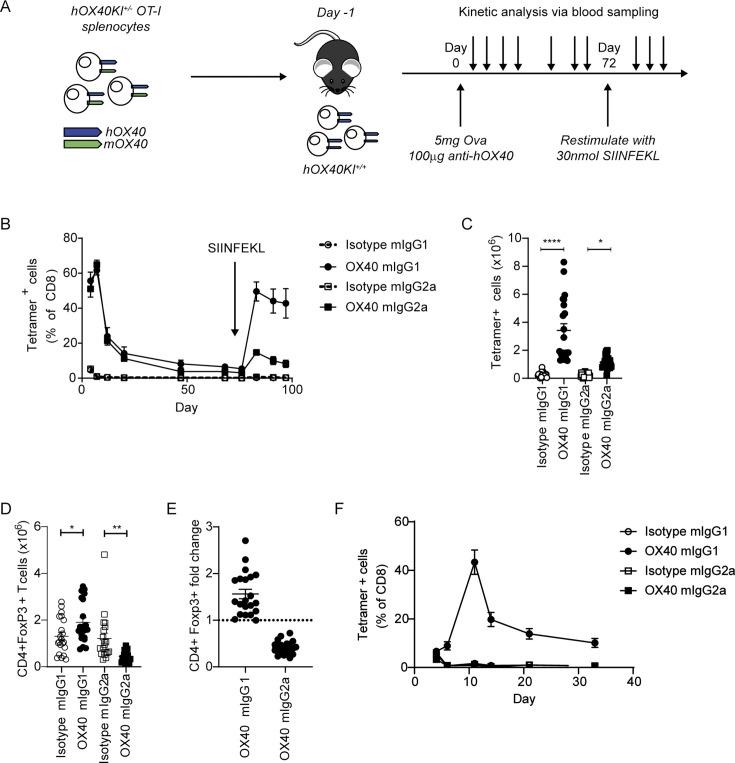
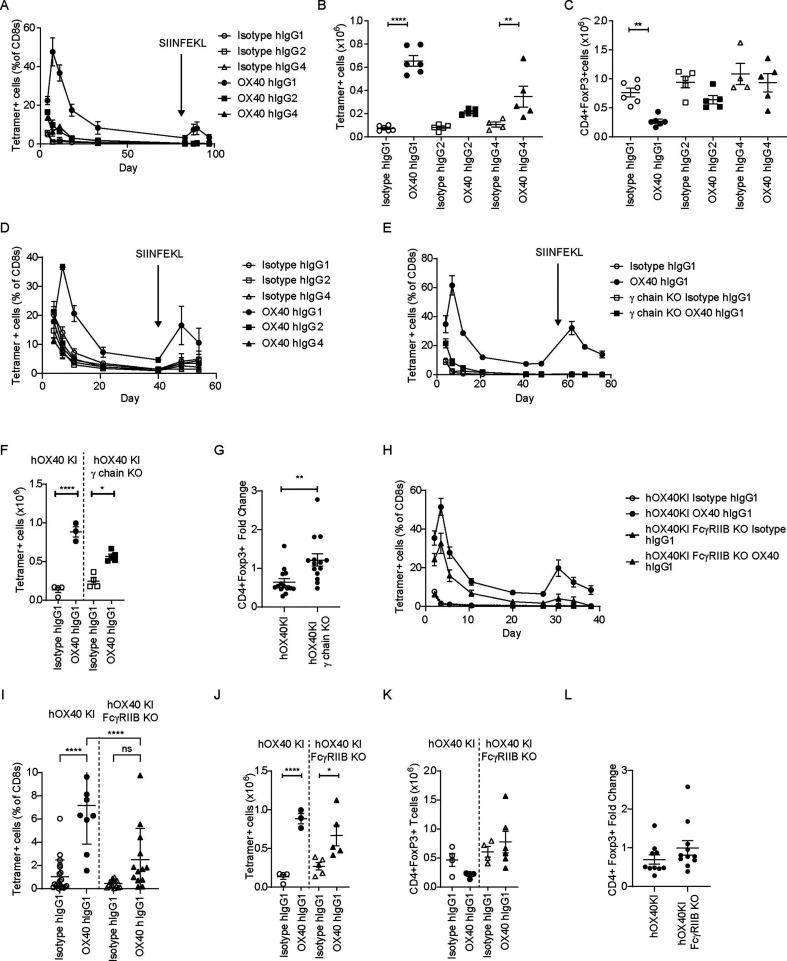
Isotype variants of the clinically relevant mAb GSK3174998 showed immunomodulatory effects that differed in mechanism; mIgG1 mediated direct T-cell agonism while mIgG2a acted indirectly, likely through depletion of regulatory T cells (Tregs) via activating FcγRs. In both the OT-I and EG.7-OVA models, hIgG1 was the most effective human isotype, capable of acting both directly and through Treg depletion. The anti-hOX40 hIgG1 synergized with anti-mPD-1 to improve therapeutic outcomes in the EG.7-OVA model. Finally, in vitro assays with human peripheral blood mononuclear cells (hPBMCs), anti-hOX40 hIgG1 also showed the potential for T-cell stimulation and Treg depletion.
CONCLUSIONS
These findings underline the importance of understanding the role of isotype in the mechanism of action of therapeutic mAbs. As an hIgG1, the anti-hOX40 mAb can elicit multiple mechanisms of action that could aid or hinder therapeutic outcomes, dependent on the microenvironment. This should be considered when designing potential combinatorial partners and their FcγR requirements to achieve maximal benefit and improvement of patient outcomes.
背景
OX40 已被广泛研究作为免疫疗法的靶点,激动型抗体已进入癌症的临床试验,但尚未显示出实质性疗效。在这里,我们研究了抗鼠(m)OX40 和抗人(h)OX40 抗体的潜在作用机制,包括一种临床相关的单克隆抗体(mAb)(GSK3174998),并评估了同种型如何改变这些机制,目的是开发用于癌症合理联合治疗的改进抗体。
方法
在多种体内模型中评估了抗 mOX40 和抗 hOX40 mAb,包括在 hOX40 敲入(KI)小鼠和同源肿瘤模型中的 OT-I 过继转移免疫模型。在缺乏 FcγR 的 hOX40 KI 小鼠中评估了 FcγR 结合的影响。此外,还评估了使用抗鼠程序性细胞死亡蛋白-1(mPD-1)的联合研究。还使用外周血单核细胞(PBMC)进行了体外实验,以研究可能的抗 hOX40 mAb 作用机制。
结果
临床相关 mAb GSK3174998 的同种型变体显示出不同机制的免疫调节作用;mIgG1 介导直接 T 细胞激动,而 mIgG2a 则通过激活 FcγR 间接作用,可能通过耗尽调节性 T 细胞(Tregs)。在 OT-I 和 EG.7-OVA 模型中,hIgG1 是最有效的人同种型,既能直接作用,又能通过 Treg 耗竭作用。抗 hOX40 hIgG1 与抗 mPD-1 协同作用,改善 EG.7-OVA 模型的治疗效果。最后,在体外检测人类外周血单核细胞(hPBMCs)时,抗 hOX40 hIgG1 也显示出刺激 T 细胞和耗尽 Treg 的潜力。
结论
这些发现强调了了解治疗性 mAb 作用机制中同种型作用的重要性。作为 hIgG1,抗 hOX40 mAb 可以引发多种作用机制,这些机制可能有助于或阻碍治疗效果,这取决于微环境。在设计潜在的组合伙伴及其 FcγR 要求时,应考虑到这一点,以实现最大的益处并改善患者的治疗效果。



 Zotero 插件