
肿瘤来源的细胞外囊泡与中性粒细胞共同调控肿瘤动态 CD73/PD-L1 通路的免疫调节之舞。
The immunomodulatory ballet of tumour-derived extracellular vesicles and neutrophils orchestrating the dynamic CD73/PD-L1 pathway in cancer.
机构信息
Department of Oral and Maxillofacial Surgery, University Hospital Regensburg, Regensburg, Germany.
Department of Oral and Maxillofacial Surgery, Experimental Oral and Maxillofacial Surgery, Center for Medical Biotechnology, University Hospital Regensburg, Regensburg, Germany.
出版信息
J Extracell Vesicles. 2024 Jul;13(7):e12480. doi: 10.1002/jev2.12480.
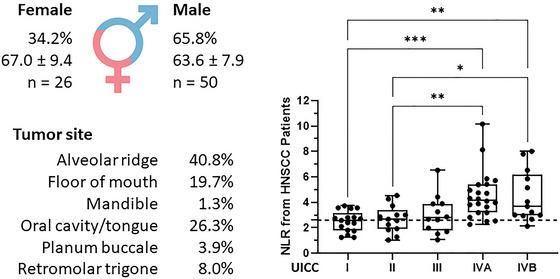
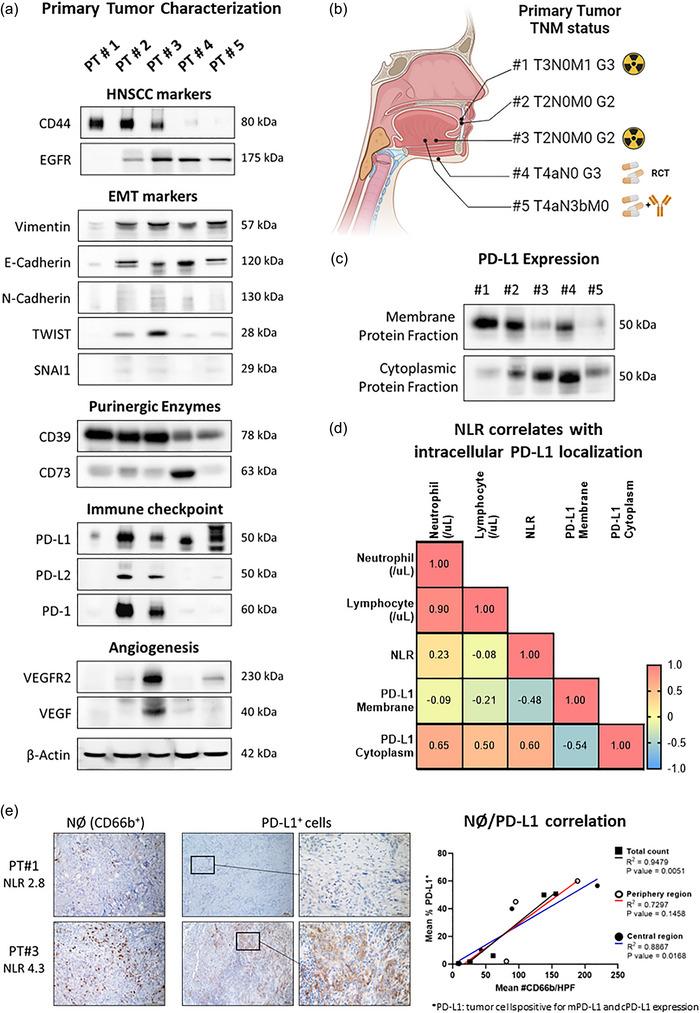
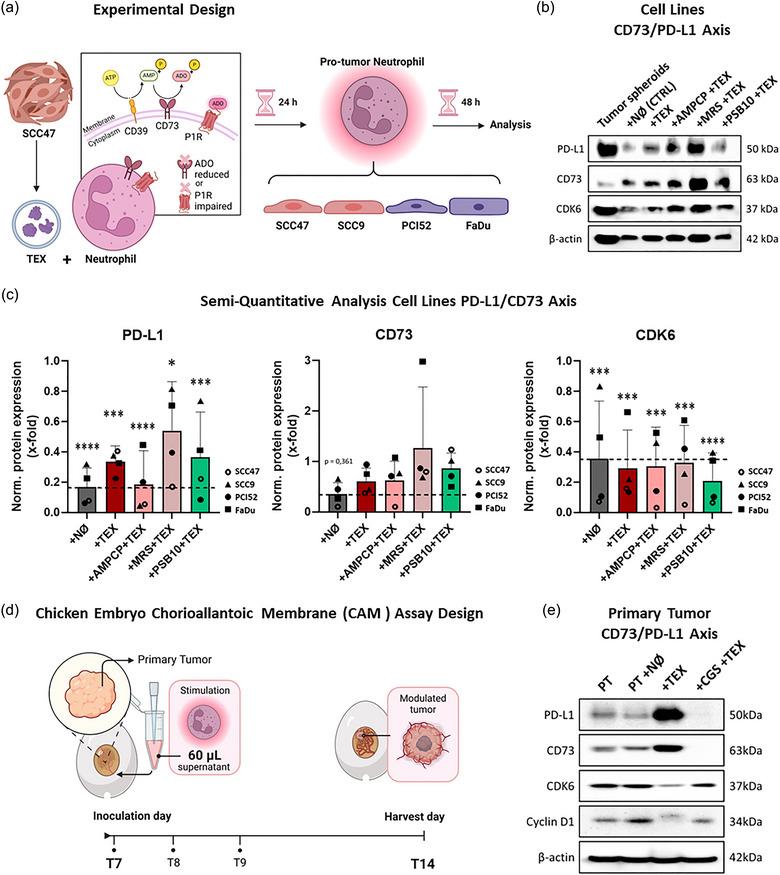
Head and neck squamous cell carcinoma (HNSCC) is a global cancer burden with a 5-year overall survival rate of around 50%, stagnant for decades. A tumour-induced immunosuppressive microenvironment contributes to HNSCC progression, with the adenosine (ADO) pathway and an upregulated expression of inhibitory immune checkpoint regulators playing a key role in this context. The correlation between high neutrophil-to-lymphocyte ratio (NLR) with advanced tumour staging suggests involvement of neutrophils (NØ) in cancer progression. Interestingly, we associated a high NLR with an increased intracellular PD-L1 localization in primary HNSCC samples, potentially mediating more aggressive tumour characteristics and therefore synergistically favouring tumour progression. Still, further research is needed to harness this knowledge for effective treatments and overcome resistance. Since it is hypothesized that the tumour microenvironment (TME) may be influenced by small extracellular vesicles (sEVs) secreted by tumours (TEX), this study aims to investigate the impact of HNSCC-derived TEX on NØ and blockade of ADO receptors as a potential strategy to reverse the pro-tumour phenotype of NØ. UMSCC47-TEX exhibited CD73 enzymatic activity involved in ADO signalling, as well as the immune checkpoint inhibitor PD-L1. Data revealed that TEX induce chemotaxis of NØ and the sustained interaction promotes a shift into a pro-tumour phenotype, dependent on ADO receptors (P1R), increasing CD170 subpopulation, CD73 and PD-L1 expression, followed by an immunosuppressive secretome. Blocking A3R reduced CD73 and PD-L1 expression. Co-culture experiments with HNSCC cells demonstrated that TEX-modulated NØ increase the CD73/PD-L1 axis, through Cyclin D-CDK4/6 signalling. To support these findings, the CAM model with primary tumour was treated with NØ supernatant. Moreover, these NØ promoted an increase in migration, invasion, and reduced cell death. Targeting P1R on NØ, particularly A3R, exhibited potential therapeutic strategy to counteract immunosuppression in HNSCC. Understanding the TEX-mediated crosstalk between tumours and NØ offers insights into immunomodulation for improving cancer therapies.
头颈部鳞状细胞癌(HNSCC)是一种全球癌症负担,其 5 年总生存率约为 50%,几十年来一直停滞不前。肿瘤诱导的免疫抑制微环境促进 HNSCC 的进展,其中腺苷(ADO)途径和上调的抑制性免疫检查点调节剂表达在这方面发挥关键作用。高中性粒细胞与淋巴细胞比值(NLR)与晚期肿瘤分期之间的相关性表明中性粒细胞(NØ)参与了癌症的进展。有趣的是,我们发现原发性 HNSCC 样本中 NLR 升高与细胞内 PD-L1 定位增加相关,这可能介导了更具侵袭性的肿瘤特征,因此协同促进了肿瘤的进展。尽管如此,仍需要进一步的研究来利用这方面的知识,制定有效的治疗方法并克服耐药性。由于假设肿瘤微环境(TME)可能受到肿瘤分泌的小细胞外囊泡(sEVs,也称为外泌体)的影响,因此本研究旨在探讨 HNSCC 衍生的 TEX 对 NØ 的影响,以及阻断 ADO 受体作为一种潜在的逆转 NØ 促肿瘤表型的策略。UMSCC47-TEX 表现出参与 ADO 信号的 CD73 酶活性,以及免疫检查点抑制剂 PD-L1。研究数据表明,TEX 诱导 NØ 的趋化作用,持续的相互作用促进了向促肿瘤表型的转变,这种转变依赖于 ADO 受体(P1R),增加 CD170 亚群、CD73 和 PD-L1 的表达,随后是免疫抑制的分泌组。阻断 A3R 可降低 CD73 和 PD-L1 的表达。与 HNSCC 细胞共培养实验表明,TEX 调节的 NØ 通过细胞周期蛋白 D-CDK4/6 信号增加 CD73/PD-L1 轴。为了支持这些发现,用原发性肿瘤的 CAM 模型进行了 NØ 上清液处理。此外,这些 NØ 促进了迁移、侵袭的增加和细胞死亡的减少。靶向 NØ 上的 P1R,特别是 A3R,可能是一种对抗 HNSCC 中免疫抑制的治疗策略。了解 TEX 介导的肿瘤与 NØ 之间的串扰为改善癌症治疗的免疫调节提供了思路。




 Zotero 插件