
孟德尔随机化分析显示,全身水分含量增加可能会增加细菌感染的风险。
Mendelian randomization analysis reveals higher whole body water mass may increase risk of bacterial infections.
机构信息
Department of Nephrology, The Second Affiliated Hospital, Jiangxi Medical College, Nanchang University, Nanchang, 330000, China.
出版信息
BMC Med Genomics. 2024 Jul 9;17(1):183. doi: 10.1186/s12920-024-01950-3.
BACKGROUND AND PURPOSE
The association of water loading with several infections remains unclear. Observational studies are hard to investigate definitively due to potential confounders. In this study, we employed Mendelian randomization (MR) analysis to assess the association between genetically predicted whole body water mass (BWM) and several infections.
METHODS
BWM levels were predicted among 331,315 Europeans in UK Biobank using 418 SNPs associated with BWM. For outcomes, we used genome-wide association data from the UK Biobank and FinnGen consortium, including sepsis, pneumonia, intestinal infections, urinary tract infections (UTIs) and skin and soft tissue infections (SSTIs). Inverse-variance weighted MR analyses as well as a series of sensitivity analyses were conducted.
RESULTS
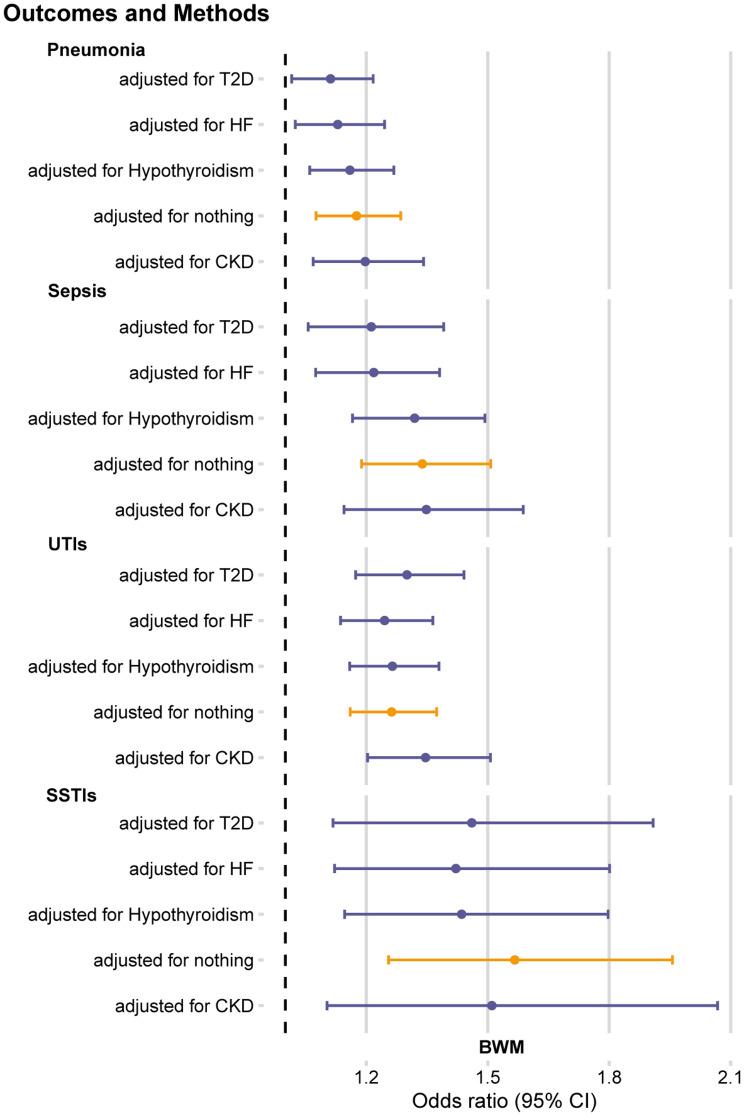
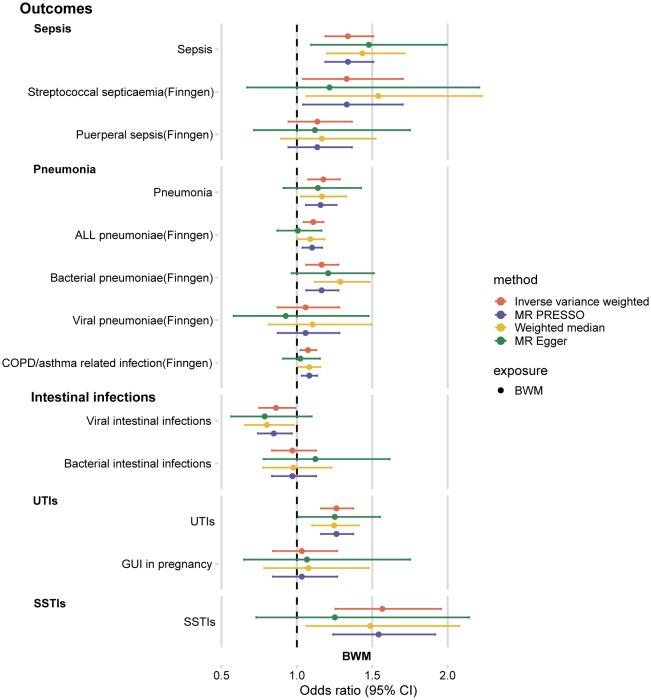
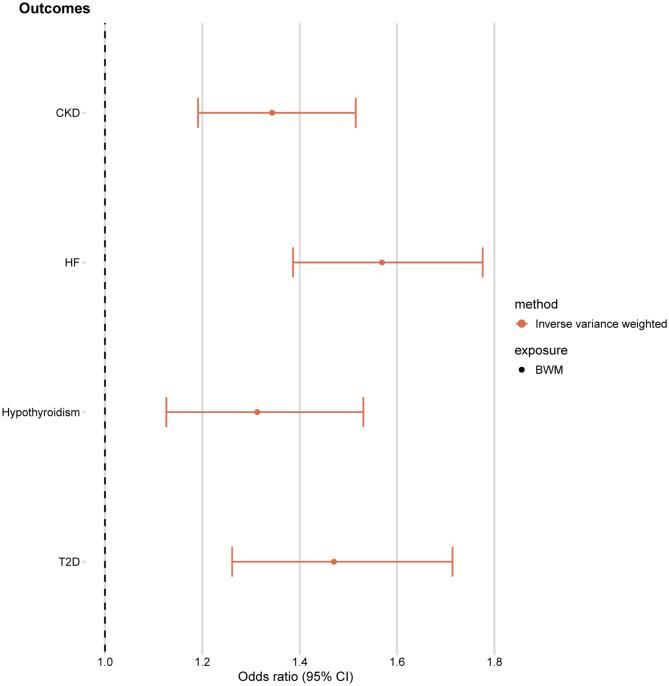
Genetic prediction of BWM is associated with an increased risk of sepsis (OR 1.34; 95% CI 1.19 to 1.51; P = 1.57 × 10), pneumonia (OR: 1.17; 95% CI 1.08 to 1.29; P = 3.53 × 10), UTIs (OR: 1.26; 95% CI 1.16 to 1.37; P = 6.29 × 10), and SSTIs (OR: 1.57; 95% CI 1.25 to 1.96; P = 7.35 × 10). In the sepsis and pneumonia subgroup analyses, the relationship between BWM and infection was observed in bacterial but not in viral infections. Suggestive evidence suggests that BWM has an effect on viral intestinal infections (OR: 0.86; 95% CI 0.75 to 0.99; P = 0.03). There is limited evidence of an association between BWM levels and bacteria intestinal infections, and genitourinary tract infection (GUI) in pregnancy. In addition, MR analyses supported the risk of BWM for several edematous diseases. However, multivariable MR analysis shows that the associations of BWM with sepsis, pneumonia, UTIs and SSTIs remains unaffected when accounting for these traits.
CONCLUSIONS
In this study, the causal relationship between BWM and infectious diseases was systematically investigated. Further prospective studies are necessary to validate these findings.
背景与目的
水负荷与多种感染之间的关联尚不清楚。由于潜在的混杂因素,观察性研究很难得出明确的结论。在这项研究中,我们采用孟德尔随机化(MR)分析来评估全身水质量(BWM)与多种感染之间的关联。
方法
在 UK Biobank 中的 331315 名欧洲人中,使用与 BWM 相关的 418 个 SNP 预测 BWM 水平。对于结局,我们使用了 UK Biobank 和 FinnGen 联盟的全基因组关联数据,包括败血症、肺炎、肠道感染、尿路感染(UTI)和皮肤软组织感染(SSTI)。进行了逆方差加权 MR 分析以及一系列敏感性分析。
结果
BWM 的遗传预测与败血症(OR 1.34;95%CI 1.19 至 1.51;P=1.57×10)、肺炎(OR:1.17;95%CI 1.08 至 1.29;P=3.53×10)、UTI(OR:1.26;95%CI 1.16 至 1.37;P=6.29×10)和 SSTI(OR:1.57;95%CI 1.25 至 1.96;P=7.35×10)的风险增加相关。在败血症和肺炎亚组分析中,BWM 与感染之间的关系仅在细菌感染中观察到,而在病毒感染中未观察到。有提示性证据表明,BWM 对病毒性肠道感染有影响(OR:0.86;95%CI 0.75 至 0.99;P=0.03)。BWM 水平与细菌肠道感染和妊娠期尿路感染(GUI)之间的关联证据有限。此外,MR 分析支持 BWM 与几种水肿性疾病的风险相关。然而,多变量 MR 分析表明,在考虑这些特征时,BWM 与败血症、肺炎、UTI 和 SSTI 的关联不受影响。
结论
在这项研究中,系统地研究了 BWM 与传染病之间的因果关系。需要进一步的前瞻性研究来验证这些发现。
 Zotero 插件