
局部麻醉混合剂用于前锯肌平面和胸肌前间隙阻滞在植入式乳房重建中的效果
The effect of a local anesthetic cocktail in a serratus anterior plane and PECS 1 block for implant-based breast reconstruction.
作者信息
Lombana Nicholas F, Beard Courtney, Mehta Ishan M, Falola Reuben A, Park Peter, Altman Andrew M, Saint-Cyr Michel H
机构信息
Division of Plastic Surgery, Department of General Surgery Texas A&M Medical School - Baylor Scott & White Memorial Hospital Temple, TX, United States of America.
Texas A&M College of Medicine, Temple, TX, United States of America.
出版信息
JPRAS Open. 2024 May 23;41:116-127. doi: 10.1016/j.jpra.2024.04.008. eCollection 2024 Sep.
INTRODUCTION
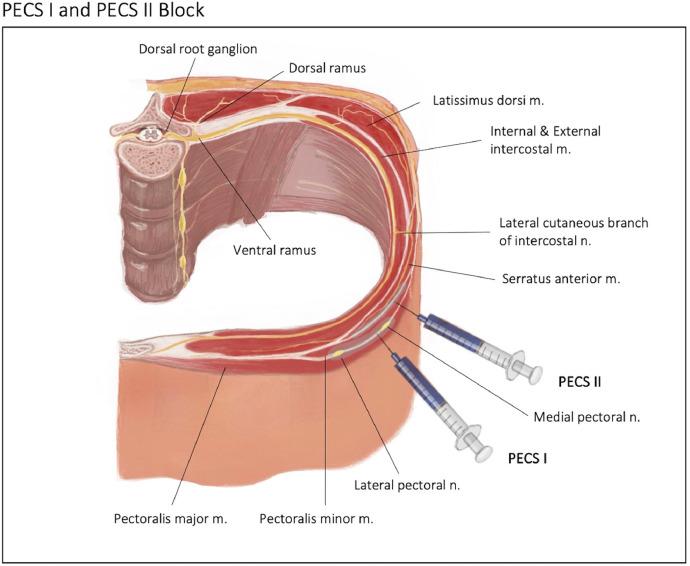
Enhanced recovery after surgery (ERAS) protocols have been implemented to decrease opioid use and decrease patient hospital length of stay (LOS, days). Serratus anterior plane (SAP) blocks anesthetize the T2 through T9 dermatomes of the breast and can be applied intraoperatively. The purpose of this study was to compare postoperative opioid (OME) consumption and LOS between a control group, an ERAS group, and an ERAS/local anesthetic cocktail group in patients who underwent implant-based breast reconstruction.
METHODS
In this study, 142 women who underwent implant-based breast reconstruction between 2004 and 2020 were divided into Group A (46 patients), a historical cohort; Group B (73 patients), an ERAS/no-block control group; and Group C (23 patients), an ERAS/anesthetic cocktail study group. Primary outcomes of interest were postanesthesia care unit (PACU), inpatient and total hospital OME consumption, and PACU LOS.
RESULTS
A significant decrease was observed from Group A to C in PACU LOS (103.3 vs. 80.2 vs. 70.5; = 0.011), OME use (25.1 vs. 11.4 vs. 5.7; < 0.0001), and total hospital OME (120.3 vs. 95.2 vs. 35.9; < 0.05). No difference was observed in inpatient OMEs between the three groups (95.2 vs. 83.8 vs. 30.8; = 0.212). Despite not reaching statistical significance, Group C consumed an average of 50-60 % less opioids per patient than did Group B in PACU, inpatient, and total hospital OMEs.
CONCLUSION
Local anesthetic blocks are important components of ERAS protocols. Our results demonstrate that a combination regional block with a local anesthetic cocktail in an ERAS protocol can decrease opioid consumption in implant-based breast reconstruction.
引言
已实施术后加速康复(ERAS)方案以减少阿片类药物的使用并缩短患者住院时间(LOS,天数)。前锯肌平面(SAP)阻滞可麻醉乳房的T2至T9皮节,且可在术中应用。本研究的目的是比较接受植入式乳房重建患者的对照组、ERAS组和ERAS/局部麻醉混合剂组之间的术后阿片类药物(OME)消耗量和住院时间。
方法
在本研究中,将2004年至2020年间接受植入式乳房重建的142名女性分为A组(46例患者),为历史队列;B组(73例患者),为ERAS/无阻滞对照组;C组(23例患者),为ERAS/麻醉混合剂研究组。感兴趣的主要结局为麻醉后恢复室(PACU)、住院期间和住院总时长的OME消耗量以及PACU住院时间。
结果
从A组到C组,观察到PACU住院时间(103.3对80.2对70.5;P = 0.011)、OME使用量(25.1对11.4对5.7;P < 0.0001)和住院总OME量(120.3对95.2对35.9;P < 0.05)均显著下降。三组之间的住院期间OME量无差异(95.2对83.8对30.8;P = 0.212)。尽管未达到统计学显著性,但在PACU、住院期间和住院总OME量方面,C组每位患者的阿片类药物消耗量平均比B组少50-60%。
结论
局部麻醉阻滞是ERAS方案的重要组成部分。我们的结果表明,在ERAS方案中联合区域阻滞与局部麻醉混合剂可减少植入式乳房重建中的阿片类药物消耗。


 Zotero 插件