
骨髓增殖性肿瘤患者急性冠状动脉综合征的预测
Prediction of acute coronary syndrome in patients with myeloproliferative neoplasms.
作者信息
Huang Jingfeng, Zhang Ping, Shen Fangjie, Zheng Xiaodong, Ding Qianjiang, Pan Yuning, Ruan Xinzhong
机构信息
Department of Radiology, The First Affiliated Hospital of Ningbo University, Ningbo, China.
Department of Hematology, The First Affiliated Hospital of Ningbo University, Ningbo, China.
出版信息
Front Cardiovasc Med. 2024 Jun 25;11:1369701. doi: 10.3389/fcvm.2024.1369701. eCollection 2024.
BACKGROUND
Patients with myeloproliferative neoplasms (MPN) are exposed to a higher risk of cardiovascular disease, especially cardiovascular calcification. The present research aimed to analyze the clinical features and coronary artery calcium score (CACS) in MPN patients, and construct an effective model to predict acute coronary syndrome (ACS) in MPN patients.
MATERIALS AND METHODS
A total of 175 MPN patients and 175 controls were recruited from the First Affiliated Hospital of Ningbo University. Based on cardiovascular events, the MPN patients were divided into the ACS group and the non-ACS group. Multivariate Cox analysis was completed to explore ACS-related factors. Furthermore, ROC curves were plotted to assess the predictive effect of CACS combined with white blood cells (WBC) and platelet for ACS in MPN patients.
RESULTS
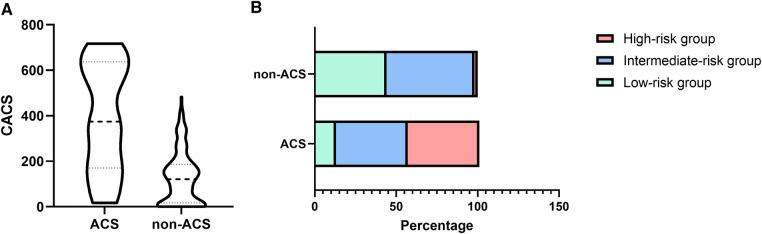
The MPN group exhibited a higher CACS than the control group (133 vs. 55, < 0.001). A total of 16 patients developed ACS in 175 MPN patients. Compared with non-ACS groups, significant differences in age, diabetes, smoking history, WBC, percentage of neutrophil, percentage of lymphocyte, neutrophil count, hemoglobin, hematocrit, platelet, lactate dehydrogenase, -microglobulin, and JAK2V617F mutation were observed in the ACS groups. In addition, the CACS in the ACS group was also significantly higher than that in the non-ACS group (374.5 vs. 121, < 0.001). The multivariable Cox regression analysis identified WBC, platelet, and CACS as independent risk factors for ACS in MPN patients. Finally, ROC curves indicated that WBC, platelet, and CACS have a high predictive value for ACS in MPN patients (AUC = 0.890).
CONCLUSION
CACS combined with WBC and platelet might be a promising model for predicting ACS occurrence in MPN patients.
背景
骨髓增殖性肿瘤(MPN)患者面临更高的心血管疾病风险,尤其是心血管钙化。本研究旨在分析MPN患者的临床特征和冠状动脉钙化评分(CACS),并构建一个有效的模型来预测MPN患者的急性冠状动脉综合征(ACS)。
材料与方法
从宁波大学附属第一医院招募了175例MPN患者和175例对照。根据心血管事件,将MPN患者分为ACS组和非ACS组。完成多变量Cox分析以探索与ACS相关的因素。此外,绘制ROC曲线以评估CACS联合白细胞(WBC)和血小板对MPN患者ACS的预测效果。
结果
MPN组的CACS高于对照组(133对55,<0.001)。175例MPN患者中有16例发生ACS。与非ACS组相比,ACS组在年龄、糖尿病、吸烟史、WBC、中性粒细胞百分比、淋巴细胞百分比、中性粒细胞计数、血红蛋白、血细胞比容、血小板、乳酸脱氢酶、β-微球蛋白和JAK2V617F突变方面存在显著差异。此外,ACS组的CACS也显著高于非ACS组(374.5对121,<0.001)。多变量Cox回归分析确定WBC、血小板和CACS是MPN患者ACS的独立危险因素。最后,ROC曲线表明WBC、血小板和CACS对MPN患者的ACS具有较高的预测价值(AUC = 0.890)。
结论
CACS联合WBC和血小板可能是预测MPN患者ACS发生的有前景的模型。


 Zotero 插件