
利用新西兰奥特亚罗瓦的病例和废水数据联合估计新冠疫情的流行病学动态。
Jointly estimating epidemiological dynamics of Covid-19 from case and wastewater data in Aotearoa New Zealand.
作者信息
Watson Leighton M, Plank Michael J, Armstrong Bridget A, Chapman Joanne R, Hewitt Joanne, Morris Helen, Orsi Alvaro, Bunce Michael, Donnelly Christl A, Steyn Nicholas
机构信息
School of Mathematics and Statistics, University of Canterbury, Christchurch, New Zealand.
Institute of Environmental Science and Research Ltd, Porirua, New Zealand.
出版信息
Commun Med (Lond). 2024 Jul 15;4(1):143. doi: 10.1038/s43856-024-00570-3.
BACKGROUND
Timely and informed public health responses to infectious diseases such as COVID-19 necessitate reliable information about infection dynamics. The case ascertainment rate (CAR), the proportion of infections that are reported as cases, is typically much less than one and varies with testing practices and behaviours, making reported cases unreliable as the sole source of data. The concentration of viral RNA in wastewater samples provides an alternate measure of infection prevalence that is not affected by clinical testing, healthcare-seeking behaviour or access to care.
METHODS
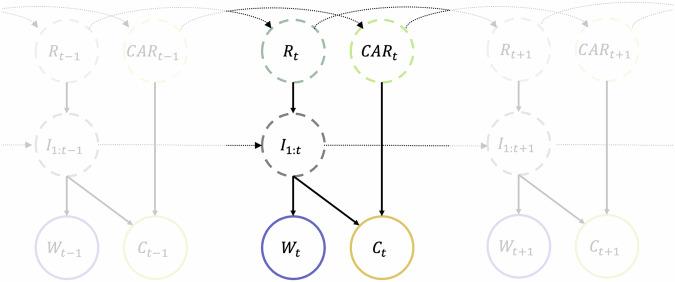
We construct a state-space model with observed data of levels of SARS-CoV-2 in wastewater and reported case incidence and estimate the hidden states of the effective reproduction number, R, and CAR using sequential Monte Carlo methods.
RESULTS
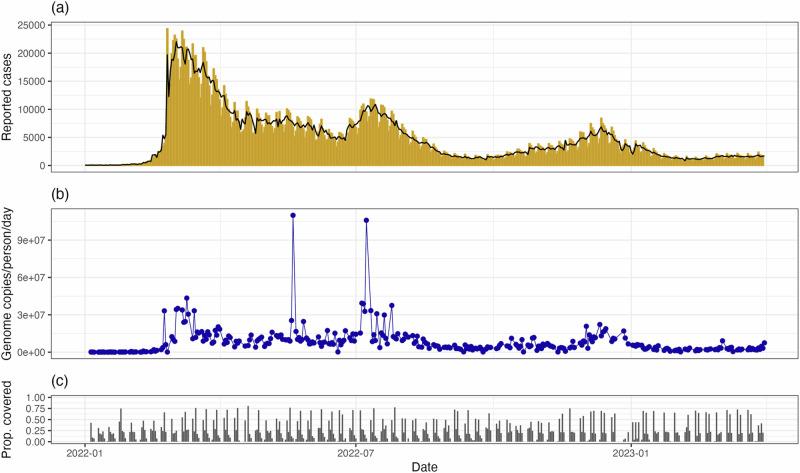
We analyse data from 1 January 2022 to 31 March 2023 from Aotearoa New Zealand. Our model estimates that R peaks at 2.76 (95% CrI 2.20, 3.83) around 18 February 2022 and the CAR peaks around 12 March 2022. We calculate that New Zealand's second Omicron wave in July 2022 is similar in size to the first, despite fewer reported cases. We estimate that the CAR in the BA.5 Omicron wave in July 2022 is approximately 50% lower than in the BA.1/BA.2 Omicron wave in March 2022.
CONCLUSIONS
Estimating R, CAR, and cumulative number of infections provides useful information for planning public health responses and understanding the state of immunity in the population. This model is a useful disease surveillance tool, improving situational awareness of infectious disease dynamics in real-time.
背景
要及时且明智地对 COVID - 19 等传染病做出公共卫生应对措施,就需要有关感染动态的可靠信息。病例确诊率(CAR),即报告为病例的感染比例,通常远低于 1,并且会因检测方法和行为而有所不同,这使得报告的病例作为唯一数据来源并不可靠。废水样本中病毒 RNA 的浓度提供了一种不受临床检测、就医行为或医疗服务可及性影响的感染流行率替代测量方法。
方法
我们构建了一个状态空间模型,利用废水样本中 SARS-CoV-2 水平的观测数据以及报告的病例发病率,并使用序贯蒙特卡罗方法估计有效繁殖数 R 和病例确诊率的隐藏状态。
结果
我们分析了来自新西兰奥塔哥从 2022 年 1 月 1 日至 2023 年 3 月 31 日的数据。我们的模型估计,R 在 2022 年 2 月 18 日左右达到峰值 2.76(95% 可信区间 2.20,3.83),病例确诊率在 2022 年 3 月 12 日左右达到峰值。我们计算得出,尽管报告的病例较少,但新西兰在 2022 年 7 月的第二次奥密克戎浪潮规模与第一次相似。我们估计,2022 年 7 月 BA.5 奥密克戎浪潮中的病例确诊率比 2022 年 3 月的 BA.1/BA.2 奥密克戎浪潮低约 50%。
结论
估计 R、病例确诊率和累计感染数为规划公共卫生应对措施和了解人群免疫状态提供了有用信息。该模型是一种有用的疾病监测工具,可提高对传染病动态的实时态势感知。


 Zotero 插件