
基于模拟从时间聚合且报告不完整的疾病发病率时间序列数据推断随时间变化的繁殖数。
Simulation-based inference of the time-dependent reproduction number from temporally aggregated and under-reported disease incidence time series data.
作者信息
Ogi-Gittins Isaac, Steyn Nicholas, Polonsky Jonathan, Hart William S, Keita Mory, Ahuka-Mundeke Steve, Hill Edward M, Thompson Robin N
机构信息
Mathematics Institute, University of Warwick, Coventry, UK.
Zeeman Institute for Systems Biology and Infectious Disease Epidemiology Research (SBIDER), University of Warwick, Coventry, UK.
出版信息
Philos Trans A Math Phys Eng Sci. 2025 Apr 2;383(2293):20240412. doi: 10.1098/rsta.2024.0412.
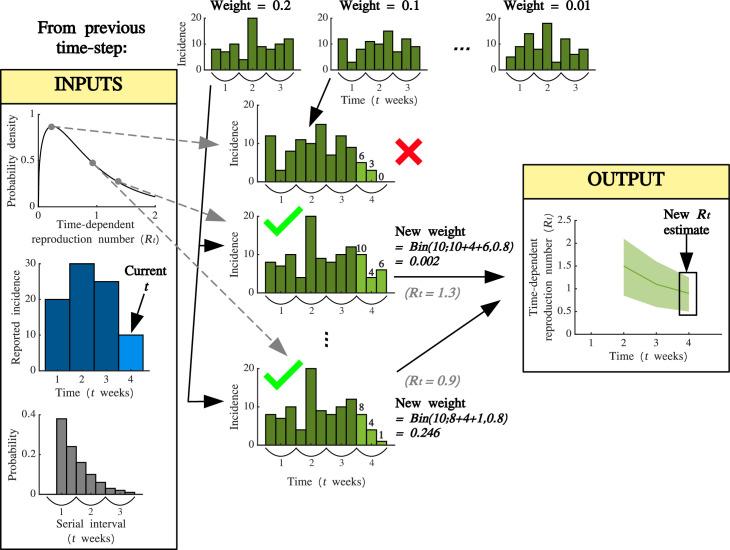
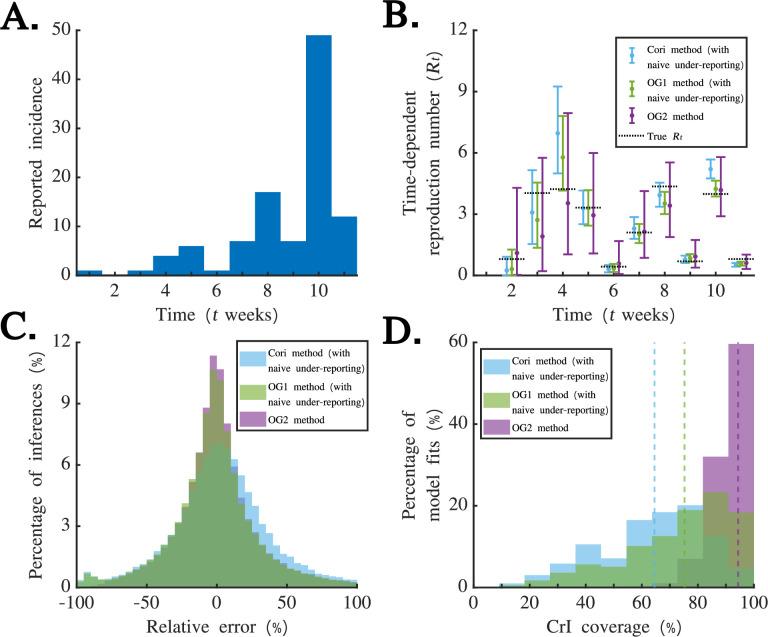
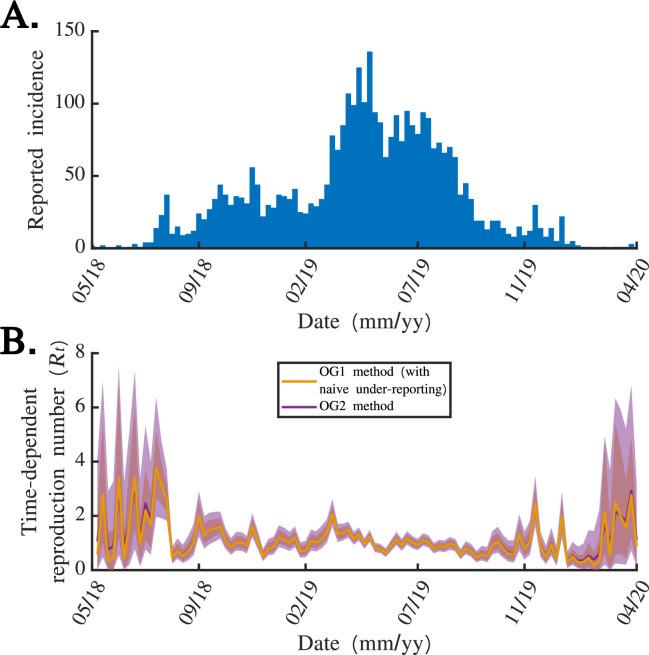
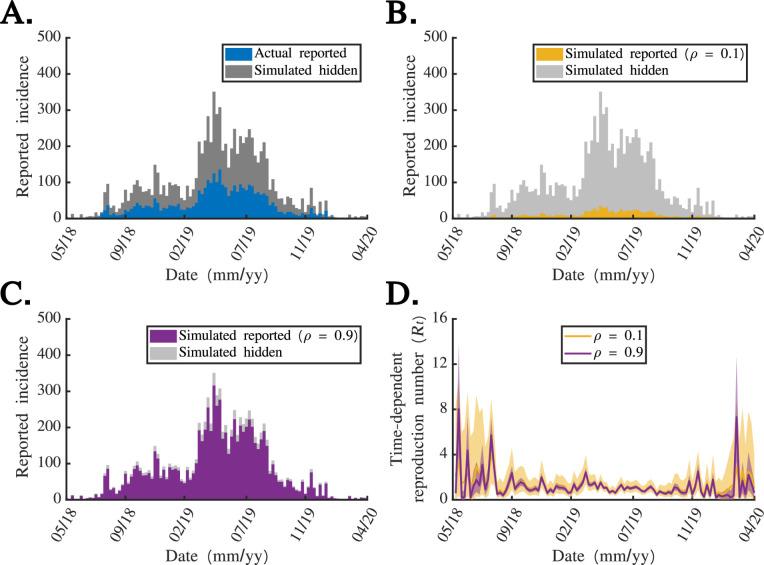
During infectious disease outbreaks, the time-dependent reproduction number ([Formula: see text]) can be estimated to monitor pathogen transmission. In previous work, we developed a simulation-based method for estimating [Formula: see text] from temporally aggregated disease incidence data (e.g. weekly case reports). While that approach is straightforward to use, it assumes implicitly that all cases are reported and the computation can be slow when applied to large datasets. In this article, we extend our previous approach and develop a computationally efficient simulation-based method for estimating [Formula: see text] in real-time accounting for both temporal aggregation of incidence data and under-reporting (with a fixed reporting probability per case). Using simulated data, we show that failing to consider stochastic under-reporting can lead to inappropriately precise estimates, including scenarios in which the true [Formula: see text] value lies outside inferred credible intervals more often than expected. We then apply our approach to data from the 2018 to 2020 Ebola outbreak in the Democratic Republic of the Congo (DRC), again exploring the effects of case under-reporting. Finally, we show how our method can be extended to account for temporal variations in reporting. Given information about the level of case reporting, our framework can be used to estimate [Formula: see text] during future outbreaks with under-reported and temporally aggregated case data.This article is part of the theme issue 'Uncertainty quantification for healthcare and biological systems (Part 2)'.
在传染病暴发期间,可以估计随时间变化的繁殖数([公式:见原文])以监测病原体传播。在之前的工作中,我们开发了一种基于模拟的方法,用于从按时间汇总的疾病发病率数据(例如每周病例报告)中估计[公式:见原文]。虽然该方法使用起来很直接,但它隐含地假设所有病例都已报告,并且应用于大型数据集时计算可能会很慢。在本文中,我们扩展了之前的方法,开发了一种计算效率高的基于模拟的方法,用于实时估计[公式:见原文],同时考虑发病率数据的时间汇总和漏报情况(每个病例有固定的报告概率)。使用模拟数据,我们表明,不考虑随机漏报会导致估计结果过于精确,包括在某些情况下,真实的[公式:见原文]值比预期更频繁地落在推断的可信区间之外。然后,我们将我们的方法应用于刚果民主共和国2018年至2020年埃博拉疫情的数据,再次探讨病例漏报的影响。最后,我们展示了如何扩展我们的方法以考虑报告中的时间变化。给定病例报告水平的信息,我们的框架可用于在未来暴发期间利用漏报且按时间汇总的病例数据估计[公式:见原文]。本文是主题为“医疗保健和生物系统的不确定性量化(第2部分)”的一部分。


 Zotero 插件