
北美五大湖城市化地区休闲捕获的淡水鱼体内的微塑料和人为颗粒
Microplastics and Anthropogenic Particles in Recreationally Caught Freshwater Fish from an Urbanized Region of the North American Great Lakes.
作者信息
Milne Madeleine H, Helm Paul A, Munno Keenan, Bhavsar Satyendra P, Rochman Chelsea M
机构信息
Department of Ecology and Evolutionary Biology, University of Toronto, Toronto, Ontario, Canada.
Environmental Monitoring and Reporting Branch, Ontario Ministry of the Environment, Conservation and Parks, Toronto, Ontario, Canada.
出版信息
Environ Health Perspect. 2024 Jul;132(7):77004. doi: 10.1289/EHP13540. Epub 2024 Jul 17.
BACKGROUND
Microplastics are a pervasive contaminant cycling through food webs-leading to concerns regarding exposure and risk to humans.
OBJECTIVES
We aimed to quantify and characterize anthropogenic particle contamination (including microplastics) in fish caught for human consumption from the Humber Bay region of Lake Ontario. We related quantities of anthropogenic particles to other factors (e.g., fish size) that may help in understanding accumulation of microplastics in fish.
METHODS
A total of 45 samples of six fish species collected from Humber Bay in Lake Ontario near Toronto, Ontario, Canada, were examined for anthropogenic particles in their gastrointestinal (GI) tracts and fillets. Using microscopy and spectroscopy, suspected anthropogenic particles were identified and characterized.
RESULTS
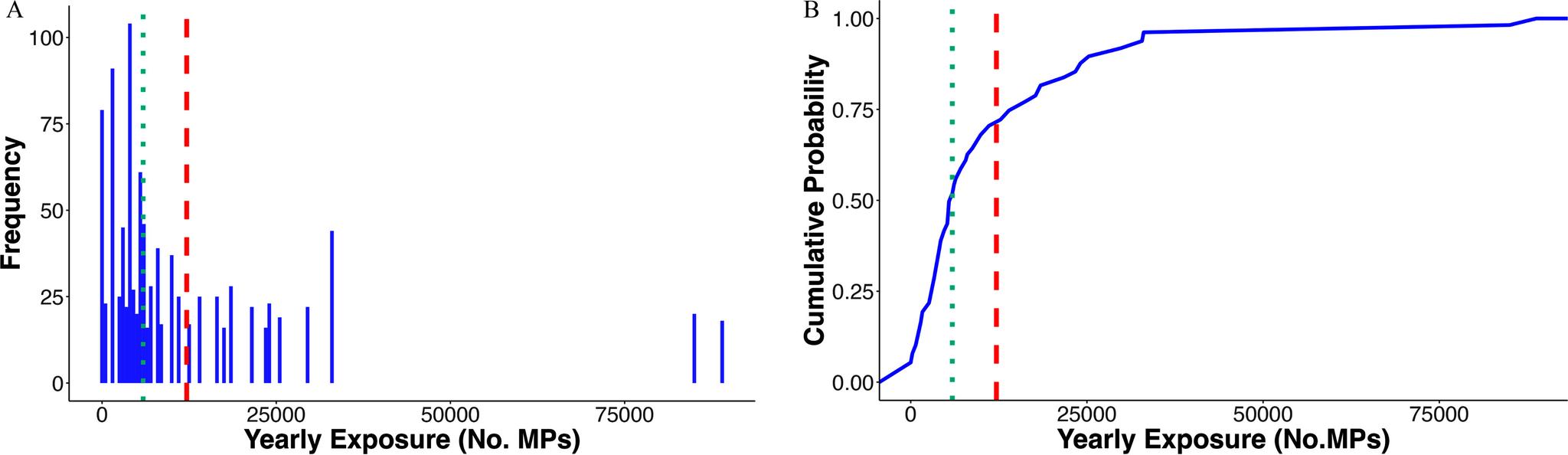
We observed anthropogenic particles in the GI tracts and fillets of all species. Individual fish had a of anthropogenic particles, with a single fish containing up to 1,508 particles. GI tracts had particles/fish ( particles/gram), and fillets had particles/fish ( particles/gram). Based on a consumption rate of 2 servings/week, the average yearly human exposure through the consumption of these fish fillets would be particles.
DISCUSSION
Our findings suggest that consumption of recreationally caught freshwater fish can be a pathway for human exposure to microplastics. The elevated number of particles observed in fish from Humber Bay highlights the need for large-scale geographic monitoring, especially near sources of microplastics. Currently, it is unclear what the effects of ingesting microplastics are for humans, but given that recreationally caught freshwater fish are one pathway for human exposure, these data can be incorporated into future human health risk assessment frameworks for microplastics. https://doi.org/10.1289/EHP13540.
背景
微塑料是一种普遍存在的污染物,在食物网中循环,引发了人们对其对人类暴露和风险的担忧。
目的
我们旨在量化和描述从安大略湖亨伯湾地区捕获的供人类食用的鱼类中的人为颗粒污染(包括微塑料)。我们将人为颗粒的数量与其他可能有助于理解微塑料在鱼类中积累的因素(如鱼的大小)相关联。
方法
从加拿大安大略省多伦多附近的安大略湖亨伯湾采集了45个六种鱼类的样本,检查其胃肠道和鱼片内的人为颗粒。使用显微镜和光谱学对疑似人为颗粒进行识别和表征。
结果
我们在所有物种的胃肠道和鱼片中都观察到了人为颗粒。每条鱼的人为颗粒数量中位数为 ,单条鱼含有的颗粒数最多可达1508个。胃肠道中每条鱼有 个颗粒( 个/克),鱼片中每条鱼有 个颗粒( 个/克)。按照每周食用两份的消费率,通过食用这些鱼片,人类每年的平均暴露量将为 个颗粒。
讨论
我们的研究结果表明,食用休闲捕捞的淡水鱼可能是人类接触微塑料的一条途径。在亨伯湾鱼类中观察到的颗粒数量增加凸显了进行大规模地理监测的必要性,尤其是在微塑料来源附近。目前尚不清楚摄入微塑料对人类有何影响,但鉴于休闲捕捞的淡水鱼是人类接触的一条途径,这些数据可纳入未来微塑料对人类健康风险评估框架。https://doi.org/10.1289/EHP13540 。


 Zotero 插件