
生物年龄加速与遗传风险和子宫内膜癌发病的关联:英国生物银行的前瞻性分析
Associations of biological age accelerations and genetic risk with incident endometrial cancer: a prospective analysis in UK Biobank.
作者信息
Yang Ziye, Shen Yufei, Zhang Tongtong, Tang Xiaolin, Mao Rui
机构信息
Department of Dermatology, Xiangya Hospital, Central South University.
National Clinical Research Center for Geriatric Disorders, Xiangya Hospital, Central South University.
出版信息
Int J Surg. 2025 Jan 1;111(1):512-519. doi: 10.1097/JS9.0000000000001966.
BACKGROUND
Endometrial cancer (EC) is one of the gynecologic malignancy cancer with increasing incidence and mortality rates, partly due to aging populations and genetic risks. This study explores the associations between biological age accelerations (BAA) and risk of incident EC and assesses the joint effect of genetic factors and BAA.
MATERIALS AND METHODS
Based on the UK Biobank cohort, 132 315 women participants were included for primary analysis and 124 119 white participants for genetic risk analysis. Biological age (BA) was calculated using the Klemera-Doubal (KDM) and PhenoAge method based on clinical biomarkers. The authors calculated two metrics for BAA (including KDM residual and PhenoAge residual) using residual analysis, comparing them against chronological age. The risk of incident EC was evaluated using multivariable Cox proportional-hazards models, adjusting for relevant covariates. Polygenic risk scores (PRS) were computed from known EC-associated SNPs.
RESULTS
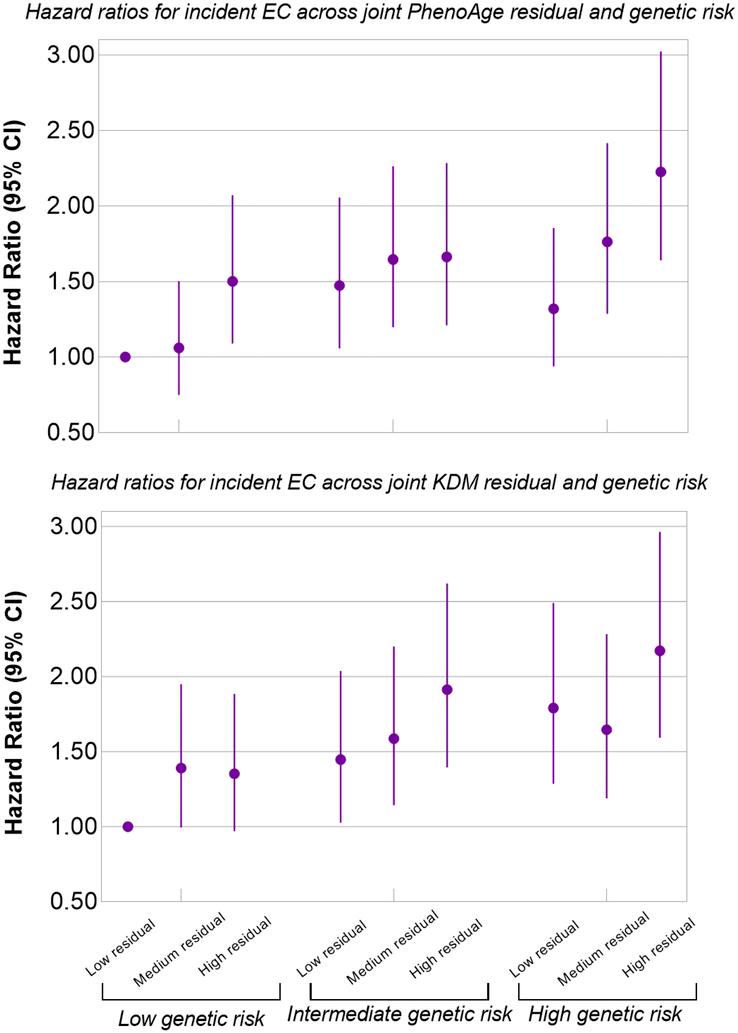
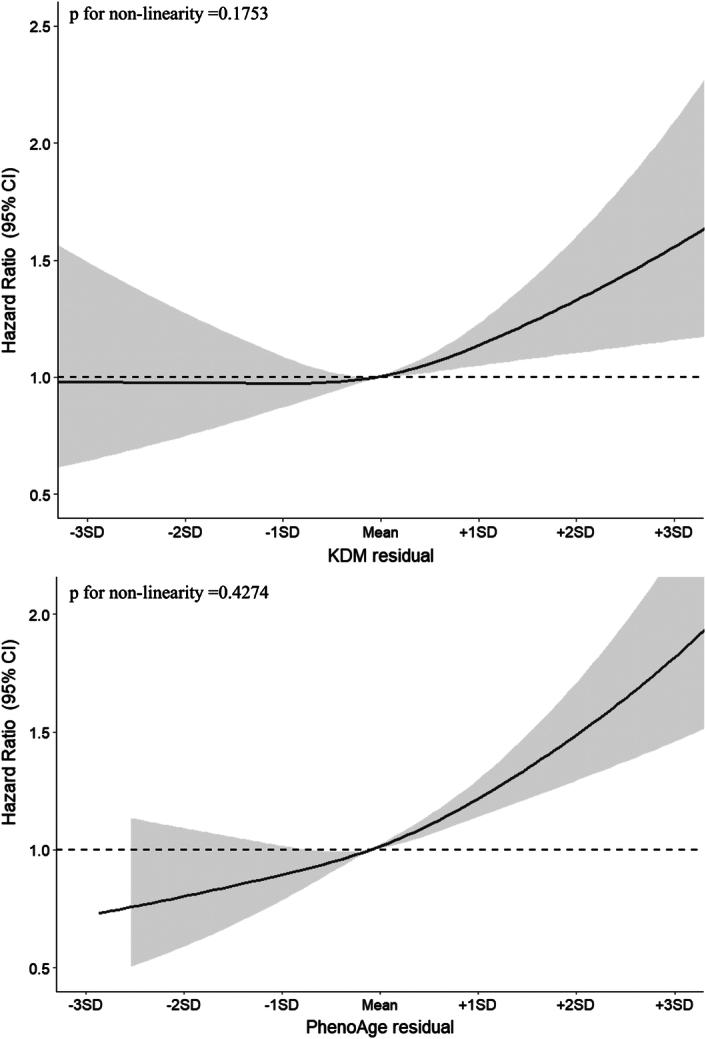
Both KDM and PhenoAge residual, were significantly associated with increased EC risk. In fully adjusted models, the highest tertile of KDM and PhenoAge residual was significantly associated with incident EC compared with the lowest group, with HRs of 1.278 ( P =0.0044) and 1.424 ( P <0.0001), repectively. The population-attributable fractions were 7.84% for KDM residual ( P =0.0044), 9.78% for PhenoAge residual ( P =0.0005), and 8.47% for genetic risk ( P =0.0005). Additionally, joint associations of BAA and genetic risk with incident EC was evaluated. Compared with low genetic risk and low BAA, high genetic risk and high BAA was significantly associated with the incidence of EC with HRs of up to 2.172 (95% CI: 1.592-2.963) for KDM and 2.226 (95% CI: 1.640-3.022) for PhenoAge. Overall, higher levels of PhenoAge residual were consistently associated with an increased risk of incident EC, regardless of genetic risk.
CONCLUSION
BAA and genetics both enhance the risk of incident EC. The effect of the PhenoAge residual is greater than that of the investigated genes, which in turn is greater than that of the KDM residual. These findings highlight the importance of considering both BAA and genetic factors in EC prevention.
背景
子宫内膜癌(EC)是一种妇科恶性肿瘤,其发病率和死亡率不断上升,部分原因是人口老龄化和遗传风险。本研究探讨生物学年龄加速(BAA)与EC发病风险之间的关联,并评估遗传因素和BAA的联合作用。
材料与方法
基于英国生物银行队列,纳入132315名女性参与者进行初步分析,124119名白人参与者进行遗传风险分析。基于临床生物标志物,使用克莱梅拉-杜巴尔(KDM)和表型年龄方法计算生物学年龄(BA)。作者使用残差分析计算了BAA的两个指标(包括KDM残差和表型年龄残差),并将它们与实际年龄进行比较。使用多变量Cox比例风险模型评估EC发病风险,并对相关协变量进行调整。从已知的与EC相关的单核苷酸多态性(SNP)计算多基因风险评分(PRS)。
结果
KDM和表型年龄残差均与EC风险增加显著相关。在完全调整模型中,与最低组相比,KDM和表型年龄残差最高三分位数与EC发病显著相关,HR分别为1.278(P = 0.0044)和1.424(P < 0.0001)。KDM残差的人群归因分数为7.84%(P = 0.0044),表型年龄残差为9.78%(P = 0.0005),遗传风险为8.47%(P = 0.0005)。此外,评估了BAA和遗传风险与EC发病的联合关联。与低遗传风险和低BAA相比,高遗传风险和高BAA与EC发病率显著相关,KDM的HR高达2.172(95%CI:1.592 - 2.963),表型年龄的HR为2.226(95%CI:1.640 - 3.022)。总体而言,无论遗传风险如何,较高水平的表型年龄残差始终与EC发病风险增加相关。
结论
BAA和遗传学均增加EC发病风险。表型年龄残差的影响大于所研究基因的影响,而所研究基因的影响又大于KDM残差的影响。这些发现突出了在EC预防中同时考虑BAA和遗传因素的重要性。
 Zotero 插件