
质子泵抑制剂在经皮冠状动脉介入治疗后的应用与心血管不良结局相关:系统评价和荟萃分析。
Adverse cardiovascular outcomes associated with proton pump inhibitor use after percutaneous coronary intervention: a systematic review and meta-analysis.
机构信息
Department of Community Medicine and School of Public Health, Postgraduate Institute of Medical Education and Research, Chandigarh, 160012, India.
Division of Evidence Synthesis, Global Consortium of Public Health and Research, Datta Meghe Institute of Higher Education, Wardha, India.
出版信息
BMC Cardiovasc Disord. 2024 Jul 17;24(1):372. doi: 10.1186/s12872-024-04029-0.
BACKGROUND
Proton pump inhibitors (PPIs) are commonly prescribed for gastroprotection in patients undergoing percutaneous coronary intervention (PCI), who are at increased risk of gastrointestinal bleeding due to antiplatelet therapy. However, emerging evidence suggests that PPIs may adversely impact cardiovascular outcomes. This systematic review and meta-analysis sought to assess the relationship between using PPIs and cardiovascular outcomes in patients following PCI.
METHODS
We searched various databases up to March 15, 2024, for observational studies and randomized controlled trials (RCTs) assessing the cardiovascular effects of PPIs in PCI patients. Data were extracted on study characteristics, patient demographics, PPI use, and cardiovascular outcomes. The Newcastle-Ottawa Scale and Cochrane Risk of Bias Tool 2 assessed study quality. Meta-analyses were conducted using a random-effects model using R software version 4.3.
RESULTS
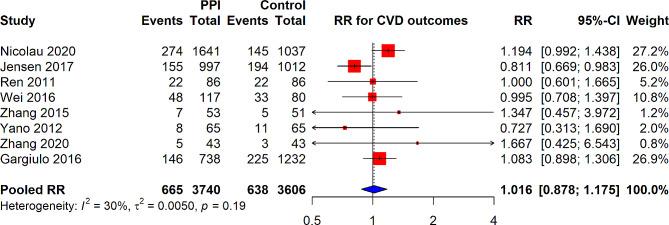
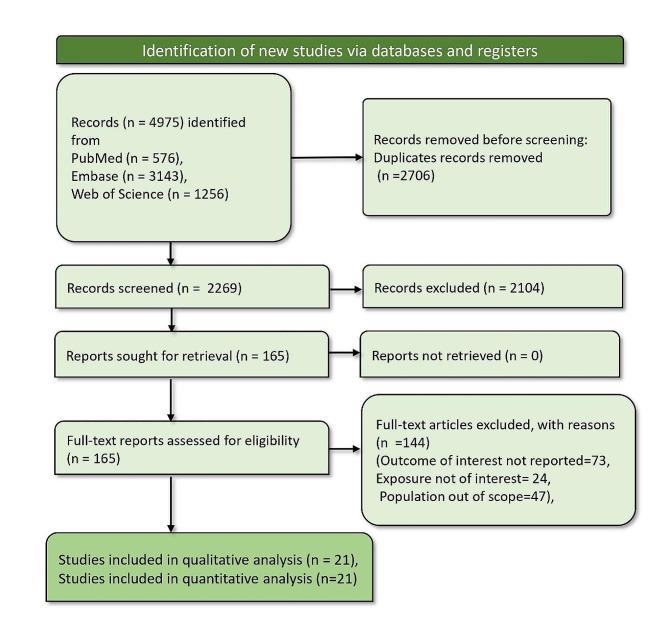
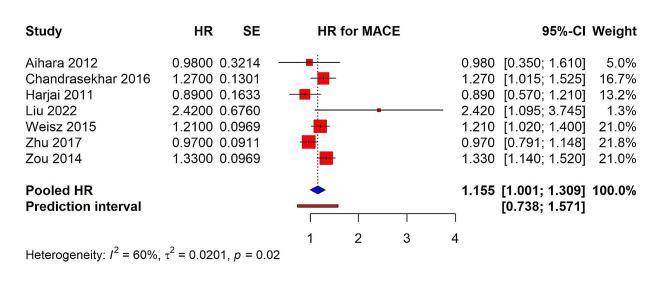
A total of 21 studies involving diverse populations and study designs were included. Observational studies suggested a moderate increase in risk for composite cardiovascular diseases (CVD), myocardial infarction (MI), and major adverse cardiac events (MACE) associated with PPI use, with pooled hazard ratios (HRs) of 1.20 (95% CI: 1.093-1.308) for CVD, 1.186 (95% CI: 1.069-1.303) for MI, and 1.155 (95% CI: 1.001-1.309) for MACE. However, RCTs showed no significant link between PPI therapy and negative cardiovascular events (Relative Risk: 1.016, 95% CI: 0.878-1.175). Substantial heterogeneity was observed among observational studies but not RCTs.
CONCLUSION
The findings indicate that while observational studies suggest a potential risk of adverse cardiovascular events with post-PCI use of PPI, RCTs do not support this association. Further large-scale, high-quality studies are required to understand the cardiovascular implications of individual PPIs better and optimize patient management post-PCI. This analysis shows the complexity of PPI use in patients with coronary artery diseases and the necessity to balance gastroprotective benefits against potential cardiovascular risks.
背景
质子泵抑制剂(PPIs)常用于经皮冠状动脉介入治疗(PCI)患者的胃保护,由于抗血小板治疗,这些患者胃肠道出血的风险增加。然而,新出现的证据表明,PPIs 可能对心血管结局产生不利影响。本系统评价和荟萃分析旨在评估 PCI 后使用 PPI 与心血管结局之间的关系。
方法
我们检索了截至 2024 年 3 月 15 日的各种数据库,以评估评估 PCI 患者中 PPI 心血管作用的观察性研究和随机对照试验(RCT)。我们提取了关于研究特征、患者人口统计学、PPI 使用和心血管结局的数据。使用纽卡斯尔-渥太华量表和 Cochrane 风险偏倚工具 2 评估研究质量。使用 R 软件版本 4.3 进行荟萃分析,使用随机效应模型。
结果
共有 21 项涉及不同人群和研究设计的研究被纳入。观察性研究表明,与 PPI 使用相关的复合心血管疾病(CVD)、心肌梗死(MI)和主要不良心脏事件(MACE)风险适度增加,使用 PPI 的汇总危险比(HR)分别为 1.20(95%CI:1.093-1.308)用于 CVD、1.186(95%CI:1.069-1.303)用于 MI 和 1.155(95%CI:1.001-1.309)用于 MACE。然而,RCT 显示 PPI 治疗与负面心血管事件之间没有显著关联(相对风险:1.016,95%CI:0.878-1.175)。观察性研究中观察到明显的异质性,但 RCT 中没有。
结论
研究结果表明,虽然观察性研究表明 PCI 后使用 PPI 可能存在不良心血管事件的风险,但 RCT 并不支持这种关联。需要进行更大规模、高质量的研究,以更好地了解个体 PPI 的心血管影响,并优化 PCI 后的患者管理。本分析显示了在患有冠状动脉疾病的患者中使用 PPI 的复杂性,以及需要平衡胃保护益处与潜在心血管风险。



 Zotero 插件