
基于 PBPK 的抗疟药物评估作为新冠候选药物:模拟作用部位浓度以提供药物再利用策略信息。
PBPK-led assessment of antimalarial drugs as candidates for Covid-19: Simulating concentrations at the site of action to inform repurposing strategies.
机构信息
MMV Medicines for Malaria Venture, Geneva, Switzerland.
Certara UK Ltd, Sheffield, UK.
出版信息
Clin Transl Sci. 2024 Jul;17(7):e13865. doi: 10.1111/cts.13865.
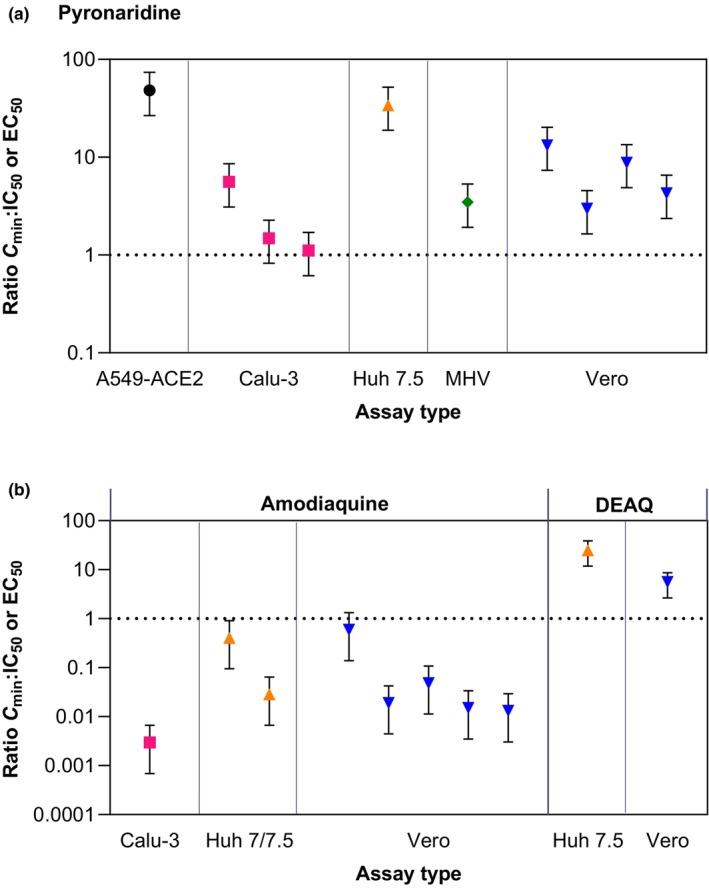
The urgent need for safe, efficacious, and accessible drug treatments to treat coronavirus disease 2019 (COVID-19) prompted a global effort to evaluate drug repurposing opportunities. Pyronaridine and amodiaquine are both components of approved antimalarials with in vitro activity against severe acute respiratory syndrome coronavirus 2 (SARS-CoV-2). In vitro activity does not always translate to clinical efficacy across a therapeutic dose range. This study applied available, verified, physiologically based pharmacokinetic (PBPK) models for pyronaridine, amodiaquine, and its active metabolite N-desethylamodiaquine (DEAQ) to predict drug concentrations in lung tissue relative to plasma or blood in the default healthy virtual population. Lung exposures were compared to published data across the reported range of in vitro EC values against SARS-CoV-2. In the multicompartment permeability-limited PBPK model, the predicted total C in lung mass for pyronaridine was 34.2 μM on Day 3, 30.5-fold greater than in blood (1.12 μM) and for amodiaquine was 0.530 μM, 8.83-fold greater than in plasma (0.060 μM). In the perfusion-limited PBPK model, the DEAQ predicted total C on Day 3 in lung mass (30.2 μM) was 21.4-fold greater than for plasma (1.41 μM). Based on the available in vitro data, predicted drug concentrations in lung tissue for pyronaridine and DEAQ, but not amodiaquine, appeared sufficient to inhibit SARS-CoV-2 replication. Simulations indicated standard dosing regimens of pyronaridine-artesunate and artesunate-amodiaquine have potential to treat COVID-19. These findings informed repurposing strategies to select the most relevant compounds for clinical investigation in COVID-19. Clinical data for model verification may become available from ongoing clinical studies.
治疗 2019 年冠状病毒病(COVID-19)的安全、有效且易于获得的药物治疗方法的迫切需求促使全球努力评估药物再利用的机会。派罗尼拉汀和阿莫地喹均为已批准的抗疟药物成分,具有体外抗严重急性呼吸综合征冠状病毒 2(SARS-CoV-2)的活性。体外活性并不总是能转化为治疗剂量范围内的临床疗效。本研究应用现有的、经过验证的、基于生理学的药代动力学(PBPK)模型来预测吡喹酮、阿莫地喹及其活性代谢物 N-去乙基阿莫地喹(DEAQ)在默认健康虚拟人群中的肺组织药物浓度相对于血浆或血液。肺暴露与报告的体外 EC 值对 SARS-CoV-2的范围进行了比较。在多室渗透限制 PBPK 模型中,吡喹酮在第 3 天的总 C in lung mass 预测值为 34.2 μM,是血液(1.12 μM)的 30.5 倍,而阿莫地喹为 0.530 μM,是血浆(0.060 μM)的 8.83 倍。在灌注限制 PBPK 模型中,第 3 天的 DEAQ 预测总 C in lung mass 为 30.2 μM,是血浆的 21.4 倍。根据现有的体外数据,吡喹酮-青蒿琥酯和青蒿琥酯-阿莫地喹的预测肺组织药物浓度似乎足以抑制 SARS-CoV-2 的复制,但阿莫地喹则不然。模拟表明,吡喹酮-青蒿琥酯和青蒿琥酯-阿莫地喹的标准剂量方案有可能治疗 COVID-19。这些发现为再利用策略提供了信息,以选择最适合 COVID-19 临床研究的相关化合物。模型验证的临床数据可能会从正在进行的临床研究中获得。

 Zotero 插件