
使用体声波谐振器虚拟传感器阵列在动态振荡下研究挥发性有机化合物与超分子之间的吸附相互作用。
Investigation of sorptive interactions between volatile organic compounds and supramolecules at dynamic oscillation using bulk acoustic wave resonator virtual sensor arrays.
作者信息
Wang Zilun, Zhao Zeyu, Jin Suhan, Bian Feilong, Chang Ye, Duan Xuexin, Men Xiangdong, You Rui
机构信息
State Key Laboratory of NBC Protection for Civilian, Beijing, 102205 China.
State Key Laboratory of Precision Measuring Technology & Instruments, Tianjin University, Tianjin, 300072 China.
出版信息
Microsyst Nanoeng. 2024 Jul 17;10:99. doi: 10.1038/s41378-024-00729-x. eCollection 2024.
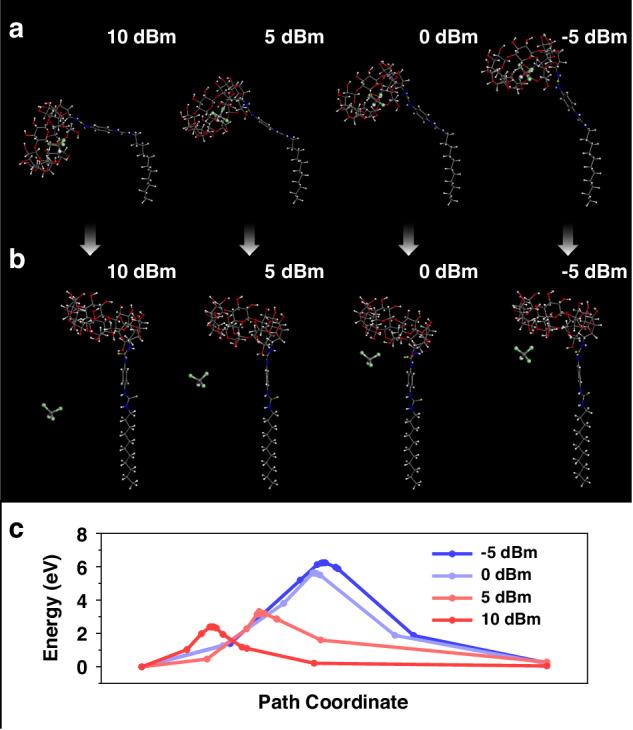
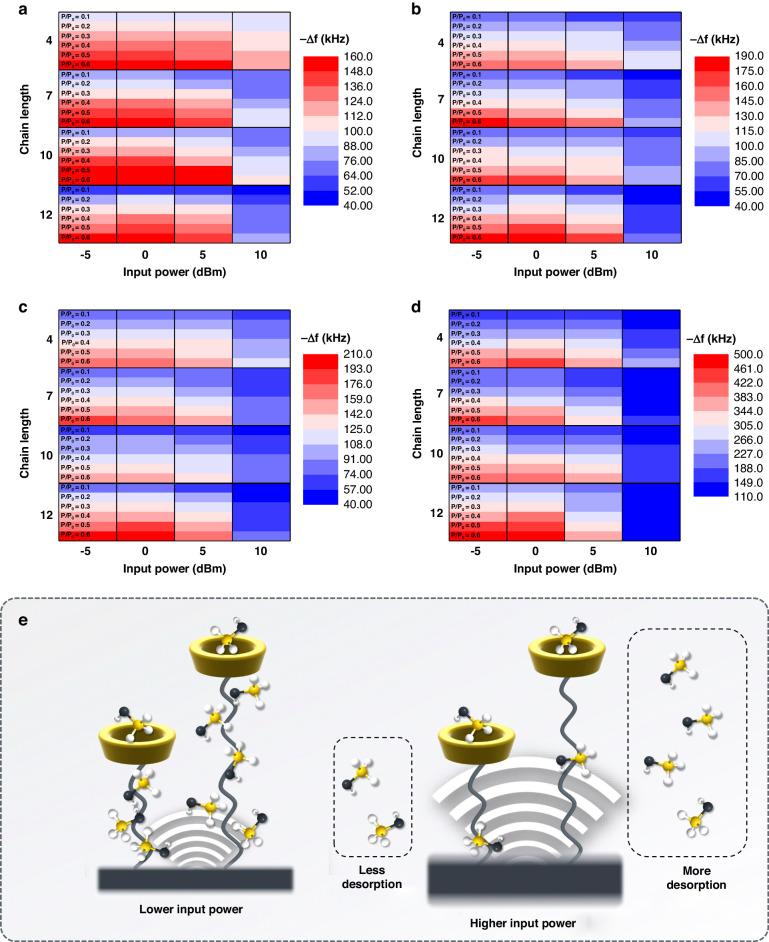
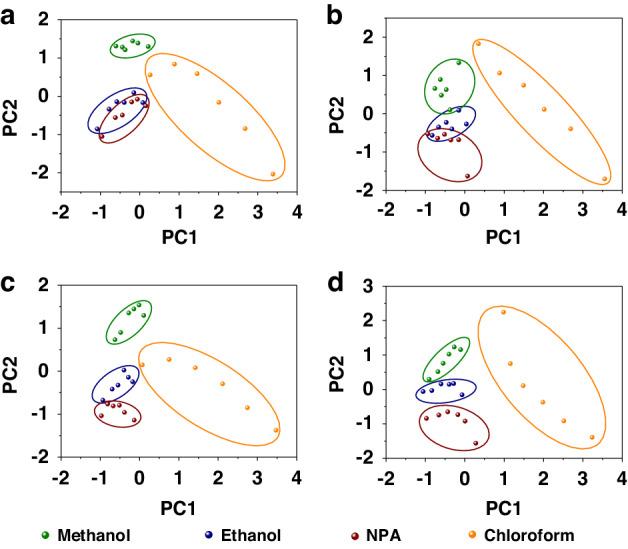
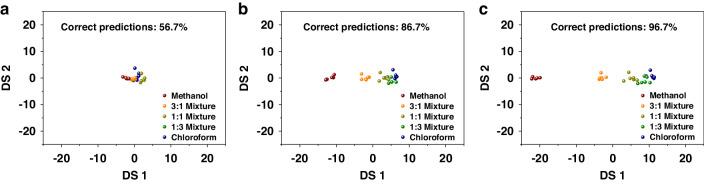
Supramolecules are considered as promising materials for volatile organic compounds (VOCs) sensing applications. The proper understanding of the sorption process taking place in host-guest interactions is critical in improving the pattern recognition of supramolecules-based sensing arrays. Here, we report a novel approach to investigate the dynamic host-guest recognition process by employing a bulk acoustic wave (BAW) resonator capable of producing multiple oscillation amplitudes and simultaneously recording multiple responses to VOCs. Self-assembled monolayers (SAMs) of β-cyclodextrin (β-CD) were modified on four BAW sensors to demonstrate the gas-surface interactions regarding oscillation amplitude and SAM length. Based on the method, a virtual sensor array (VSA) type electronic nose (e-nose) can be realized by pattern recognition of multiple responses at different oscillation amplitudes of a single sensor. VOCs analysis was realized respectively by using principal component analysis (PCA) for individual VOC identification and linear discriminant analysis (LDA) for VOCs mixtures classification.
超分子被认为是用于挥发性有机化合物(VOCs)传感应用的有前景的材料。正确理解主客体相互作用中发生的吸附过程对于改善基于超分子的传感阵列的模式识别至关重要。在此,我们报告一种新颖的方法,通过使用能够产生多个振荡幅度并同时记录对VOCs的多个响应的体声波(BAW)谐振器来研究动态主客体识别过程。在四个BAW传感器上修饰了β-环糊精(β-CD)的自组装单分子层(SAMs),以证明关于振荡幅度和SAM长度的气-表面相互作用。基于该方法,通过对单个传感器在不同振荡幅度下的多个响应进行模式识别,可以实现虚拟传感器阵列(VSA)型电子鼻(e-nose)。分别通过使用主成分分析(PCA)进行单个VOC识别和线性判别分析(LDA)进行VOCs混合物分类来实现VOCs分析。

 Zotero 插件