
氮杂肽中丙氨酸残基构象空间的邻位效应。
Neighbor effect on conformational spaces of alanine residue in azapeptides.
作者信息
Lee Ho-Jin, Liu Shi-Wei, Sulyok-Eiler Máté, Harmat Veronika, Farkas Viktor, Bánóczi Zoltán, El Khabchi Mouna, Shawn Fan Hua-Jun, Hirao Kimihiko, Song Jong-Won
机构信息
Division of Natural and Mathematics Sciences, LeMoyne-Own College, Memphis, TN, 38126, USA.
Department of Natural Sciences, Southwest Tennessee Community College, Memphis, TN, 38015, USA.
出版信息
Heliyon. 2024 Jun 15;10(12):e33159. doi: 10.1016/j.heliyon.2024.e33159. eCollection 2024 Jun 30.
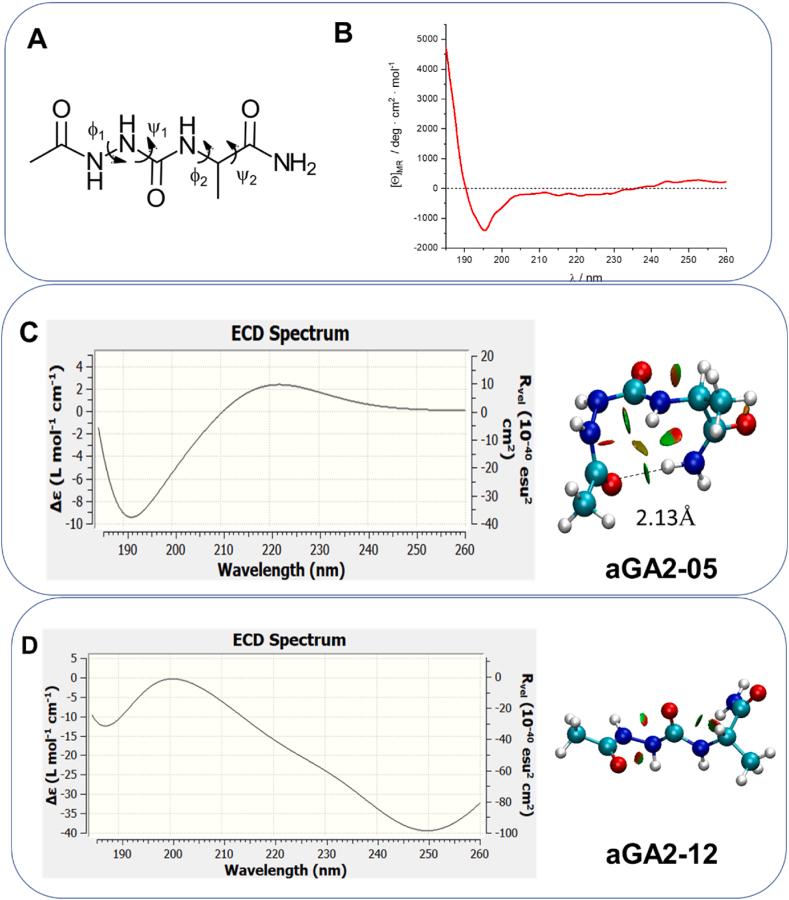
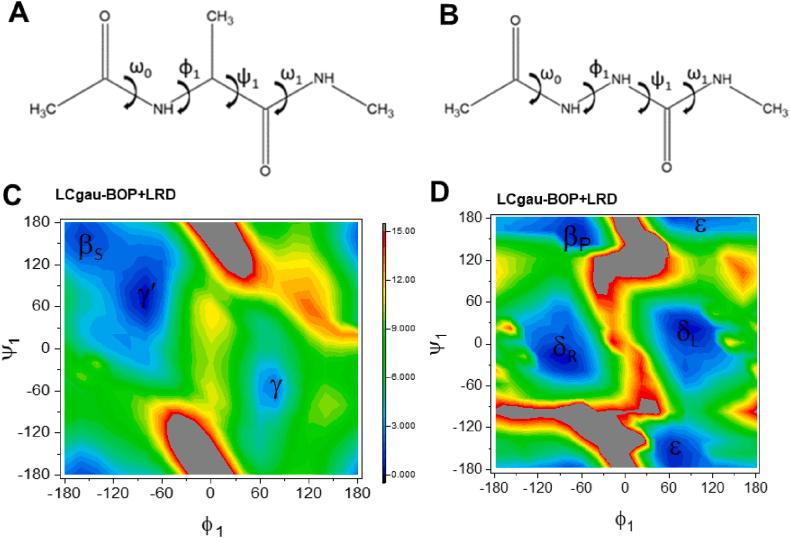
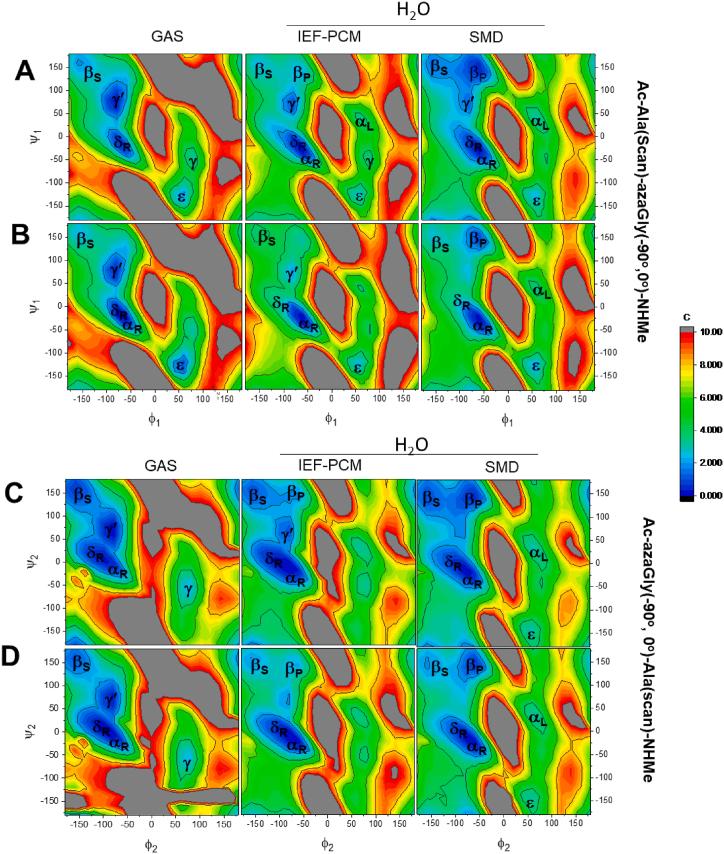
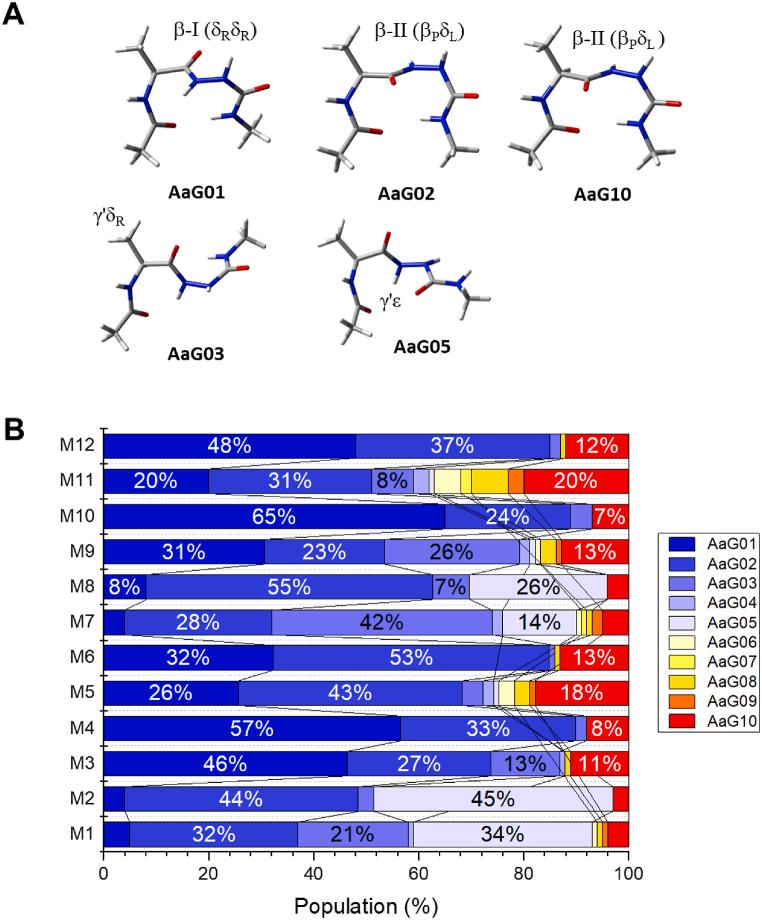
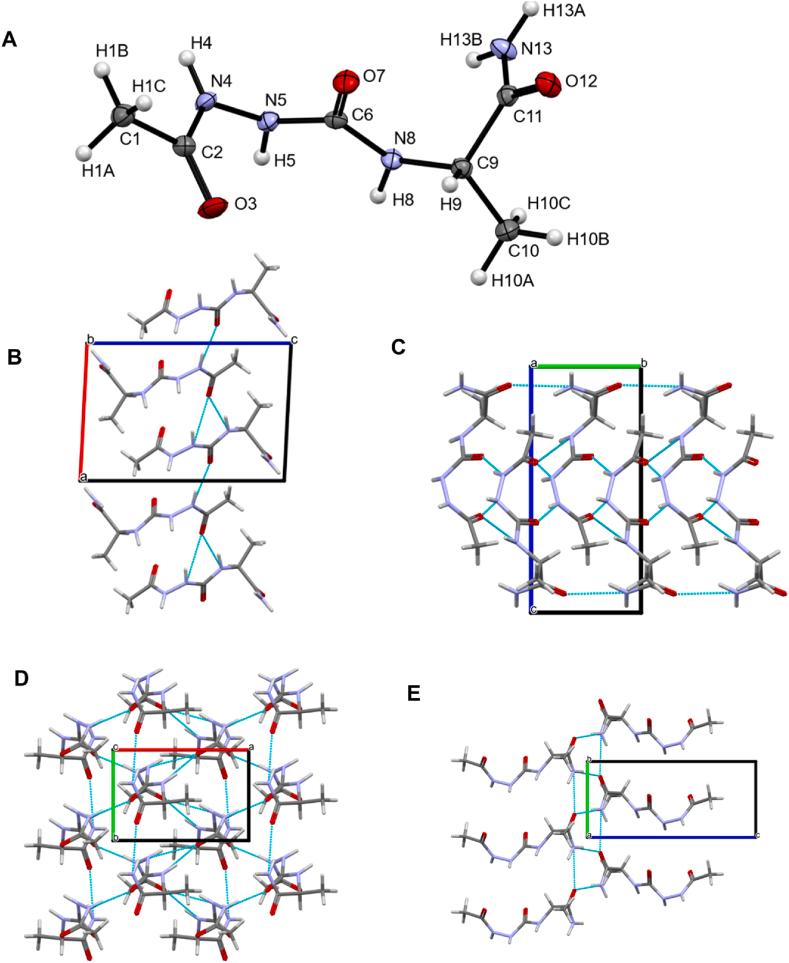
The conformational properties of Alanine (Ala) residue have been investigated to understand protein folding and develop force fields. In this work, we examined the neighbor effect on the conformational spaces of Ala residue using model azapeptides, Ac-Ala-azaGly-NHMe (, ), and Ac-azaGly-Ala-NHMe (). Ramachandran energy maps were generated by scanning (φ, ψ) dihedral angles of the Ala residues in models with the fixed dihedral angles (φ = ±90°, ψ = ±0° or ±180°) of azaGly residue using LCgau-BOP and LCgau-BOP + LRD functionals in the gas and water phases. The integral-equation-formalism polarizable continuum model (IEF-PCM) and a solvation model density (SMD) were employed to mimic the solvation effect. The most favorable conformation of Ala residue in azapeptide models is found as the polyproline II (β), inverse γ-turn (γ'), β-sheet (β), right-handed helix (α), or left-handed helix (α) depending on the conformation of neighbor azaGly residue in isolated form. Solvation methods exhibit that the Ala residue favors the β, δ, and α conformations regardless of its position in azapeptides and in water. Azapeptide , Ac-azaGly-Ala-NH (), was synthesized to evaluate the theoretical results. The X-ray structure showed that azaGly residue adopts the polyproline II (β) and Ala residue adopts the right-handed helical (α) structure in . The conformational preferences of and the dimer structure of based on the X-ray structure were examined to assess the performance of DFT functionals. In addition, the local minima of azapeptide , Ac-Phe-azaGly-NH (), were compared with the previous experimental results. SMD/LCgau-BOP + LRD methods agreed well with the reported experimental results. The results suggest the importance of weak dispersion interactions, neighbor effect, and solvent influence in the conformational preferences of Ala residue in model azapeptides.
为了理解蛋白质折叠并开发力场,人们对丙氨酸(Ala)残基的构象性质进行了研究。在这项工作中,我们使用模型氮杂肽Ac-Ala-azaGly-NHMe( )和Ac-azaGly-Ala-NHMe( )研究了邻位对Ala残基构象空间的影响。通过使用LCgau-BOP和LCgau-BOP + LRD泛函在气相和水相中扫描氮杂甘氨酸(azaGly)残基固定二面角(φ = ±90°,ψ = ±0°或±180°)的模型中Ala残基的(φ,ψ)二面角,生成了拉马钱德兰能量图。采用积分方程形式的极化连续介质模型(IEF-PCM)和溶剂化模型密度(SMD)来模拟溶剂化效应。在氮杂肽模型中,根据孤立形式下相邻氮杂甘氨酸残基的构象,发现Ala残基最有利的构象为多聚脯氨酸II型(β)、反向γ-转角(γ')、β-折叠(β)、右手螺旋(α)或左手螺旋(α)。溶剂化方法表明,无论Ala残基在氮杂肽 和 中的位置如何,在水中它都倾向于β、δ和α构象。合成了氮杂肽Ac-azaGly-Ala-NH( )以评估理论结果。X射线结构表明,在 中氮杂甘氨酸残基采用多聚脯氨酸II型(β),Ala残基采用右手螺旋(α)结构。基于X射线结构研究了 的构象偏好和 的二聚体结构,以评估DFT泛函的性能。此外,还将氮杂肽Ac-Phe-azaGly-NH( )的局部极小值与先前的实验结果进行了比较。SMD/LCgau-BOP + LRD方法与报道的实验结果吻合良好。结果表明,弱色散相互作用、邻位效应和溶剂影响在模型氮杂肽中Ala残基的构象偏好中具有重要作用。




 Zotero 插件