
一种新型氨基酸相关基因特征可预测肝细胞癌患者的总生存期。
A Novel Amino Acid-Related Gene Signature Predicts Overall Survival in Patients With Hepatocellular Carcinoma.
机构信息
Hunan Key Laboratory of Viral Hepatitis, Department of Infectious Diseases, Nation Clinical Research Center for Geriatric Disorders, Xiangya Hospital, Central South University, Changsha, Hunan, China.
Guilin Medical University, Guilin, China.
出版信息
Cancer Rep (Hoboken). 2024 Jul;7(7):e2131. doi: 10.1002/cnr2.2131.
BACKGROUND AND AIMS
Hepatocellular carcinoma (HCC) is an extremely harmful malignant tumor in the world. Since the energy metabolism and biosynthesis of HCC cells are closely related to amino acids, it is necessary to further explore the relationship between amino acid-related genes and the prognosis of HCC to achieve individualized treatment. We herein aimed to develop a prognostic model for HCC based on amino acid genes.
METHODS
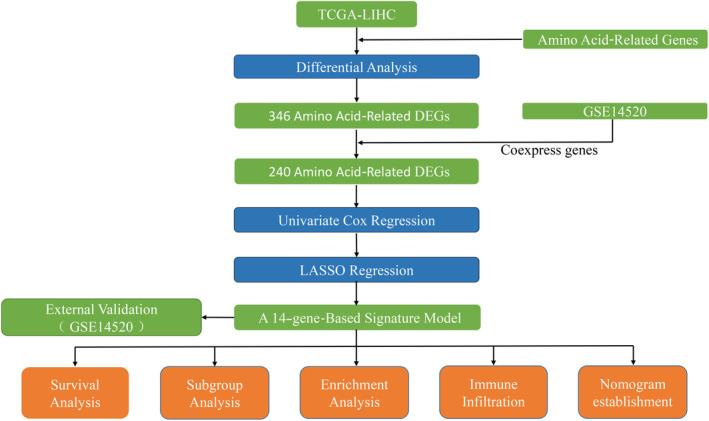
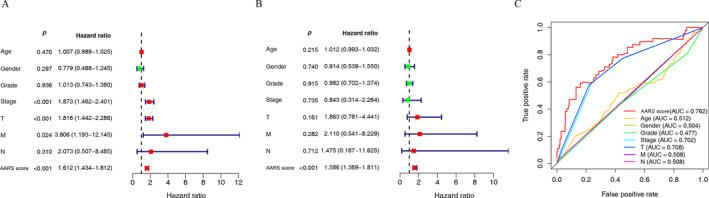
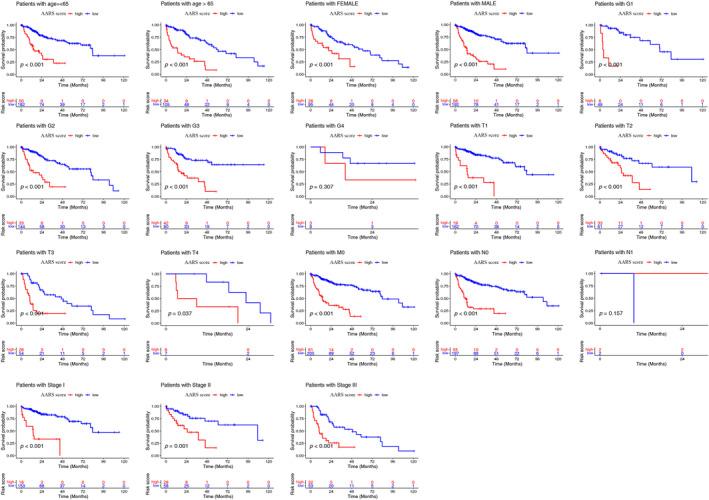
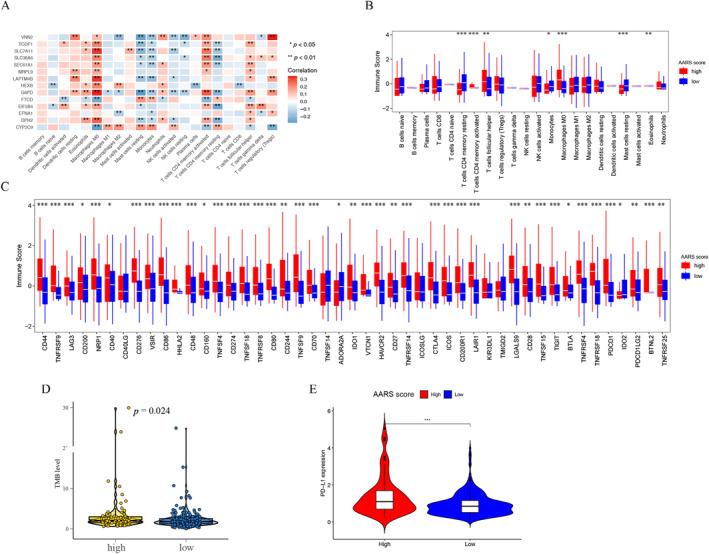
In this study, RNA-sequencing data of HCC patients were downloaded from the TCGA-LIHC cohort as the training cohort and the GSE14520 cohort as the validation cohort. Amino acid-related genes were derived from the Molecular Signatures Database. Univariate Cox and Lasso regression analysis were used to construct an amino acid-related signature (AARS). The predictive value of this risk score was evaluated by Kaplan-Meier (K-M) curve, receiver operating characteristic (ROC) curve, univariate and multivariate Cox regression analysis. Gene set variation analysis (GSVA) and immune characteristics evaluation were used to explore the underlying mechanisms. Finally, a nomogram was established to help the personalized prognosis assessment of patients with HCC.
RESULTS
The AARS comprises 14 amino acid-related genes to predict overall survival (OS) in HCC patients. HCC patients were divided into AARS-high group and AARS-low group according to the AARS scores. The K-M curve, ROC curve, and univariate and multivariate Cox regression analysis verified the good prediction efficiency of the risk score. Using GSVA, we found that AARS variants were concentrated in four pathways, including cholesterol metabolism, delayed estrogen response, fatty acid metabolism, and myogenesis metabolism.
CONCLUSION
Our results suggest that the AARS as a prognostic model based on amino acid-related genes is of great value in the prediction of survival of HCC, and can help improve the individualized treatment of patients with HCC.
背景与目的
肝细胞癌(HCC)是世界上一种极其有害的恶性肿瘤。由于 HCC 细胞的能量代谢和生物合成与氨基酸密切相关,因此有必要进一步探讨氨基酸相关基因与 HCC 预后之间的关系,以实现个体化治疗。本研究旨在基于氨基酸基因构建 HCC 的预后模型。
方法
本研究从 TCGA-LIHC 队列中下载 HCC 患者的 RNA-seq 数据作为训练队列,并从 GSE14520 队列中下载数据作为验证队列。氨基酸相关基因来自分子特征数据库。采用单因素 Cox 和 Lasso 回归分析构建氨基酸相关特征(AARS)。通过 Kaplan-Meier(K-M)曲线、受试者工作特征(ROC)曲线、单因素和多因素 Cox 回归分析评估风险评分的预测价值。采用基因集变异分析(GSVA)和免疫特征评估来探讨潜在的机制。最后,建立列线图以帮助 HCC 患者的个性化预后评估。
结果
AARS 由 14 个氨基酸相关基因组成,可预测 HCC 患者的总生存期(OS)。根据 AARS 评分,将 HCC 患者分为 AARS 高组和 AARS 低组。K-M 曲线、ROC 曲线、单因素和多因素 Cox 回归分析验证了风险评分的良好预测效率。通过 GSVA,我们发现 AARS 变异主要集中在四个途径,包括胆固醇代谢、延迟雌激素反应、脂肪酸代谢和肌生成代谢。
结论
我们的研究结果表明,基于氨基酸相关基因的 AARS 作为一种预后模型,在预测 HCC 患者的生存方面具有重要价值,并有助于改善 HCC 患者的个体化治疗。




 Zotero 插件