
中老年人群静息心率与基于机器学习的脑龄之间的关联
Association between Resting Heart Rate and Machine Learning-Based Brain Age in Middle- and Older-Age.
作者信息
Wang J, Huang H, Yang W, Dove A, Ma X, Xu W
机构信息
Weili Xu, Professor, Department of Neurobiology, Care Sciences and Society, Karolinska Institutet, Tomtebodavägen 18A Floor 10, Solna 17165, Sweden; Phone: +46 8 524 858 26; Email:
出版信息
J Prev Alzheimers Dis. 2024;11(4):1140-1147. doi: 10.14283/jpad.2024.76.
BACKGROUND
Resting heart rate (RHR), has been related to increased risk of dementia, but the relationship between RHR and brain age is unclear.
OBJECTIVE
We aimed to investigate the association of RHR with brain age and brain age gap (BAG, the difference between predicted brain age and chronological age) assessed by multimodal Magnetic Resonance Imaging (MRI) in mid- and old-aged adults.
DESIGN
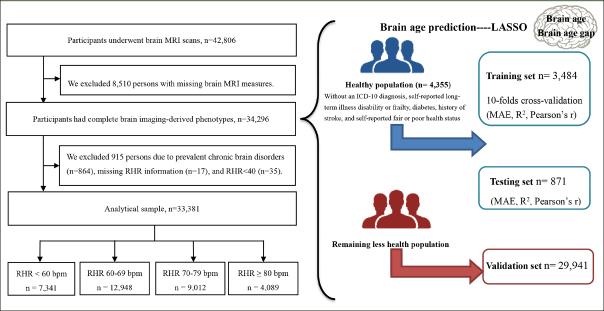
A longitudinal study from the UK Biobank neuroimaging project where participants underwent brain MRI scans 9+ years after baseline.
SETTING
A population-based study.
PARTICIPANTS
A total of 33,381 individuals (mean age 54.74 ± 7.49 years; 53.44% female).
MEASUREMENTS
Baseline RHR was assessed by blood pressure monitor and categorized as <60, 60-69 (reference), 70-79, or ≥80 beats per minute (bpm). Brain age was predicted using LASSO through 1,079 phenotypes in six MRI modalities (including T1-weighted MRI, T2-FLAIR, T2*, diffusion-MRI, task fMRI, and resting-state fMRI). Data were analyzed using linear regression models.
RESULTS
As a continuous variable, higher RHR was associated with older brain age (β for per 1-SD increase: 0.331, 95% [95% confidence interval, CI]: 0.265, 0.398) and larger BAG (β: 0.263, 95% CI: 0.202, 0.324). As a categorical variable, RHR 70-79 bpm and RHR ≥80 bpm were associated with older brain age (β [95% CI]: 0.361 [0.196, 0.526] / 0.737 [0.517, 0.957]) and larger BAG (0.256 [0.105, 0.407] / 0.638 [0.436, 0.839]), but RHR< 60 bpm with younger brain age (-0.324 [-0.500, -0.147]) and smaller BAG (-0.230 [-0.392, -0.067]), compared to the reference group. These associations between elevated RHR and brain age were similar in both middle-aged (<60) and older (≥60) adults, whereas the association of RHR< 60 bpm with younger brain age and larger BAG was only significant among middle-aged adults. In stratification analysis, the association between RHR ≥80 bpm and older brain age was present in people with and without CVDs, while the relation of RHR 70-79 bpm to brain age present only in people with CVD.
CONCLUSION
Higher RHR (>80 bpm) is associated with older brain age, even among middle-aged adults, but RHR< 60 bpm is associated with younger brain age. Greater RHR could be an indicator for accelerated brain aging.
背景
静息心率(RHR)与痴呆风险增加有关,但RHR与脑龄之间的关系尚不清楚。
目的
我们旨在研究中年和老年成年人中,RHR与通过多模态磁共振成像(MRI)评估的脑龄和脑龄差距(BAG,预测脑龄与实际年龄之间的差异)之间的关联。
设计
一项来自英国生物银行神经影像学项目的纵向研究,参与者在基线后9年以上接受脑部MRI扫描。
设置
一项基于人群的研究。
参与者
共有33381人(平均年龄54.74±7.49岁;53.44%为女性)。
测量
通过血压监测仪评估基线RHR,并分为每分钟<60次、60 - 69次(参考)、70 - 79次或≥80次心跳(bpm)。使用套索回归通过六种MRI模式(包括T1加权MRI、T2-FLAIR、T2*、扩散MRI、任务功能磁共振成像和静息态功能磁共振成像)中的1079种表型预测脑龄。使用线性回归模型分析数据。
结果
作为连续变量,较高的RHR与较老的脑龄相关(每增加1个标准差的β值:0.331,95%[95%置信区间,CI]:0.265,0.398)和较大的BAG(β值:0.263,95%CI:0.202,0.324)。作为分类变量,RHR为70 - 79 bpm和RHR≥80 bpm与较老的脑龄相关(β[95%CI]:0.361[0.196,0.526]/0.737[0.517,0.957])和较大的BAG(0.256[0.105,0.407]/0.638[0.436,0.839]),但与参考组相比,RHR<60 bpm与较年轻的脑龄(-0.324[-0.500,-0.147])和较小的BAG(-0.230[-0.392,-0.067])相关。RHR升高与脑龄之间的这些关联在中年(<60岁)和老年(≥60岁)成年人中相似,而RHR<60 bpm与较年轻的脑龄和较大的BAG之间的关联仅在中年成年人中显著。在分层分析中,RHR≥80 bpm与较老的脑龄之间的关联在有和没有心血管疾病的人群中均存在,而RHR 70 - 79 bpm与脑龄的关系仅在有心血管疾病的人群中存在。
结论
较高的RHR(>80 bpm)与较老的脑龄相关,即使在中年成年人中也是如此,但RHR<60 bpm与较年轻的脑龄相关。较高的RHR可能是脑加速衰老的一个指标。

 Zotero 插件