
确定澳大利亚社区足病医生处理足部溃疡的信心和焦虑程度:一项横断面研究。
Determining confidence and anxiety of Australian community podiatrists in managing foot ulceration: A cross-sectional study.
机构信息
School of Medicine and Public Health, University of Newcastle, Callaghan, New South Wales, Australia.
Faculty of Health Science and Medicine, Bond University, Gold Coast, Queensland, Australia.
出版信息
J Foot Ankle Res. 2024 Sep;17(3):e12037. doi: 10.1002/jfa2.12037.
BACKGROUND
Diabetes related foot ulcer (DFU) is a leading cause of impaired quality of life, disability, hospitalisation, amputation and mortality in people with diabetes. It is therefore critical that podiatrists across all settings, including community settings, are confident and capable of providing care for diabetes-related foot complications. This study aims to describe current practice, confidence and anxiety levels of community podiatrists in the management of patients with foot ulceration. Furthermore, current barriers to service provision and interest in future educational opportunities will also be explored.
METHODS
An online cross-sectional survey was distributed to Australian community podiatrists. Descriptive variables including gender, age, professional experience, practice location and practise setting were elicited. A modified competitive State Anxiety Inventory-2 (CSAI-2) was utilised to measure anxiety related to managing a foot ulcer. Other questions included a combination of multiple choice and open-ended free-text responses relating to assessment, confidence and referral pathways.
RESULTS
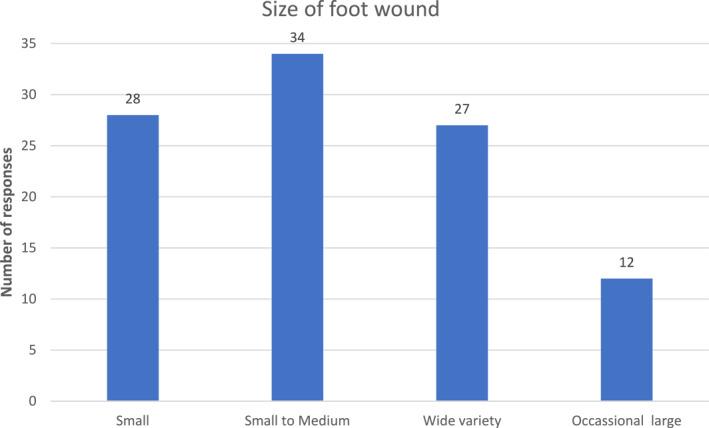
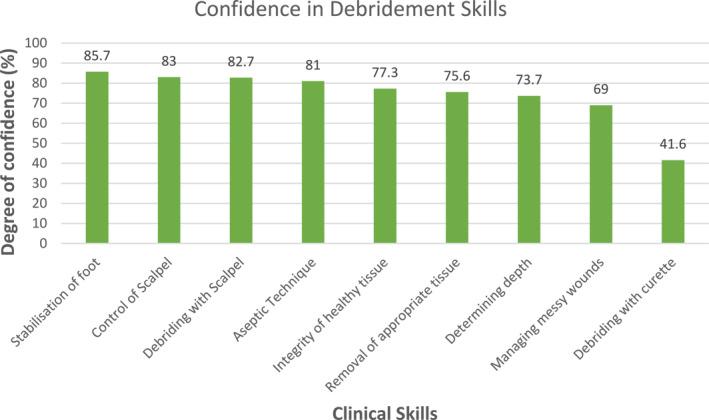
One hundred and twenty-two Australian community-based podiatrists responded to the survey. A variety of ulcer sizes and complexity were reported to be managed in community settings. Confidence in DFU management was high in most manual skill domains including: stabilisation of the foot (85.7%, standard deviation [SD] 17.42), scalpel control (83.0%, SD 20.02), debridement with a scalpel (82.7%, SD 18.19) and aseptic technique (81.0%, SD 18.62, maintaining integrity of healthy tissue (77.3%, SD 21.11), removal of appropriate tissue (75.6%, SD 22.53), depth of ulceration (73.7%, SD 23.99) and ability to manage messy wounds (69.1%, SD 26.04). Curette debridement had substantially lower levels of reported confidence (41.0%, SD 34.24). Performance anxiety was low with somatic and cognitive anxiety of 6/24 and 3/8 on the CSAI-2, respectively.
CONCLUSION
Community podiatrists are managing foot ulcers of varying size and complexity. Confidence and anxiety do not pose a barrier to care. Adherence to wound assessment clinical guidelines is low and confidence with the use of curette was sub-optimal. Further educational programs may overcome these barriers and support shared models of care between community and acute podiatry services.
背景
糖尿病相关足部溃疡(DFU)是导致糖尿病患者生活质量下降、残疾、住院、截肢和死亡的主要原因。因此,至关重要的是,所有环境中的足病医生,包括社区环境中的足病医生,都有信心并有能力为糖尿病相关足部并发症提供护理。本研究旨在描述社区足病医生在管理足部溃疡患者方面的当前实践、信心和焦虑水平。此外,还将探讨当前服务提供的障碍以及对未来教育机会的兴趣。
方法
向澳大利亚社区足病医生分发了在线横断面调查。收集了描述性变量,包括性别、年龄、专业经验、执业地点和执业环境。使用改良的竞争状态焦虑量表-2(CSAI-2)来衡量与管理足部溃疡相关的焦虑。其他问题包括与评估、信心和转诊途径相关的多项选择和开放式自由文本回答的组合。
结果
122 名澳大利亚社区基础足病医生对调查做出了回应。据报道,在社区环境中管理各种大小和复杂程度的溃疡。大多数手动技能领域的 DFU 管理信心都很高,包括:足部稳定(85.7%,标准差 [SD] 17.42)、手术刀控制(83.0%,SD 20.02)、手术刀清创(82.7%,SD 18.19)和无菌技术(81.0%,SD 18.62),保持健康组织完整性(77.3%,SD 21.11)、去除适当组织(75.6%,SD 22.53)、溃疡深度(73.7%,SD 23.99)和处理脏伤口的能力(69.1%,SD 26.04)。清创刮匙的报告信心明显较低(41.0%,SD 34.24)。躯体焦虑和认知焦虑分别为 CSAI-2 的 6/24 和 3/8,表现出低的操作焦虑。
结论
社区足病医生正在管理各种大小和复杂程度的足部溃疡。信心和焦虑不会成为护理的障碍。对伤口评估临床指南的遵守程度较低,并且对使用刮匙的信心不足。进一步的教育计划可能会克服这些障碍,并支持社区和急性足病服务之间的共享护理模式。



 Zotero 插件