
开发和验证一种可解释的机器学习模型,用于预测 ICU 恶性肿瘤合并高钾血症患者的早期预后。
Development and Validation of an Interpretable Machine Learning Model for Early Prognosis Prediction in ICU Patients with Malignant Tumors and Hyperkalemia.
机构信息
Centre for Evidence-Based Chinese Medicine, Beijing University of Chinese Medicine, Beijing, China.
School of Traditional Chinese Medicine, Beijing University of Chinese Medicine, Beijing, China.
出版信息
Medicine (Baltimore). 2024 Jul 26;103(30):e38747. doi: 10.1097/MD.0000000000038747.
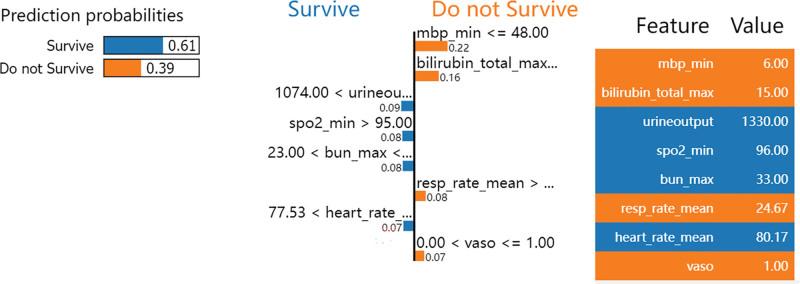
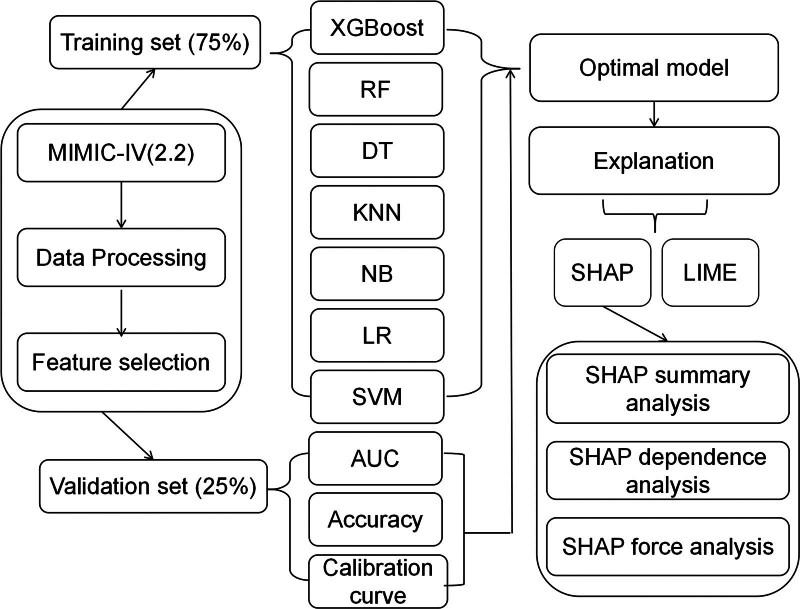
This study aims to develop and validate a machine learning (ML) predictive model for assessing mortality in patients with malignant tumors and hyperkalemia (MTH). We extracted data on patients with MTH from the Medical Information Mart for Intensive Care-IV, version 2.2 (MIMIC-IV v2.2) database. The dataset was split into a training set (75%) and a validation set (25%). We used the Least Absolute Shrinkage and Selection Operator (LASSO) regression to identify potential predictors, which included clinical laboratory indicators and vital signs. Pearson correlation analysis tested the correlation between predictors. In-hospital death was the prediction target. The Area Under the Curve (AUC) and accuracy of the training and validation sets of 7 ML algorithms were compared, and the optimal 1 was selected to develop the model. The calibration curve was used to evaluate the prediction accuracy of the model further. SHapley Additive exPlanations (SHAP) and Local Interpretable Model-agnostic Explanations (LIME) enhanced model interpretability. 496 patients with MTH in the Intensive Care Unit (ICU) were included. After screening, 17 clinical features were included in the construction of the ML model, and the Pearson correlation coefficient was <0.8, indicating that the correlation between the clinical features was small. eXtreme Gradient Boosting (XGBoost) outperformed other algorithms, achieving perfect scores in the training set (accuracy: 1.000, AUC: 1.000) and high scores in the validation set (accuracy: 0.734, AUC: 0.733). The calibration curves indicated good predictive calibration of the model. SHAP analysis identified the top 8 predictive factors: urine output, mean heart rate, maximum urea nitrogen, minimum oxygen saturation, minimum mean blood pressure, maximum total bilirubin, mean respiratory rate, and minimum pH. In addition, SHAP and LIME performed in-depth individual case analyses. This study demonstrates the effectiveness of ML methods in predicting mortality risk in ICU patients with MTH. It highlights the importance of predictors like urine output and mean heart rate. SHAP and LIME significantly enhanced the model's interpretability.
本研究旨在开发和验证一种机器学习(ML)预测模型,以评估恶性肿瘤和高钾血症(MTH)患者的死亡率。我们从医疗信息监护 IV 版,版本 2.2(MIMIC-IV v2.2)数据库中提取了 MTH 患者的数据。数据集分为训练集(75%)和验证集(25%)。我们使用最小绝对收缩和选择算子(LASSO)回归来识别潜在的预测因素,包括临床实验室指标和生命体征。Pearson 相关分析测试了预测因素之间的相关性。住院期间死亡是预测目标。比较了 7 种 ML 算法在训练集和验证集的 AUC 和准确性,并选择最佳的 1 种来开发模型。校准曲线用于进一步评估模型的预测准确性。SHapley Additive exPlanations(SHAP)和 Local Interpretable Model-agnostic Explanations(LIME)增强了模型的可解释性。纳入了重症监护病房(ICU)中 496 例 MTH 患者。筛选后,17 项临床特征纳入 ML 模型构建,Pearson 相关系数<0.8,提示临床特征相关性较小。极端梯度提升(XGBoost)优于其他算法,在训练集上取得了完美的分数(准确率:1.000,AUC:1.000),在验证集上也取得了较高的分数(准确率:0.734,AUC:0.733)。校准曲线表明模型具有良好的预测校准能力。SHAP 分析确定了前 8 个预测因素:尿量、平均心率、最大尿素氮、最低氧饱和度、最低平均血压、最大总胆红素、平均呼吸频率和最低 pH。此外,SHAP 和 LIME 进行了深入的个体案例分析。本研究证明了 ML 方法在预测 ICU 恶性肿瘤和高钾血症患者死亡率方面的有效性。它强调了尿量和平均心率等预测因素的重要性。SHAP 和 LIME 极大地增强了模型的可解释性。




 Zotero 插件